
Running many accounts from one computer is simple in theory, until your tool locks you into one operating system, a three-day trial and a $99 entry price. In this Incogniton vs VMLogin comparison, both anti-detect browsers give every account its own browser profile and fingerprint. But they are built for very different users, and the gap shows the moment you add a Mac, a teammate or a budget.
Both are anti-detect browsers: they let you create unique browser fingerprints, keep accounts separate and work privately online. We put them through the essential anti-detect browser criteria so you can pick the right one in a few minutes.
Who each tool is for: Incogniton is built for marketers, agencies, e-commerce sellers and freelancers on Windows or macOS who want to start free, get proxies included and grow into a team. VMLogin suits Windows users who already know they need up to 200 profiles and are happy to decide within a 3-day trial.
Our verdict up front: for most readers, Incogniton is the better choice. It runs natively on Windows and macOS, you can try 10 profiles free for 2 months without a credit card, free built-in proxies come with every plan, and the Professional plan includes 150 profiles and 3 team seats for $79.99/month. VMLogin offers Windows downloads only on its official download pages (as of September 2026), and its paid plans started at $99/month when we researched this article.
TL;DR
- Windows and macOS: Incogniton has native downloads for both. VMLogin’s official download page offers Windows only (September 2026).
- Start free: 10 profiles for 2 months, then 3, no credit card. VMLogin offers a 3-day trial with up to 5 profiles.
- Proxies included: free built-in proxies on every Incogniton plan.
- Team seats included: 3 on Professional, 10 on Custom Package, extra seats $5/month.
- Your data, your choice: turn off Cloud saving and your browsing data stays on your own computer. Optional 2FA on every plan, including free.
- Where VMLogin wins: its $99 plan covers up to 200 profiles, so a solo Windows user who needs 151 to 200 profiles pays less than moving up to Incogniton’s Custom Package.
Start free: 10 profiles for 2 months → No credit card required. Or compare all Incogniton plans.
Incogniton vs VMLogin: Key Features Compared

Incogniton was developed in Amsterdam, launched publicly in 2020 and is used by more than 1 million people. It holds a 4.6/5 rating on Trustpilot (208 reviews, September 2026). VMLogin runs a Chinese-language main site (vmlogin.com) and an English site (vmlogin.us), and it is actively maintained, with new releases as recently as September 2026. Here is how they compare where it counts.
1. Fingerprint Spoofing and Management
Both browsers let you create unique digital fingerprints for each profile.
Incogniton gives you control over the parameters that make up a browser fingerprint: user agent, screen resolution, browser version, language, fonts and more. In our view, it’s the easiest way to get realistic, distinct profiles, because you can create a profile, add a proxy and start working without a technical background, while power users can still fine-tune every setting.
VMLogin also offers fingerprint customization: you adjust details like the browser type, operating system and hardware specs to generate profiles with different fingerprints. Its recent release notes mention work on mobile-emulation fingerprints (VMLogin download page).
2. Multi-Accounting Tools and Use Case Support
Both Incogniton and VMLogin are used for multi-accounting work such as:
- Social media management
- Affiliate marketing
- Data scraping and web research
- E-commerce and cryptocurrency airdrop hunting
Incogniton is built for doing that work at scale, with tools designed around real multi-account workflows:
- Synchronizer: mirror what you do in one profile across many others (Entrepreneur and up).
- Cookie Collector and cookie export: warm up new profiles and move cookies where you need them (Entrepreneur and up).
- Profile transfer: hand profiles to another account (Entrepreneur and up).
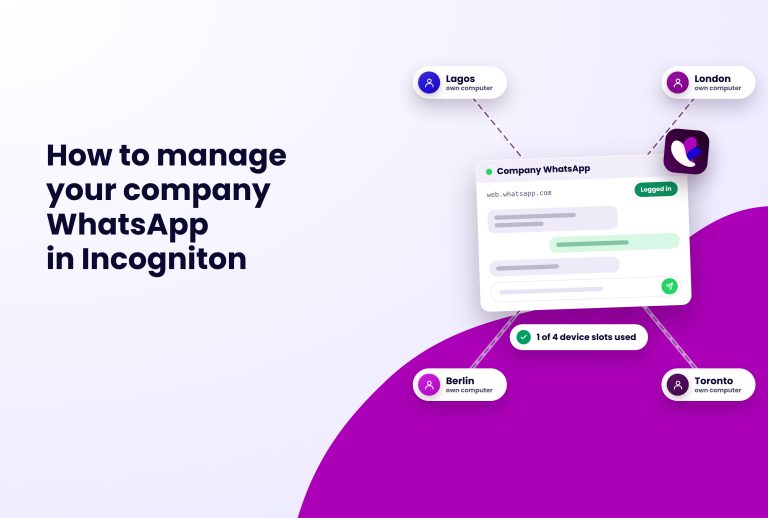
- Free built-in proxies on every plan, so a new profile can go online straight away.
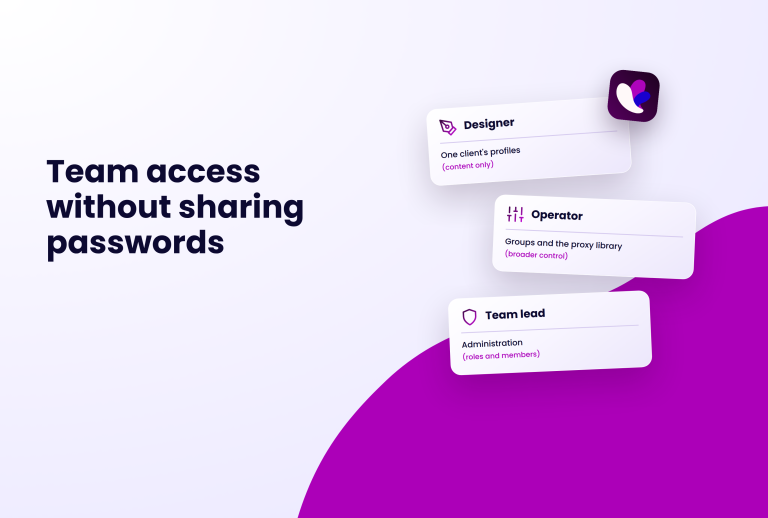
- Team roles and permissions per member and per group (Professional and up).
VMLogin covers the multi-account basics: creating, organizing and launching profiles. For teams that want built-in proxies, synchronized actions and seats included in the price, Incogniton is the more complete package.
3. User Experience and Ease of Use
An anti-detect browser is only as good as it is easy to use every day. Incogniton has a clean, modern interface with a logical layout from profile creation to settings, and it runs natively on both Windows and macOS, so mixed teams work in the same profiles without extra setup. Help is available through live chat and email.
VMLogin has a denser, more utilitarian interface that some users may find dated. More importantly, its Chinese download page lists Windows systems only (Win11, Win10 and Win7 SP1), so Mac users need a Windows machine or virtual machine to run it.
4. Automation Capabilities
Automation is how multi-account operations scale. Incogniton integrates with Selenium and Puppeteer and offers its own REST API on the Entrepreneur plan ($29.99/month) and up, so existing scripts work in Incogniton profiles with minimal changes. And if you don’t code, the Synchronizer lets you repeat actions across profiles by hand.
VMLogin also offers automation: its download page links to REST API documentation and Selenium browser automation (source).
See Incogniton plans: proxies and team seats included → Or Start free: 10 profiles for 2 months.
5. Security and Data Control
Your anti-detect browser holds the keys to every account you run, so the company behind it matters as much as the software. Incogniton is developed in Amsterdam, in the European Union, where the GDPR governs how user data is collected and handled, and its privacy policy is publicly available. On the product side, Incogniton gives you the controls:
- Two-factor authentication on every plan. Optional TOTP 2FA works with any authenticator app, on every plan, including the free one.
- Session control. See every device where you’re signed in, and log out of all of them in one click.
- Team permissions. Role-based permissions per member and per group.
- Keep browsing data on your computer. Turn off “Cloud saving” and your browsing data (cookies, saved logins, local storage and history) stays on your own computer. Profile settings and fingerprint configuration are still stored on Incogniton’s servers.
- Choose your storage region. United States, Europe or Asia.
- Transfers over HTTPS with short-lived signed links.
By contrast, VMLogin publishes little information in English about its data-security processes, infrastructure or how user data is handled, which makes those practices harder to verify before you commit. If your business is bound by strict data rules, that lack of published detail makes VMLogin harder to vet.
| Security and data control | Incogniton | VMLogin |
| Two-factor authentication (2FA) | Optional TOTP with any authenticator app, on every plan including free | — |
| Keep browsing data on your computer | Yes: turn off Cloud saving and cookies, saved logins, local storage and history stay on your computer (profile settings and fingerprint configuration remain on Incogniton’s servers) | — |
| See signed-in devices, log out of all in one click | Yes | — |
| Role-based team permissions | Per member and per group (Professional and up) | — |
| Choose storage region | United States, Europe or Asia | — |
| Data transfer | HTTPS with short-lived signed links | — |
“—” means we found no published information on VMLogin’s official sites as of September 2026. Whichever tool you choose, use a strong, unique password and turn on two-factor authentication where it’s offered.
6. Cost and Pricing
Incogniton’s free Starter plan gives you 10 profiles for the first 2 months and 3 profiles after that, with no credit card required, and free built-in proxies are included on every plan. Paid monthly plans are Starter Plus at $19.99 (10 profiles), Entrepreneur at $29.99 (50 profiles), Professional at $79.99 (150 profiles plus 3 team seats) and the Custom Package at $149.99 (500 profiles plus 10 seats, scalable to 5,000 profiles). Extra seats cost $5/month, 6-month billing saves 30% and yearly billing saves 40%.
VMLogin offers a 3-day free trial with up to 5 browser profiles. When we researched this article, its paid plans were $99/month (up to 200 profiles), $209/month (up to 500 profiles) and $499/month (up to 3,000 profiles). Check the VMLogin website for current prices before you buy.
| What you need (monthly billing) | Incogniton | VMLogin (vmlogin.us, prices as researched for this article) |
| Try it free | 10 profiles for 2 months, then 3; no credit card | 3-day trial, up to 5 profiles |
| 10 profiles, solo | Starter Plus: $19.99, free built-in proxies included | Lowest paid plan: $99 (up to 200 profiles) |
| 150 profiles + 3 team seats | Professional: $79.99 (150 profiles and 3 seats included) | $99 (up to 200 profiles); team seats: — |
| 500 profiles + 10 team seats | Custom Package: $149.99 (500 profiles and 10 seats included) | $209 (up to 500 profiles); team seats: — |
| Same, billed yearly (per month) | $11.99 (10) · $47.99 (150 + 3 seats) · $89.99 (500 + 10 seats), 40% off | — |
| Extra team seat | $5/month | — |
| Proxies | Free built-in proxies on every plan | — |
| Largest plan | Custom Package, scalable to 5,000 profiles | $499/month, up to 3,000 profiles |
Where VMLogin genuinely wins: a solo Windows user who needs between 151 and 200 profiles gets them on VMLogin’s $99 plan, while Incogniton’s next step after Professional is the $149.99 Custom Package. But that Custom Package also includes 500 profiles, 10 team seats and free proxies, and at 10 or 150 profiles Incogniton costs far less.
Where VMLogin Falls Short
VMLogin is a Windows-only download. As of September 2026, VMLogin’s Chinese download page lists Windows systems only (Win11, Win10 and Win7 SP1), and its English download page offers a Windows version only. We found no native macOS or Linux installer on either official download page.
This is a compatibility limitation, not a verdict on how well VMLogin masks fingerprints, and VMLogin is still actively maintained: its English download history lists new releases as recently as September 2026. But if your team works on Macs, you need a workaround such as a separate Windows machine or virtual machine to use VMLogin. Incogniton offers native downloads for both Windows and macOS, so mixed Windows and Mac teams can work in the same profiles without extra setup.
- A short, small trial. 3 days and up to 5 profiles, against 10 free profiles for 2 months on Incogniton.
- A high entry price. Paid plans started at $99/month when we researched this article, even if you need only 10 profiles.
- Little published security detail. We found little information in English about VMLogin’s data-security processes, infrastructure or data handling.
- Few public reviews. At the time of writing we found no Trustpilot reviews for VMLogin. Incogniton scores 4.6/5 from 208 reviews (September 2026).
Comparison Table (Incogniton Vs. VMLogin)
| Evaluation Criteria | INCOGNITON | VMLogin |
| Operating systems | Windows, macOS | Windows only on the official download pages (as of September 2026) |
| Free option | 10 profiles for 2 months, then 3; no credit card | 3-day trial, up to 5 profiles |
| Paid plans from | $19.99/month (10 profiles) | $99/month (up to 200 profiles), as researched for this article |
| Built-in proxies | Free on every plan | — |
| Team seats included | 3 (Professional), 10 (Custom Package); extra seats $5/month | — |
| Anti-fingerprinting | Control over fingerprint parameters, realistic profiles out of the box | Fingerprint customization (browser, OS, hardware) |
| Multi-account tools | Synchronizer, Cookie Collector, cookie export, profile transfer (Entrepreneur+) | Profile creation and management |
| Automation | REST API, Selenium, Puppeteer (Entrepreneur+) | REST API, Selenium (source) |
| Two-factor authentication | Optional TOTP on every plan, including free | — |
| Keep browsing data on your computer | Yes, with Cloud saving off | — |
| User experience | Beginner friendly, clean interface (our view) | Dense, utilitarian interface |
| Support | Live chat and email | — |
| Company | Amsterdam, the Netherlands (EU); launched publicly in 2020 | Chinese-language main site (vmlogin.com), English site (vmlogin.us) |
| Trustpilot | 4.6/5 (208 reviews, September 2026) | We found no Trustpilot reviews |
Verdict: Incogniton or VMLogin?

Choose Incogniton as your VMLogin alternative if you work on a Mac or in a mixed Windows and Mac team, want to start free and scale at your own pace, want proxies and team seats included, or want to decide for yourself whether your browsing data leaves your computer. That’s most of our readers. You get native Windows and macOS apps, 10 free profiles for 2 months, free built-in proxies on every plan, the Synchronizer and Cookie Collector, 2FA on every plan and a 4.6/5 Trustpilot rating.
Consider VMLogin only if you work alone on Windows, need between 151 and 200 profiles on a single plan, and don’t need team seats, included proxies or published security details.
Start free: 10 profiles for 2 months → No credit card required. Ready to scale? See plans with team seats and free proxies included.