

Running more than a handful of accounts is where anti-detect browsers earn their keep, and it’s also where the differences between them start to cost real money. In this Incogniton vs GoLogin comparison, both browsers give every account its own browser fingerprint: GoLogin launched in 2019, and Incogniton, first built that same year, launched publicly in early 2020. But once you add teammates, proxies and a few hundred profiles, they end up in very different places on your monthly bill.
If you’re into affiliate marketing, e-commerce, crypto, social media management, or you’re a freelancer juggling client accounts, this guide will help you pick the right tool in a few minutes.
Who each tool is for: Incogniton is built for people and teams who want realistic profiles out of the box, team seats and proxies included in the price, and control over where their browsing data lives. GoLogin suits solo users who need only a handful of profiles, or who need Linux, Android or a web version.
Our verdict up front: for most readers, and especially anyone working in a team or who wants proxies included, Incogniton is the better choice. GoLogin’s entry plan is cheaper at 10 profiles, but team members start with the Business plan at $99/month on monthly billing, with 1 member included, and proxy traffic is capped at 2 GB a month (GoLogin pricing, as of September 2026). With Incogniton, the Professional plan includes 3 team seats and free built-in proxies for $79.99/month, and you can try 10 profiles free for 2 months without a credit card.
TL;DR
- Team seats included: 3 on Incogniton Professional, 10 on Custom Package, and extra seats cost $5/month. GoLogin has no team members on Professional; they start with its Business plan ($99/month on monthly billing, 1 member included), and each extra member costs $10/month (GoLogin pricing, as of September 2026).
- Free built-in proxies on every Incogniton plan. GoLogin includes 2 GB of residential traffic per month on paid plans and none during the trial (GoLogin docs).
- Total cost: 150 profiles + 3 seats costs $79.99/month on Incogniton vs $119/month on GoLogin. 500 profiles + 10 seats costs $149.99 vs $229 (monthly billing; GoLogin pricing).
- Try it free: 10 profiles for 2 months, then 3. No credit card needed.
- Your data, your choice: turn off Cloud saving and your browsing data stays on your own computer. Optional 2FA is available on every plan, including the free one.
- Where GoLogin wins: lower prices for solo users (from $9/month for 10 profiles), plus Linux, Android and web apps.
Start free: 10 profiles for 2 months → No credit card required. Or compare all Incogniton plans.
A Brief Overview of Both Browsers
Incogniton was first built in 2019 and launched publicly in early 2020, developed in Amsterdam as a privacy-first way to manage many accounts from one computer. Today it’s used by more than 1 million people and holds a 4.6/5 rating on Trustpilot (208 reviews, as of September 2026). Reviewers regularly highlight its intuitive design, responsive support and team-friendly features.
GoLogin launched in 2019 and is based in the United States. It’s known for its developer-friendly approach and wide platform support. It holds a 3.8/5 rating on Trustpilot (380 reviews, as of September 2026).
Both tools solve the same problem. Platforms like Facebook, Google and TikTok don’t just track IP addresses; they use browser fingerprinting to recognize the small details that make your setup unique: operating system, screen resolution, fonts, time zone, browser version, and more. Anti-detect browsers give every account its own realistic, separate fingerprint, so to a platform it looks like many different people are logging in, even though you manage everything from one place.
Incogniton vs GoLogin: Key Features Comparison
1. Ease of Setup
In our view, Incogniton is the easiest way to get started with multi-accounting. The interface is clean, and the heavy lifting of fingerprint generation happens automatically. Every new profile comes with a realistic, randomized fingerprint out of the box, so you can create a profile, add a proxy and start working. You don’t need a technical background.
GoLogin places more emphasis on manual control. Its granular fingerprint settings (WebGL, fonts, audio and more) are useful for advanced operators, but they give newcomers more to think about before their first login.
2. Browser Fingerprint Control
Incogniton focuses on realism through automation. Instead of asking you to build fingerprints by hand, it provides ready-made profiles that mimic normal browsing environments. You can still fine-tune parameters in each profile’s settings or through the API, but the defaults are designed so you don’t have to. That reduces the risk of human error, where an unrealistic combination of settings tips off a website.
GoLogin lets you edit nearly every aspect of the fingerprint, from hardware specs to media devices. That’s powerful for specialists, but with that freedom comes complexity: it’s easier to create a combination of settings that doesn’t look like a real device.
3. Automation and Proxy Integration
Incogniton provides a well-documented API and SDKs that work with Puppeteer, Playwright and Selenium, the three most popular automation frameworks. REST API access and the Selenium/Puppeteer integration are included from the Entrepreneur plan ($29.99/month) upwards. Agencies, affiliate teams and e-commerce operators use them to script logins, posting or data scraping.
You don’t need to be a developer to automate the boring parts. The Synchronizer mirrors what you do in one profile across many others, and the Cookie Collector warms up new profiles with cookies automatically (both from the Entrepreneur plan). Paste as Human Typing is available on every plan.
GoLogin also offers a capable API that works with Puppeteer and Playwright. API access isn’t included in its free plan (source).
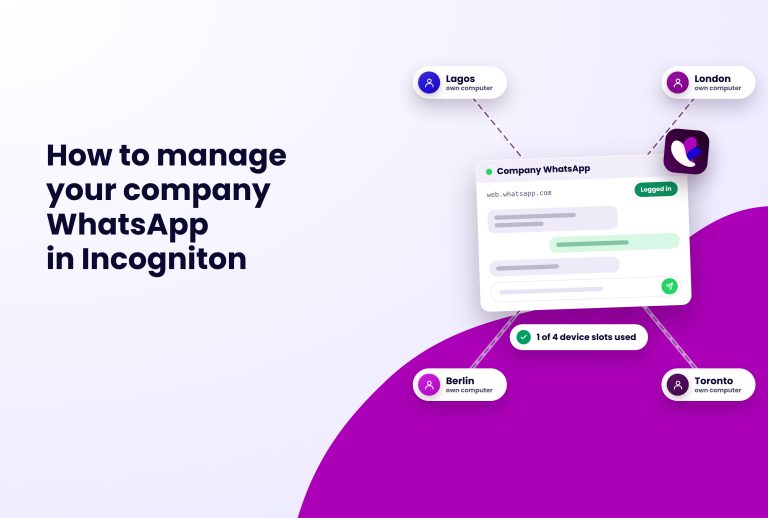
Proxies are where the two differ most day to day. Incogniton includes free built-in proxies on every plan, including the free one, so you can put a new profile online straight away. GoLogin includes 2 GB of residential proxy traffic per month on its paid plans and doesn’t provide any traffic during the trial (GoLogin docs). Top-ups start at $15.90 for 10 GB (GoLogin pricing, as of September 2026).
4. Team Collaboration
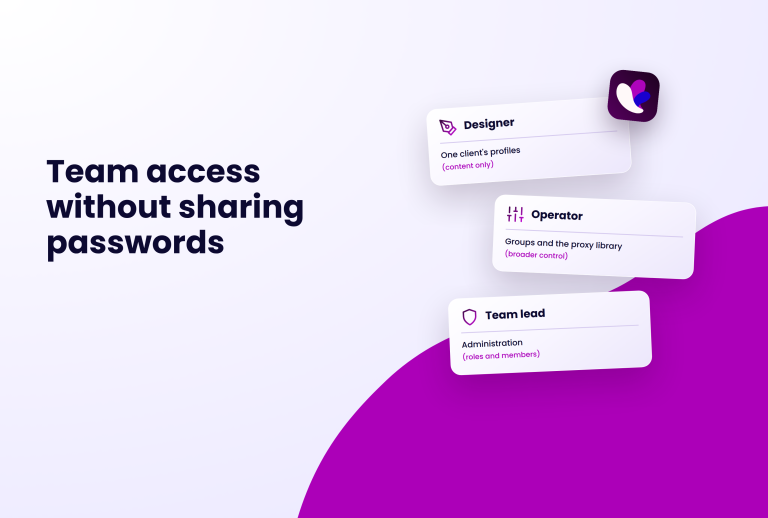
Multi-account management is rarely a solo effort, and this is where Incogniton pulls ahead. The Professional plan includes 3 team seats and Custom Package includes 10. Every extra seat costs only $5/month. With team management you set role-based permissions per team member and per group, so everyone gets exactly the access they need. Team roles are available from the Professional plan.
On GoLogin, team members aren’t available on the Professional or free plans. Seats start with the Business plan at $99/month on monthly billing on GoLogin’s pricing page, which includes one seat, and each extra seat costs $10/month (GoLogin docs; pricing, as of September 2026). GoLogin’s Help Center pricing article (10 August 2026) lists Business from $119/month on monthly billing, also with 1 team member included and extra members sold separately. It says those prices apply to accounts registered from January 2026, and older accounts may keep legacy pricing. At $119, 150 profiles + 3 seats would cost at least $139/month. On its Professional plan you get 10 profile shares instead of team members, and you can share individual profiles with free accounts as a workaround (source).
5. Pricing
Incogniton’s free plan gives you 10 browser profiles for the first 2 months and 3 profiles after that. No credit card is needed. Paid plans start at $19.99/month (Starter Plus, 10 profiles) and every one includes free built-in proxies. Paying for 6 months saves 30%, and paying yearly saves 40%.
GoLogin’s free plan is 3 profiles, without API access, bulk profile creation, cookie export or team members (source). Its paid plans start lower than ours: $9/month for 10 profiles as of September 2026, and yearly billing saves 50%. If you only ever need a few profiles on your own, that’s a genuinely good deal. But proxies beyond 2 GB and every team seat cost extra, and the math flips as soon as you scale:
| What you need (monthly billing) | Incogniton | GoLogin (as of September 2026) |
| 10 profiles, solo | Starter Plus: $19.99, free built-in proxies included | Professional: $9, 2 GB proxy traffic/month (source) |
| 150 profiles + 3 team seats | Professional: $79.99 (150 profiles and 3 seats included) | Business 300 ($99, 1 seat) + 2 seats × $10 = $119 (Professional has no team seats and stops at 100 profiles) (source) (source) |
| 500 profiles + 10 team seats | Custom Package: $149.99 (500 profiles and 10 seats included) | Business 500 ($139, 1 seat) + 9 seats × $10 = $229 (source) |
| Same, billed yearly (per month) | $47.99 (150 + 3 seats) · $89.99 (500 + 10 seats), 40% off | $59.50 (150 + 3 seats) · $114.50 (500 + 10 seats), 50% off (source) |
| Extra team seat | $5/month, on any plan with seats | $10/month, Business plan and up (source) |
| Proxies | Free built-in proxies on every plan | 2 GB/month on paid plans; +10 GB costs $15.90 (source) |
| Free option | 10 profiles for 2 months, then 3; no credit card | 7-day trial (no proxy traffic), or Forever Free with 3 profiles (source) |
| Largest plan | Custom, up to 5,000 profiles | Custom, from $279/month (2,000 profiles) up to 100,000 (source) |
GoLogin figures are from its pricing page and plan documentation, checked in September 2026. Prices exclude VAT. If the higher Business price in GoLogin’s Help Center ($119/month+) applies to your account, the GoLogin totals above are higher.
See Incogniton plans: team seats and proxies included → Or start free with 10 profiles for 2 months.
6. Performance and Reliability
Both browsers are Chromium-based, so sites behave much as they would in Google Chrome. With either tool, day-to-day performance depends mostly on your hardware, how many profiles you run at once, and the quality of your proxies.
GoLogin is cloud-first: when you close a profile, its data is uploaded to GoLogin’s servers, and its documentation advises waiting until that sync has finished before shutting down. The upside is that profiles are reachable from GoLogin’s web and Android apps too.
7. Support and Documentation
Customer support often makes or breaks the experience, especially for beginners. Incogniton offers live chat and email support, and paid plans include premium support: you can ask for a video call, and our developers can help with automation questions. Its documentation is written for both technical and non-technical users.
GoLogin offers support through in-app chat (source) and extensive technical documentation.
8. Security and Data Control
With multi-accounting, your browser holds the keys to every account you run, so it matters where that data lives and who can get to it. Incogniton gives you the controls:
- You decide where your browsing data lives. Turn off Cloud saving in Settings, and your browsing data (cookies, saved logins, local storage and history) stays on your own computer and is never uploaded. Profile settings and fingerprint configuration are still stored on Incogniton’s servers.
- Choose your region. If you use cloud saving, you choose where your profile data is stored: United States, Europe or Asia.
- Two-factor authentication on every plan. Optional TOTP two-factor authentication works with any authenticator app, such as Google Authenticator or Authy, on every plan, including the free one.
- Session control. See every device where you’re signed in, and log out of all of them in one click.
- Team permissions. Role-based permissions per team member and per group.
- Safer transfers. Profile data is transferred over encrypted HTTPS connections using short-lived signed links.
- Password hygiene. You can choose to discard saved passwords when a profile closes.
- Local automation. Browser automation listens only on your own computer and can be turned off.
GoLogin also supports two-factor authentication with an authenticator app (source) and lets you review and end active sessions (source). The difference is data control. GoLogin syncs each profile, “complete with all fingerprints, cookies, local storage, and extensions”, to its cloud (source). Its documentation doesn’t describe a desktop-app setting that keeps browsing data off its servers; the only option we found is a developer flag in its Node.js SDK that stops a profile without uploading (source).
Whichever tool you choose, use a strong, unique password, turn on two-factor authentication and keep your computer free of malware.
Where GoLogin Falls Short
GoLogin is a capable browser, and for a solo user with a handful of profiles its entry price is hard to beat. The trade-offs show up when you grow, when you need proxies, or when you read the small print. All facts below are as of September 2026.
- Teamwork costs extra. Team members are “unavailable” on GoLogin’s Professional and free plans; Professional gets only limited profile sharing (10 profile shares), and GoLogin’s Help Center calls Team Members “a Business-and-above feature”. The Business plan ($99/month on monthly billing on the pricing page; from $119/month in the Help Center) includes one seat, and each additional seat is $10/month (docs, pricing). A 10-person team with 500 profiles pays $229/month at pricing-page prices, against $149.99 on Incogniton.
- Proxy traffic is capped. Paid plans include 2 GB of residential traffic per month, and GoLogin “does not provide any trial traffic” to new users (docs). More traffic is a paid top-up, starting at $15.90 for 10 GB (pricing).
- Your sessions live in its cloud by default. Profiles, including cookies and local storage, are synced to GoLogin’s servers (docs). Its docs warn that closing a profile before sync completes “may result in the data loss” and that profile data is permanently deleted 180 days after a subscription expires (docs).
- A thin free plan. 3 profiles, with no API access, bulk profile creation, cookie export, cloud runs, profile restore or team members (docs). Incogniton’s free plan starts with 10 profiles for 2 months, with free proxies included.
- Refund terms to read carefully. The pricing page advertises “7 days free returns”, but cancelling doesn’t trigger a refund automatically; you have to request one through support (docs). The Terms of Service also reserve the right to refuse refunds for purchases made with cryptocurrency (ToS).
- Reviewers are more divided. GoLogin scores 3.8/5 on Trustpilot from 380 reviews, and 20% of those reviews are 1-star (Trustpilot). Incogniton scores 4.6/5 from 208 reviews (Trustpilot).
Where GoLogin genuinely wins: it’s cheaper for a solo user with up to 100 profiles who doesn’t need team seats or included proxies ($9 for 10, $29 for 50, $39 for 100 profiles; source), and it runs on Linux, Android and the web. Incogniton runs on Windows and macOS.
Incogniton vs GoLogin: Full Feature Set Comparison
| Evaluation Criteria | Incogniton | GoLogin (as of September 2026) |
| Price at 10 profiles | $19.99/month, proxies included | $9/month, 2 GB proxy traffic (source) |
| Price at 150 profiles + 3 seats | $79.99/month | $119/month (source) |
| Price at 500 profiles + 10 seats | $149.99/month | $229/month (source) |
| Team seats included | 3 (Professional), 10 (Custom Package); extra seats $5/month | None on Professional (10 profile shares only); Business from $99/month on monthly billing ($119/month+ in the Help Center), 1 included; extra seats $10/month (source) |
| Built-in proxies | Free on every plan | 2 GB/month on paid plans, none in trial (source) |
| Free plan | 10 profiles for 2 months, then 3; no credit card | 3 profiles; no API or team members (source) |
| Two-factor authentication | Optional TOTP on every plan, including free | Yes, authenticator app (source) |
| Keep browsing data on your computer | Yes: turn off Cloud saving and cookies, saved logins, local storage and history stay on your computer (profile settings remain in the cloud) | No desktop setting documented; SDK developer flag only (source) |
| Choose cloud storage region | United States, Europe or Asia | — |
| Anti-fingerprinting | Realistic fingerprints generated by default; adjustable per profile or via API | Granular manual control over fingerprint parameters |
| Ease of use | Beginner friendly, ready-made profiles (our view) | Many manual settings, aimed at advanced users |
| Operating systems | Windows, macOS | Windows, macOS, Linux, Android, web (source) |
| Automation | REST API, Selenium, Puppeteer, Playwright SDKs (Entrepreneur+); Synchronizer; Paste as Human Typing | REST API and SDK (paid plans) (source) |
| Cookie tools | Cookie Collector and cookie export (Entrepreneur+) | Cookie export (paid plans) (source) |
| Use cases | Social media, affiliate marketing, scraping, e-commerce, crypto airdrops | Social media, affiliate marketing, scraping, e-commerce, crypto airdrops (source) |
| Support | Live chat and email; premium support on paid plans | In-app chat (source) |
| Trustpilot | 4.6/5 (208 reviews) | 3.8/5 (380 reviews) (source) |
| Company location | Amsterdam, the Netherlands | United States |
Verdict: Incogniton or GoLogin?
Choose Incogniton as your GoLogin alternative if you work with a team, want proxies included instead of metered, or want to decide for yourself whether your browsing data leaves your computer. That’s most of our readers. You get 3 or 10 team seats included, $5 extra seats, free built-in proxies on every plan, the Synchronizer and Cookie Collector, 2FA on every plan, and a setup that just works. At 150 or 500 profiles with a team, it’s also the cheaper option by a clear margin.
Consider GoLogin only if you work alone, want the lowest possible price for up to 100 profiles and don’t mind paying separately for proxy traffic, or you need Linux, Android or a web version.
Start free: 10 profiles for 2 months → No credit card required. Ready to scale? See plans with team seats and free proxies included.