HomeFeaturesCollaborate with Your Team on Your Isolated Profiles
Multiple browser profiles
Workflow optimization
Team collaboration
Online fingerprint protection
User-friendly
Collaborate with Your Team on Your Isolated Profiles
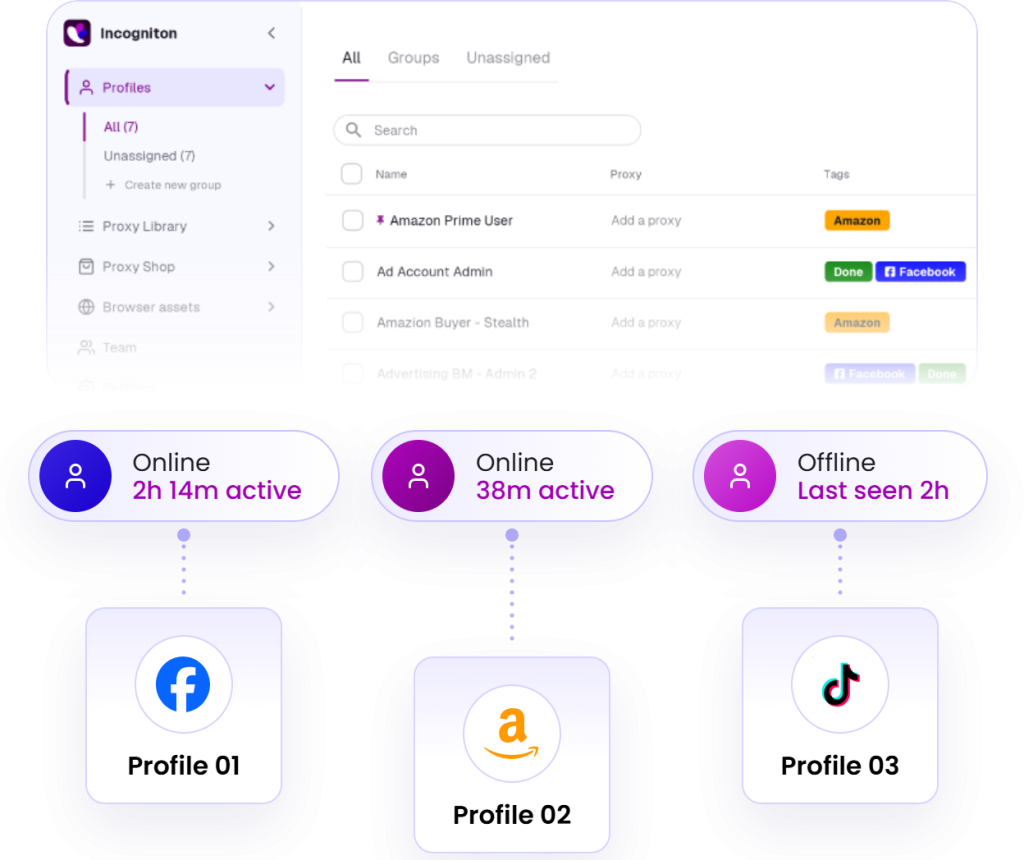
With Incogniton’s Team Activity features, you can know who’s online, who opened which profile, and how long they worked, without asking anyone to fill in a timesheet.
Shared Profiles Without Visibility Create Blind Spots
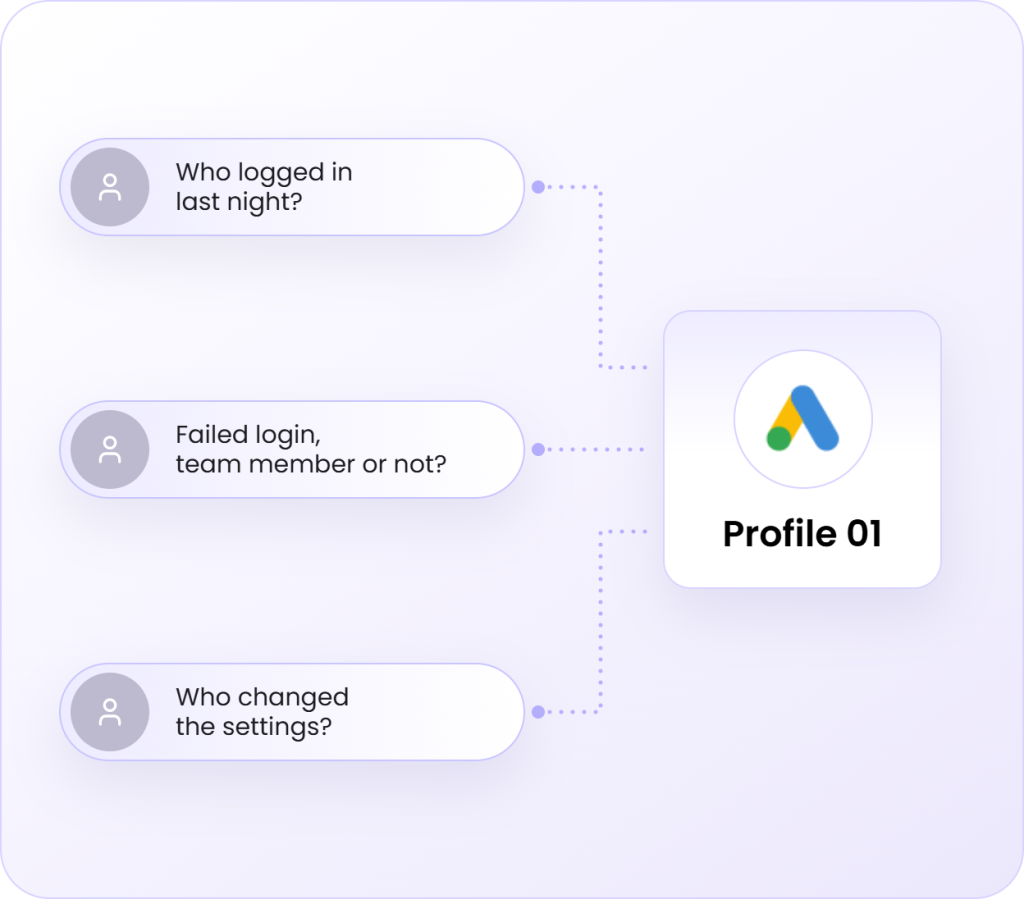
Once several people work inside the same set of browser profiles, small questions get hard to answer. Who logged into the client’s account last night? Was that failed login a teammate who mistyped a password, or someone who shouldn’t be trying at all? Which profile was open when the settings changed?
Without a record, you end up piecing the answer together from chat messages and memory. That’s slow when things go right, and useless when something goes wrong.
The Activity Tab Gives Admins a Clear Record
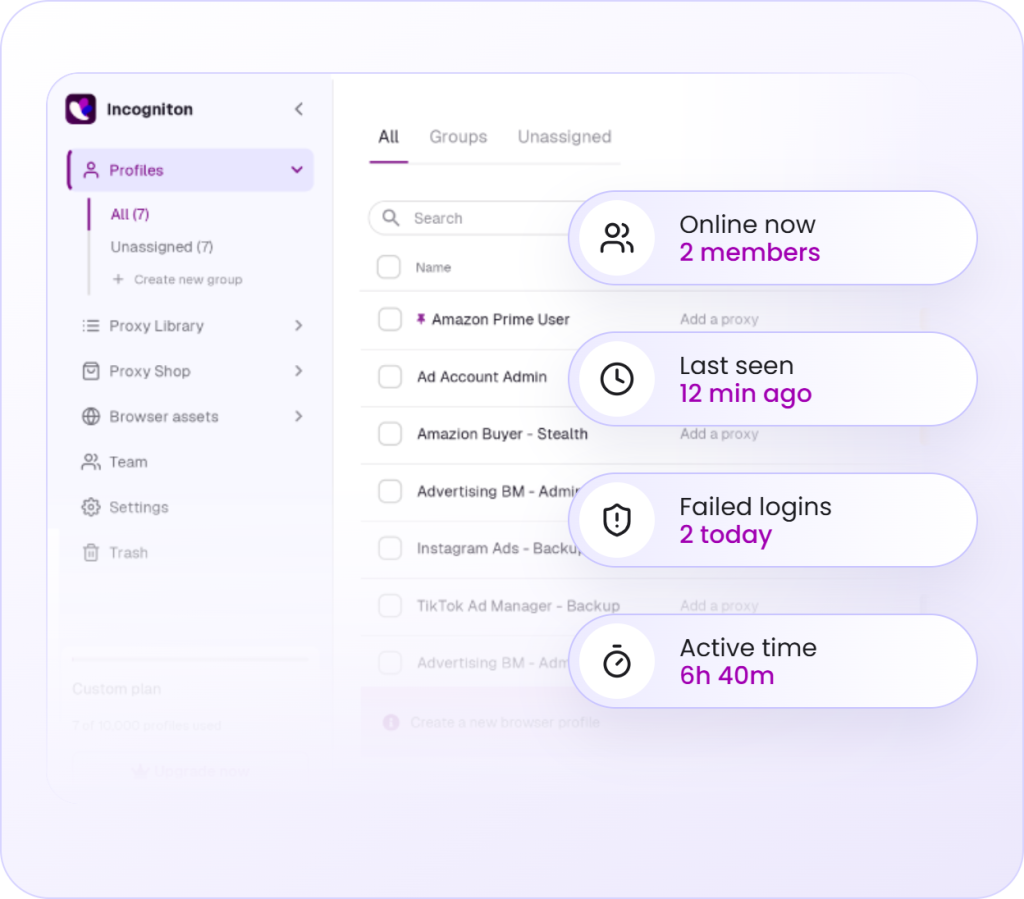
Incogniton’s Activity tab shows team admins what happens across their workspace in one place: login history, browser profile sessions, and activity per team member. At a glance you can see who’s online, when each person was last seen, their logins and failed logins, and their total active time.
No spreadsheets, no screenshots, no chasing people for updates.
A run of failed logins on one member's account is a signal. Seeing it quickly lets you reset access or ask a question before it becomes a bigger issue.
Settle "who did what" in seconds
When a client asks what happened on their account, you can check which profile sessions ran and when, instead of guessing.
Understand workload
Total active time per member shows where hours actually go, which helps with planning shifts, billing clients, and spotting who's overloaded.
Hand over work with confidence
New hires and freelancers get their own logins, and their activity shows up alongside everyone else's. Trust is easier when there's a record.
Activity Tracking Works Best With the Rest of Team Management
Team admins. Access to team management is controlled through roles, so you decide which members get admin rights.
What does the activity log show?
Login history, browser profile sessions, and per-member activity: who’s online, last seen, logins, failed logins, and total active time.
Does the Activity tab record what team members do inside websites?
No. It shows account and profile activity, such as logins and sessions, not the pages a member visits or what they type.
Is the activity log available on every plan?
It’s part of team management, which comes with paid plans that include team member seats. See the pricing page for details.
Can I stop two members from using the same profile at once?
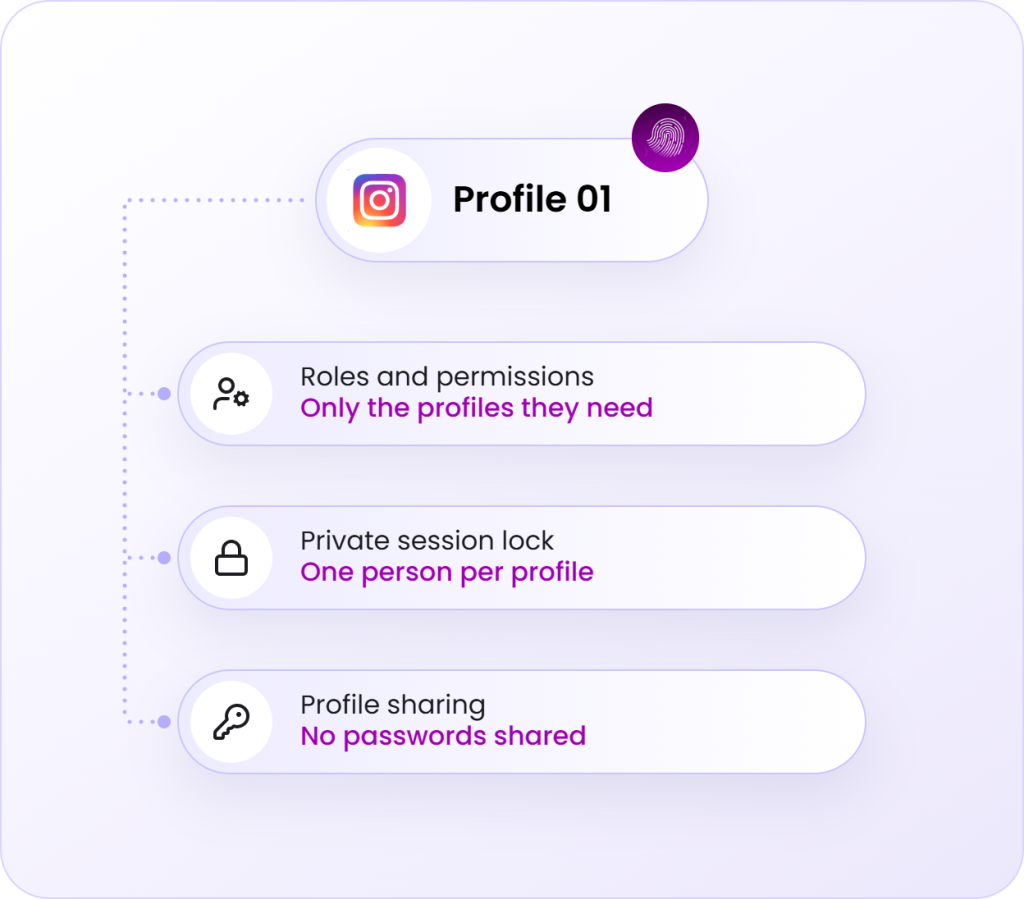
Yes. Turn on Private active session lock in the profile settings, and a profile can only be open for one person at a time.
How do I remove a team member's access?
Go to Team Management and change their role or delete the member. Because they never had the account passwords, there’s nothing else to rotate.
Cookies
We use cookies to enhance site navigation, analyze site usage, and support our marketing efforts. You can accept all cookies or manage your preferences at any time.
Functional
Always active
The technical storage or access is strictly necessary for the legitimate purpose of enabling the use of a specific service explicitly requested by the subscriber or user, or for the sole purpose of carrying out the transmission of a communication over an electronic communications network.
Manage options
The technical storage or access is necessary for the legitimate purpose of storing preferences that are not requested by the subscriber or user.
Statistics
The technical storage or access that is used exclusively for statistical purposes.The technical storage or access that is used exclusively for anonymous statistical purposes. Without a subpoena, voluntary compliance on the part of your Internet Service Provider, or additional records from a third party, information stored or retrieved for this purpose alone cannot usually be used to identify you.
Marketing
The technical storage or access is required to create user profiles to send advertising, or to track the user on a website or across several websites for similar marketing purposes.
We use cookies to enhance site navigation, analyze site usage, and support our marketing efforts. You can accept all cookies or manage your preferences at any time.
Functional
Always active
The technical storage or access is strictly necessary for the legitimate purpose of enabling the use of a specific service explicitly requested by the subscriber or user, or for the sole purpose of carrying out the transmission of a communication over an electronic communications network.
Manage options
The technical storage or access is necessary for the legitimate purpose of storing preferences that are not requested by the subscriber or user.
Statistics
The technical storage or access that is used exclusively for statistical purposes.The technical storage or access that is used exclusively for anonymous statistical purposes. Without a subpoena, voluntary compliance on the part of your Internet Service Provider, or additional records from a third party, information stored or retrieved for this purpose alone cannot usually be used to identify you.
Marketing
The technical storage or access is required to create user profiles to send advertising, or to track the user on a website or across several websites for similar marketing purposes.