
If you manage dozens or hundreds of accounts through an anti-detect browser, you have probably noticed something frustrating: the fingerprint is unique, the proxy is clean, the profile looks nothing like its neighbors, and the platform still throws a CAPTCHA at one of them. Sometimes it's the newest profile. Sometimes it's one that's been running fine for weeks and suddenly gets flagged mid-session.
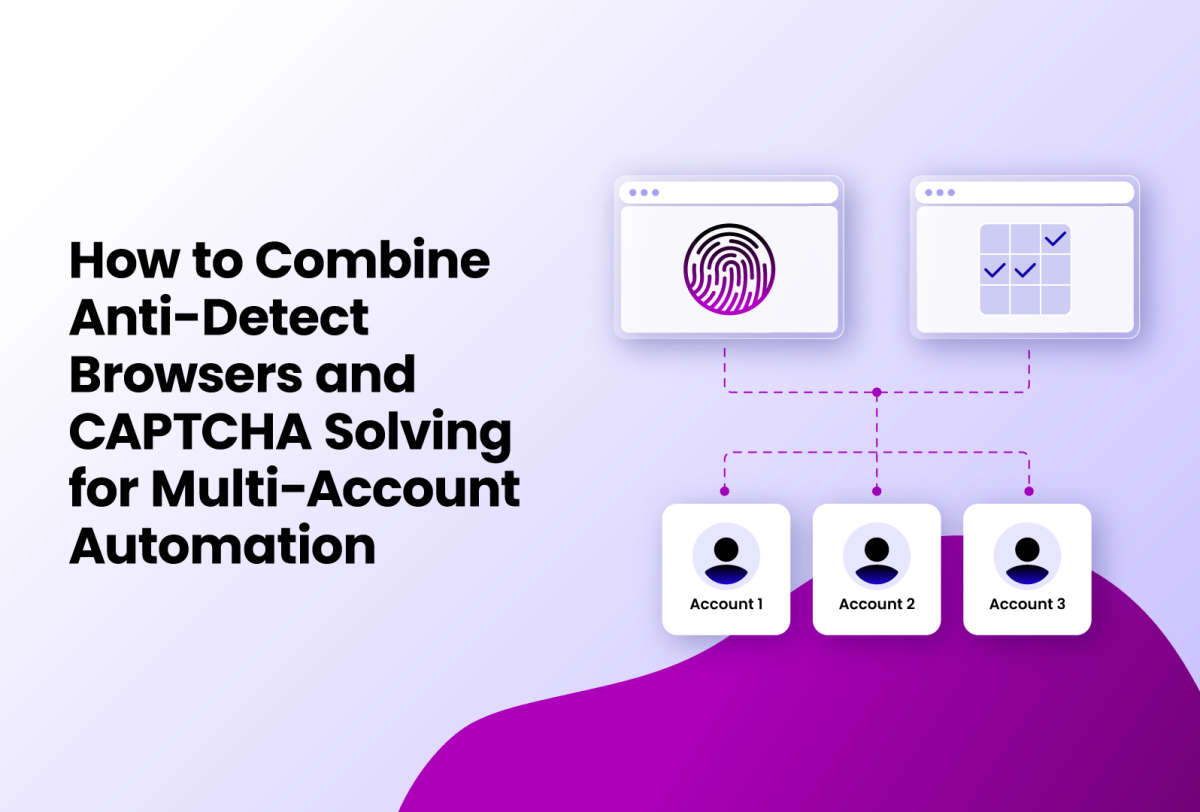
This isn't a sign that your anti-detect setup is broken. An anti-detect browser solves a specific problem: making each profile look like a distinct, real browser at the fingerprint level: canvas, WebGL, fonts, timezone, and dozens of smaller signals that would otherwise tie multiple accounts back to the same machine. It does that job well. What it doesn't do is control how a platform interprets the behavior happening inside that profile. Account-creation speed, action patterns, IP subnet reputation, and how "warmed up" a profile looks are a separate detection layer entirely, and CAPTCHA is usually where that layer surfaces.
Trying to solve this by tweaking fingerprint settings harder is a dead end. The CAPTCHA isn't questioning whether the browser is real; it's questioning whether the account's behavior is. What actually closes the gap is pairing the anti-detect browser with a dedicated CAPTCHA-solving layer: CapMonster Cloud sits inside each profile, solves whatever challenge comes up, and hands back a token without breaking the automation flow or requiring manual intervention on any single profile.
Get started now and automate CAPTCHA solving across your profiles
Why CAPTCHAs Still Appear Even With a Solid Anti-Detect Profile
It's worth separating what an anti-detect browser actually controls from what triggers a CAPTCHA, because the two are often assumed to be the same thing.
Fingerprint spoofing covers everything a platform can read about the browser itself: canvas and WebGL rendering, installed fonts, screen resolution, timezone, navigator properties, and so on. A good anti-detect browser makes each profile's fingerprint internally consistent and distinct from every other profile you run. This is necessary, but it's a static, one-time check: [1] the platform evaluates it once per session and moves on.
Behavioral analysis is ongoing, and it's where most multi-account CAPTCHAs actually come from. Platforms track how fast an account was created relative to its first actions, whether click and scroll patterns look human, whether multiple "different" accounts are logging in from the same IP subnet in a suspiciously tight window, and whether a profile has any history at all versus showing up and immediately performing high-risk actions (mass follows, bulk listings, rapid messaging).
This is why a brand-new profile with a perfect fingerprint can still get CAPTCHA'd on its first login, while an older profile with a slightly less exotic setup sails through. The platform isn't looking at the browser; it's looking at the account's behavioral footprint so far.
CAPTCHA behavior also varies meaningfully by platform type. Social networks tend to challenge based on action velocity and network patterns (many "new" accounts from the same subnet in a short window). Marketplaces lean on account age and transaction/listing history. Email providers often trigger on registration speed and volume from a single IP range, regardless of how convincing the browser fingerprint is. Knowing which pattern applies to your target platform shapes how much a solver needs to carry the workflow versus how much needs to come from pacing and warm-up.
The Anti-Detect Browser and CapMonster Cloud as Two Separate Layers
It helps to think of the two tools as covering completely different parts of the same profile, rather than one being an upgrade of the other:
● the anti-detect browser keeps each profile's fingerprint, cookies, local storage, and proxy isolated and internally consistent, so profile A never leaks anything that ties it back to profile B;
● CapMonster Cloud solves whatever CAPTCHA challenge that specific profile triggers, and returns a token scoped to that session.
Neither one substitutes for the other. A perfectly isolated profile still gets challenged when its behavior looks automated; a fast CAPTCHA solver bolted onto a poorly isolated setup just means you solve CAPTCHAs faster right up until the platform bans the whole cluster of accounts for shared fingerprints.

The request flow through one profile looks like this:
- The anti-detect browser launches the profile, with its own fingerprint, cookies, and proxy already attached.
- The profile navigates the target platform and triggers a CAPTCHA.
- An extension running inside that profile, or an external script driving it via CDP, detects the challenge and sends a createTask request to CapMonster Cloud, scoped to that profile's session.
- CapMonster Cloud solves it and returns a token via getTaskResult.
- The token is injected back into the page inside the same profile, and the workflow continues without ever crossing over to another profile's context.
The isolation matters at every step here, not just at the fingerprint level: a task, a token, or a proxy leaking between two profiles undoes a lot of what the anti-detect browser was set up to prevent in the first place. That's covered in more detail in the multi-accounting specifics section further down.
What You Need for This Setup
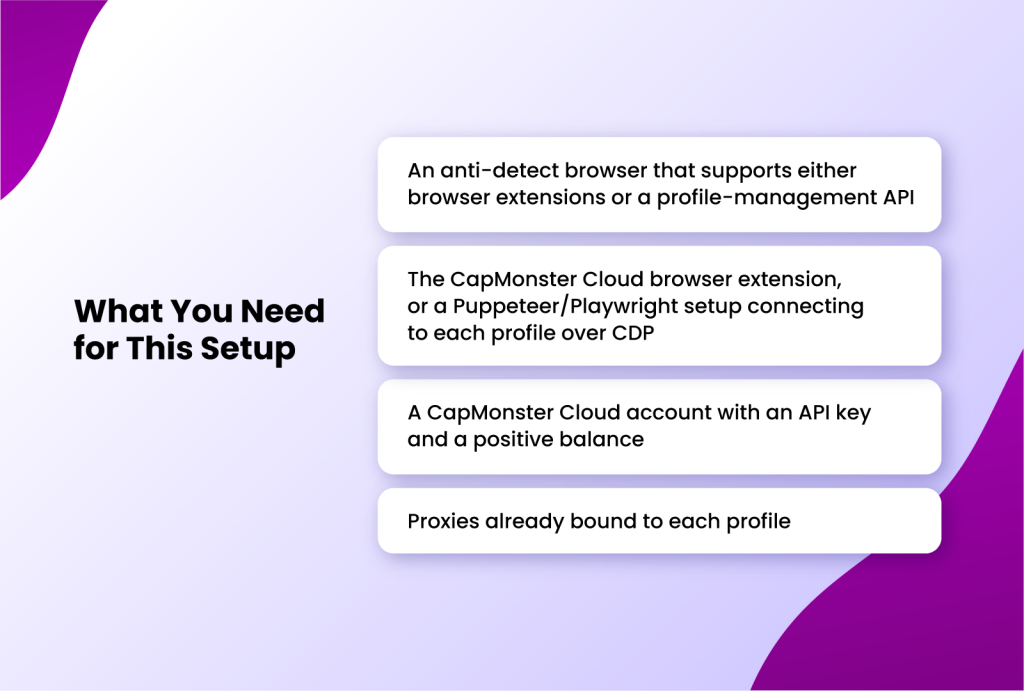
Before combining the two, make sure you have:
● an anti-detect browser that supports either browser extensions or a profile-management API (most established tools in this category, including Dolphin{anty}, Multilogin, GoLogin, AdsPower, and similar, support one or both);
● the CapMonster Cloud browser extension, or a Puppeteer/Playwright setup connecting to each profile over CDP (Chrome DevTools Protocol);
● a CapMonster Cloud account with an API key and a positive balance;
● proxies already bound to each profile (this is typically standard anti-detect practice, but it's worth confirming each profile's proxy is what CapMonster Cloud will also use if a task requires proxy-bound solving).
If your anti-detect browser exposes a profile template or a "base profile" concept, install the CapMonster Cloud extension there once. Every profile launched from that template will inherit it automatically, which saves you from re-installing it into each new account by hand.
Step-by-Step: Wiring CapMonster Cloud Into an Anti-Detect Profile
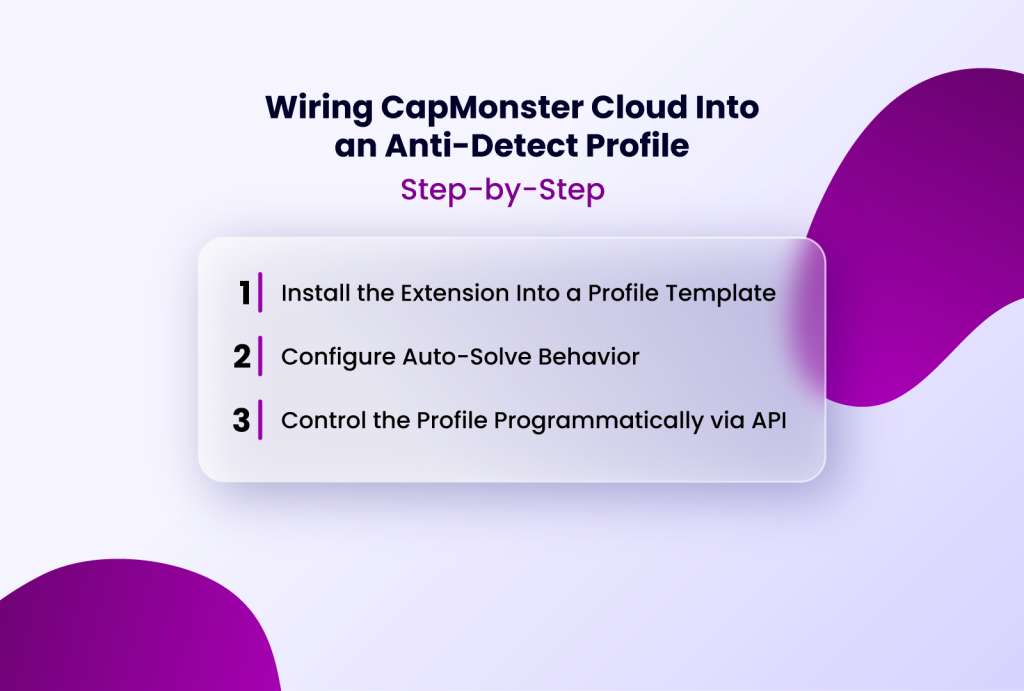
Step 1: Install the Extension Into a Profile Template[2]
Open your anti-detect browser's profile (or template) manager and add the CapMonster Cloud extension the same way you'd add it to regular Chrome, via the Chrome Web Store link or a .crx file, depending on what your anti-detect tool supports. Once it's in the template, enter your CapMonster Cloud API key in the extension's settings panel a single time.
Save the template, then create new profiles from it. Each new profile should launch with the extension already installed and authenticated, with no per-profile setup required.
Step 2: Configure Auto-Solve Behavior
Inside the extension settings, enable automatic solving for the CAPTCHA types you expect on your target platforms: reCAPTCHA v2/v3, hCaptcha, Turnstile, and GeeTest. If Cloudflare's bot check specifically is what you're running into, see our cloudflare challenge solution for a more detailed walkthrough. With auto-solve on, the extension detects a challenge on the page, requests a solution from CapMonster Cloud, and submits the token itself, which is useful for manual browsing sessions or lightly scripted flows where you don't want to write custom detection logic.
For fully automated, scripted multi-account workflows, though, you'll usually want tighter control than the extension's defaults give you. That's where driving the profile programmatically comes in.
Step 3: Control the Profile Programmatically via API
Most anti-detect browsers expose an API to launch a profile and return a CDP (Chrome DevTools Protocol) endpoint you can connect to with Playwright or Puppeteer. This lets your script detect a CAPTCHA on the page, call CapMonster Cloud directly, and inject the token, all scoped to that one profile's browser context.
Python
import requests
from playwright.sync_api import sync_playwright

# 1. Launch the profile via the anti-detect browser's API
launch_resp = requests.post("http://localhost:PORT/api/v1/profiles/start", json={
	"profileId": "profile_123"
})
ws_endpoint = launch_resp.json()["wsEndpoint"]  # CDP endpoint for this profile

with sync_playwright() as p:
	browser = p.chromium.connect_over_cdp(ws_endpoint)
	context = browser.contexts[0]
	page = context.pages[0]

    page.goto("https://target-platform.com/signup")

	# 2. Detect the CAPTCHA (sitekey present in the DOM)
	sitekey = page.get_attribute("[data-sitekey]", "data-sitekey")

	if sitekey:
    	# 3. Send the task to CapMonster Cloud
    	task_resp = requests.post("https://api.capmonster.cloud/createTask", json={
        	"clientKey": "YOUR_API_KEY",
        	"task": {
            	"type": "RecaptchaV2TaskProxyless",
            	"websiteURL": page.url,
            	"websiteKey": sitekey
        	}
    	})
    	task_id = task_resp.json()["taskId"]

    	# 4. Poll for the result
    	import time
    	while True:
        	result = requests.post("https://api.capmonster.cloud/getTaskResult", json={
            	"clientKey": "YOUR_API_KEY",
            	"taskId": task_id
        	}).json()
        	if result["status"] == "ready":
            	token = result["solution"]["gRecaptchaResponse"]
            	break
        	time.sleep(3)

    	# 5. Inject the token into the same profile's page
    	page.evaluate(f"""
            document.querySelector('textarea[name="g-recaptcha-response"]').value = "{token}";
    	""")
JavaScript
const axios = require("axios");
const { chromium } = require("playwright");

// 1. Launch the profile via the anti-detect browser's API
const { data: launch } = await axios.post("http://localhost:PORT/api/v1/profiles/start", {
  profileId: "profile_123",
});
const wsEndpoint = launch.wsEndpoint;

const browser = await chromium.connectOverCDP(wsEndpoint);
const context = browser.contexts()[0];
const page = context.pages()[0];

await page.goto("https://target-platform.com/signup");

// 2. Detect the CAPTCHA (sitekey present in the DOM)
const sitekey = await page.getAttribute("[data-sitekey]", "data-sitekey");

if (sitekey) {
  // 3. Send the task to CapMonster Cloud
  const { data: task } = await axios.post("https://api.capmonster.cloud/createTask", {
	clientKey: "YOUR_API_KEY",
	task: {
  	type: "RecaptchaV2TaskProxyless",
  	websiteURL: page.url(),
  	websiteKey: sitekey,
	},
  });

  // 4. Poll for the result
  let token;
  while (true) {
	const { data: result } = await axios.post("https://api.capmonster.cloud/getTaskResult", {
  	clientKey: "YOUR_API_KEY",
  	taskId: task.taskId,
	});
	if (result.status === "ready") {
  	token = result.solution.gRecaptchaResponse;
  	break;
	}
	await new Promise((r) => setTimeout(r, 3000));
  }

  // 5. Inject the token into the same profile's page
  await page.evaluate((t) => {
    document.querySelector('textarea[name="g-recaptcha-response"]').value = t;
  }, token);
}[3] [4]
Everything in this flow (the CDP connection, the createTask call, the injected token) stays scoped to the single profile launched in step 1. Running this same logic across multiple profiles just means repeating it per wsEndpoint, never sharing a browser context or a task between two profiles.
Multi-Accounting Specifics
Keep Isolation Strict, Including on the CapMonster Side
The anti-detect browser already isolates fingerprint, cookies, and local storage per profile. Extend that same discipline to the CAPTCHA-solving step: each profile's createTask calls should use that profile's own proxy (when the task type needs one), and the resulting token should only ever be injected into the page it was solved for. Reusing a token across profiles, or routing two profiles' CAPTCHA tasks through the same proxy, reintroduces exactly the kind of cross-profile signal the anti-detect setup was built to avoid.
Why Fresh Profiles Get CAPTCHA'd More Often
A profile with no history looks, from the platform's side, indistinguishable from a bot on its first action. Age, prior logins, and a gradual build-up of normal-looking activity all reduce how often a profile gets challenged. This means:
● Expect a higher CAPTCHA-solve rate on brand-new profiles, and budget for it rather than treating it as a sign something's misconfigured;
● A short warm-up period (logging in, browsing, waiting before performing higher-risk actions) tends to reduce CAPTCHA frequency on later steps, even though it doesn't eliminate it;
● Don't judge whether your anti-detect fingerprint setup is "good enough" purely by CAPTCHA frequency on day one; a well-configured profile still gets challenged early and less often over time.
Scaling: Syncing Thread Limits
Running N profiles in parallel means two limits need to line up: how many browser instances your anti-detect tool can run concurrently, and how many concurrent tasks your CapMonster Cloud plan allows. If you run more profiles in parallel than your CapMonster concurrent-task limit supports, tasks queue rather than fail outright, but that queueing shows up as slower CAPTCHA resolution across every profile, not just the ones over the limit. Check your plan's thread limit against your actual parallel-profile count before scaling up, and raise it if you're consistently near the ceiling.
Pace Actions to Avoid Provoking Unnecessary CAPTCHAs
Because a lot of CAPTCHA triggers are behavioral rather than fingerprint-based, action timing inside a profile matters. Firing off registration, verification, and a first high-risk action back-to-back, with no delay that a real user would naturally have, is one of the more common self-inflicted causes of CAPTCHA frequency. Spacing actions out, and avoiding identical timing patterns across many profiles running the same script, reduces how often you need CapMonster Cloud to intervene in the first place, even though it remains there as the fallback when a challenge does appear.
Possible Errors and Solutions
| Error | What to Check |
| Extension installed but not auto-solving inside the profile | Confirm the API key was entered in the extension settings for that specific profile template, and that the profile was actually launched from the updated template rather than an older one. |
| Token retrieved from CapMonster Cloud but not appearing in the page | The DOM selector used to inject the token may not match the target site's actual form field. Re-check the field name (g-recaptcha-response or the site-specific equivalent) via dev tools on that same profile. |
| Solve rate drops when running many profiles in parallel | You're likely near or over your CapMonster Cloud plan's concurrent-task limit. Tasks are queueing rather than failing. Check your thread limit against your parallel-profile count. |
| ERROR_PROXY_CONNECT_REFUSED on a proxy-bound task | The proxy passed to CapMonster Cloud doesn't match the profile's actual assigned proxy, or the proxy is currently down. Re-verify the binding between the profile and the task parameters. |
| One profile's failures seem to affect others | Retry or error-handling logic is likely shared across profiles instead of scoped per profile. Isolate retry state so one profile's failed task doesn't block or delay others running in parallel. |
A full list of API errors is available in the CapMonster Cloud documentation.
Optimizing the Workflow
Monitor CAPTCHA frequency by platform and by profile. Logging how often each profile hits a CAPTCHA, broken down by target platform and by profile age, tells you where warm-up time is paying off and where a specific platform's detection is simply more aggressive than others, which is useful for deciding where to invest in pacing versus where to just budget for a higher solve rate.
Balance CapMonster tasks across profiles without exceeding your limits. With many profiles running at once, it's easy for a burst of simultaneous CAPTCHAs to spike your concurrent-task usage. Staggering profile launches slightly, rather than starting all of them in the same instant, smooths out the load on both your anti-detect browser and your CapMonster Cloud plan.
Scope retry logic to the profile, not the whole batch. A failed task on one profile shouldn't pause or slow down the rest. Structure retries so each profile's error handling (backoff, re-attempt, or skip) is fully independent, which keeps a single flaky profile from degrading throughput across the entire run.
Conclusion
Anti-detect browsers and CapMonster Cloud close two different gaps in multi-account automation, fingerprint detection and the CAPTCHA barrier, and neither one covers for the other. Keeping the two working as a single unit at the profile level, with strict isolation carried all the way through to proxy usage and token handling, is what lets automation scale across many accounts without one profile's problems spilling into the rest. Once that pattern is in place, most of the remaining work is pacing, monitoring, and keeping thread limits in sync, not rebuilding the flow itself.