
Every time you open a webpage, your browser sends information to the website’s server. Among that information is your user agent string.
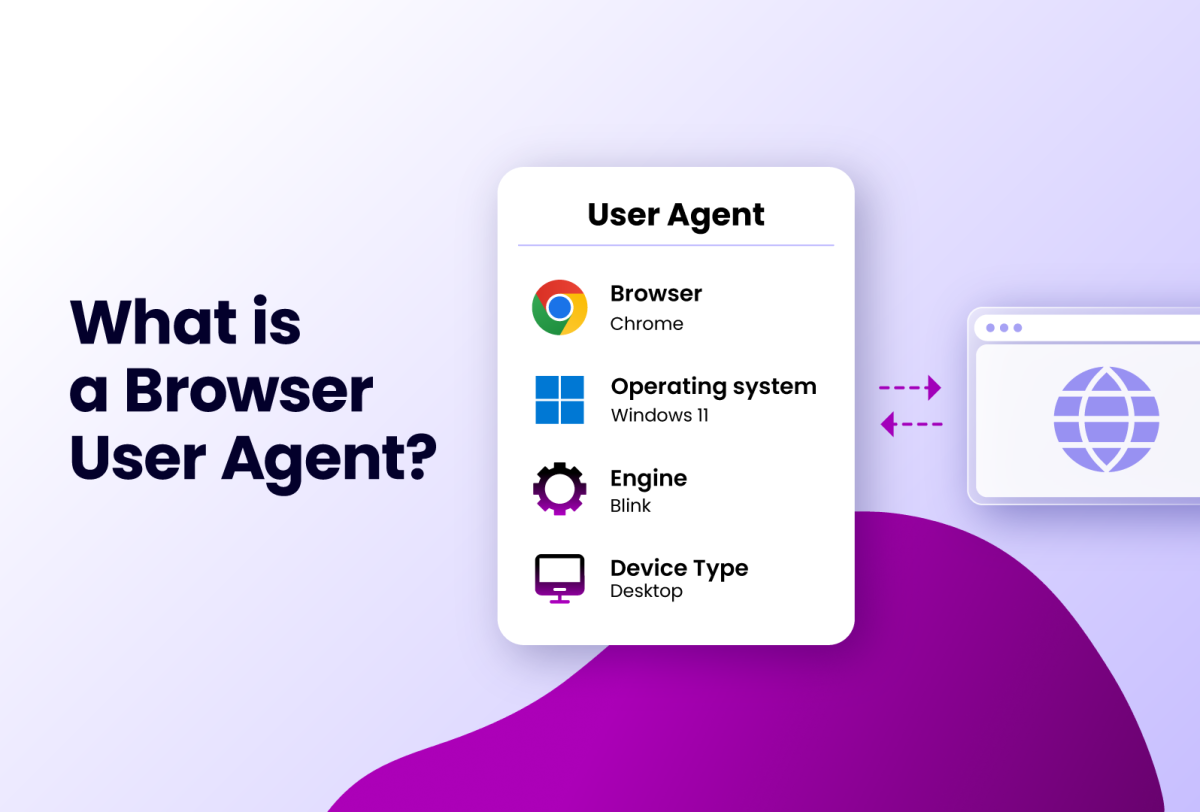
A browser user agent is a text string that identifies your browser, operating system, and device to a website whenever you make a request. It is included in an HTTP request header and helps websites understand how to deliver content that works correctly on your device.
A typical user agent string looks like this:
Mozilla/5.0 (Macintosh; Intel Mac OS X 14_7_2) AppleWebKit/537.36 (KHTML, like Gecko) Chrome/132.0.0.0 Safari/537.36
Although it appears complicated, the string mainly communicates details such as:
- Browser: Google Chrome, Firefox, Safari, Edge, etc.
- Browser version: The version currently installed.
- Operating system: Windows, macOS, Linux, Android, iOS.
- Rendering engine: The software responsible for displaying webpages.
- Device information: Whether the request comes from a desktop, tablet, or mobile device.
Websites use this information to determine how they should respond to your request. For example, when someone visits a website from an iPhone, the website can detect the mobile browser environment and provide a mobile-friendly layout instead of the desktop version.
How Does a User Agent Work?
A user agent works as part of the HTTP communication process between your browser and a website.
When you enter a URL into your browser, your browser sends a request to the website’s server. The server reads the user agent information and uses it to make decisions about the content it sends back.
For example, a mobile user agent may receive a responsive mobile layout while an older browser version may receive compatibility warnings. A known search engine crawler may receive content designed for indexing.
Please note that user agents are not authentication tools. They do not prove who a user is, and they do not contain personal information such as your name or account details.
How to Check Your Browser User Agent
There are several ways to check your current user agent.
The easiest method is to search for a “what is my user agent” tool online. These tools automatically display the user agent string your browser sends.
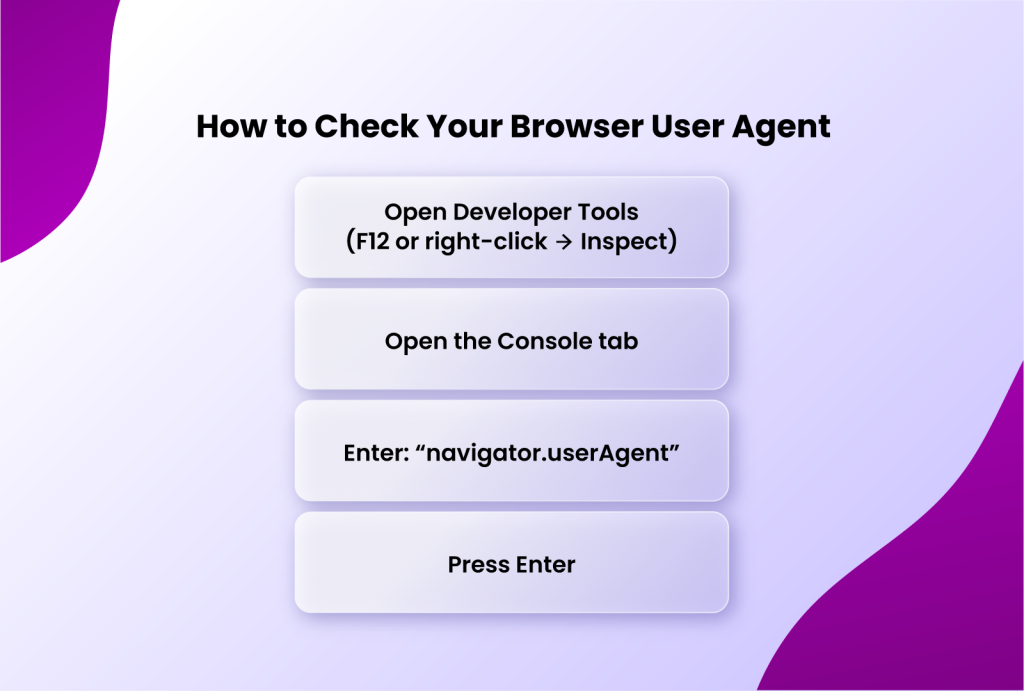
You can also check it manually through your browser developer tools:
- Open Developer Tools (F12 or right-click → Inspect).
- Open the Console tab.
- Enter: “navigator.userAgent”
- Press Enter.
Your browser will display your current user agent string.
Why Do Websites Use User Agents?
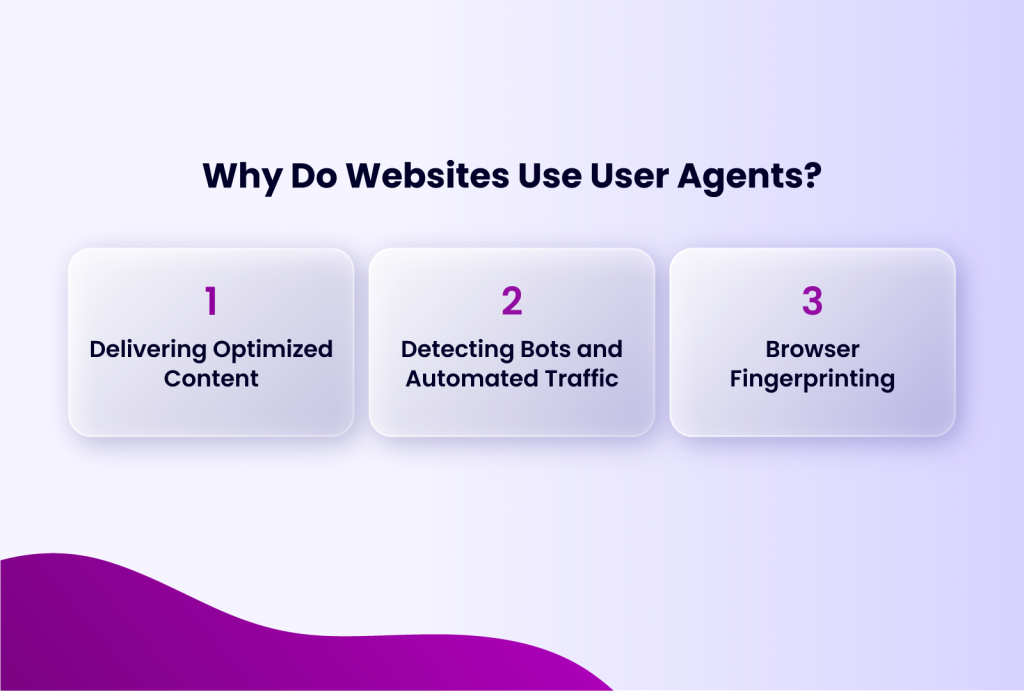
User agents were originally created to improve website compatibility, but today they serve several important purposes.
1. Delivering Optimized Content
Different devices and browsers have different capabilities. Websites use user agents to determine the best version of a page to deliver. Different browsers may receive different code depending on compatibility requirements.
For example, mobile users may receive smaller images and touch-friendly layouts, while older browsers may receive alternative versions of pages. The browser user agent allows a website server to know this.
2. Detecting Bots and Automated Traffic
Websites also use user agents as one signal when identifying automated traffic.
Many bots identify themselves through their user agent string. For example, search engine crawlers typically use recognisable user agents that allow websites to understand who is accessing their pages.
3. Browser Fingerprinting
While the user agent was originally designed to improve user experience by delivering compatible content, it has become a cornerstone of modern web tracking techniques like browser fingerprinting.
We’ve explained in detail what these techniques are all about, but the long and short of it is that the techniques collect a lot of simple information about your browser to create an identity that is unique to you almost 99% of the time.
Your user agent, like a session token, is a significant piece of the information collected to make this work. When combined with other signals like screen resolution, installed fonts, and timezone, your browser becomes as unique as a fingerprint, making you trackable even if you use "Incognito" mode.
Managing Your Digital Identity with Incogniton
If you are managing multiple accounts or performing large-scale data collection, standard browser settings are rarely enough. Websites don't judge your user agent on its own; they check whether it lines up with everything else your browser exposes: screen resolution, timezone, language, WebGL renderer, canvas output. A mismatch between any of these is often a bigger red flag than a spoofed value by itself.
Incogniton is built around that problem. Instead of changing one signal and hoping the rest goes unnoticed, it lets you configure a full browser profile, with its own consistent set of parameters, and keeps that profile completely separate from every other one you run.
Each profile also gets its own isolated cookies and local storage, and can be paired with a proxy so WebRTC reports the proxy IP and the browser language matches the proxy's region automatically. The result reads as one coherent, real-looking browser rather than a patchwork of spoofed values. That's really what control means here: instead of a tracking script deciding what parts of your identity leak through, you decide, profile by profile, what version of your browser the internet sees.
READ MORE ABOUT Incogniton here: The best free anti-detect browser: Incogniton
Conclusion
The browser user agent is far more than a simple identifier; it is the primary interface through which your hardware communicates with the digital world. Whether you are a casual surfer, a developer testing cross-browser compatibility, or a professional web scraper aiming to maintain anonymity, understanding this string of text is essential.
Knowledge of these terms is the first step toward reclaiming your online footprint and navigating the web on your own terms. I hope this article helped you with that.
Remember, in the game of online anonymity, consistency is your greatest asset. Keep your digital fingerprint aligned, stay updated, and always be aware of the "handshake" you are offering to the websites you visit.