
We've written about virtual browsers, and we've written plenty about antidetect browsers. What we haven't done is put them side by side and explain where one ends and the other begins. That gap matters because the two tools are constantly lumped together, and picking the wrong one can mean paying for infrastructure you don't need or, worse, losing accounts you thought were protected.
So let's settle it: what each tool actually does, where they overlap, where they diverge, and which one fits your workflow.
A Quick Recap
A virtual browser runs your browsing session somewhere other than your local device, either on a remote server or inside a sandboxed environment like a virtual machine. The point is separation from your own hardware. Your actual computer just renders the output while a different machine handles the requests, scripts, and cookies.
Close the session and the activity disappears with it. We covered the mechanics of this in detail in our virtual browser guide, so we won't rebuild that explanation here.
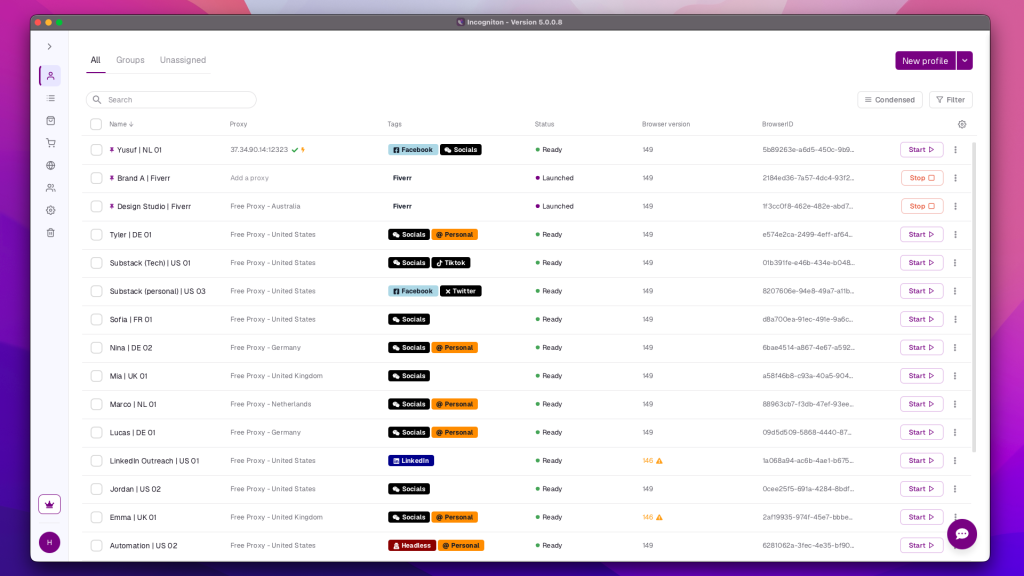
An antidetect browser like Incogniton takes a different approach. Instead of just moving the browser somewhere else, it builds distinct, isolated browser profiles on your own machine (or synced across a team), each with its own fingerprint, cookie jar, and proxy. The goal isn't to hide where the browsing happens. It's to make each profile look like a genuinely different person using a genuinely different device.
Both tools involve isolation. That's why they're so often confused. But what they isolate, and why, is not the same thing.
The Core Difference Between Virtual Browsers and Anti-detect Browsers: Environment vs. Identity
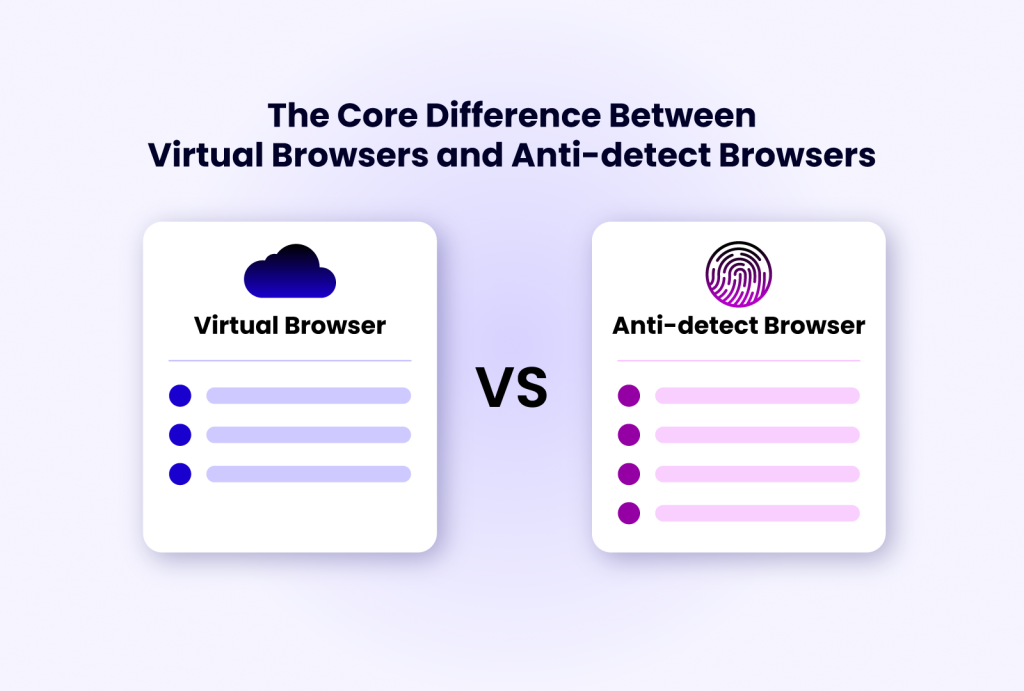
The difference between the two types of browsers is already implicit in their definitions. A virtual browser changes where the browser runs. An anti-detect browser changes how the browser is perceived online.
When you use a virtual browser, you are essentially borrowing someone else’s computer. That computer still has a fixed set of attributes. If that server runs Windows Server 2019 with a specific GPU driver and a default set of fonts, every session launched from it will share that exact signature.
Running your session on a remote server gets it away from your local device, but that alone doesn't create a unique identity. If the fingerprint, IP, and session data stay consistent across every use, a website can still connect the dots between sessions, even if none of them touches your actual laptop.
An antidetect browser like Incogniton is built specifically to address the three vectors websites use to track and correlate users: cookies, network identity, and browser fingerprint. They give you the ability to run different browsing sessions on the same device, yet the website/online platform perceives each of them as coming from different devices.
Put simply: an antidetect browser can function as a virtual browser, since it isolates sessions the same way a virtual browser does. But the same is not true the other way round.
Other Differences
The differences between an anti-detect browser and a virtual browser are quite vivid in the kinds of features that come with each of them.
Because anti-detect browsers are purpose-built, usually for multi-accounting, they come with features like cookie collectors, proxy integrations, bulk-profile creators, and team collaboration features.
Automation is where the gap widens further. A Virtual browser can be scripted with Puppeteer or Playwright, but each instance still needs to be managed on its own. Rotating IPs, swapping user agents, or mimicking human typing patterns quickly runs into the limits of a generic cloud instance.
An antidetect browser plugs directly into automation frameworks through its API and SDK. Developers can script profile creation, proxy attachment, and even human-like input patterns. In Incogniton, for people who don't code, a Synchronizer can broadcast one action across dozens of profiles at once, useful when you need to update a bio field on 30 accounts without doing it by hand 30 times.
Finally, virtual browsers often look cheaper up front: pay per session or per hour, no commitment. But the math changes fast once you need persistent sessions, higher concurrency, or secure team access. Every additional session usually means another license or instance fee, with no unified layer to manage them all.
Incogniton runs on fixed tiers scaled to profile count rather than session time, and there's a free starter package with 10 profiles for the first two months (it steps down to 3 profiles after that unless you upgrade). Paid plans start at $19.99 a month on the entry Starter Plus tier, and higher tiers add the Cookie Collector, Synchronizer, API access, and team seats. That predictability matters for anyone planning to scale. You're not paying for redundant infrastructure per session; you're paying for a platform that reduces the manual work and the ban rate as you grow.
Side-by-Side Comparison: Virtual Browser vs. Antidetect Browser
| Feature | Virtual Browser | Antidetect Browser (e.g., Incogniton) |
| Fingerprint Isolation | Depends on server environment; same fingerprint across all sessions | Unique, configurable fingerprint per profile; consistent across sessions |
| Proxy Integration | Typically one IP per instance; manual reconfiguration | Per-profile proxy assignment, automatic geolocation matching, free built-in proxies |
| Multi-Account Management | High risk of linking if sessions share server fingerprint | Engineered for multi-accounting; airtight profile isolation |
| Automation Support | Limited to browser-level scripting (Puppeteer, Playwright) | Full API/SDK support for Selenium, Puppeteer, Playwright; plus Synchronizer for non-coders |
| Team Collaboration | Rarely includes user roles and permissions | Role-based access, cloud synchronization, audit logs |
| Cookie Management | Basic, often cleared between sessions | Advanced: Cookie Collector, import/export, conversion tools |
| Performance at Scale | Strains under multiple concurrent isolated sessions | Optimized for dozens or hundreds of profiles simultaneously |
| Cost Model | Usually per-hour or per-session | Fixed monthly tiers based on profile count |
Virtual browsers vs Anti-detect browsers: Which One Do You Actually Need?
The answer depends on your primary objective and what you intend to achieve online.
Choose a virtual browser if:
- You're running a temporary session on a shared or public machine
- You want lightweight browsing separation without managing fingerprints
- Your team needs a cloud-accessible browser for a shared purpose
- You only need one browsing identity and aren't managing multiple accounts
- Advanced fingerprint tracking isn't a concern in your workflow
For example, a customer success agent working from a laptop while traveling may use a virtual browser to access internal support dashboards without relying on their local machine. In this case, the focus is convenience and access continuity, so a virtual browser is probably good for them.
An antidetect browser is the better fit when your work involves multiple online identities that need to stay genuinely separate. Choose one if:
- You manage multiple accounts on the same platform (e-commerce, social media, ad accounts) and can't afford cross-account bans
- You need each session to appear as a distinct, real user with a coherent browser fingerprint
- Your workflow demands team collaboration, automation, or the ability to scale from 10 to 1,000 profiles without operational chaos
How to Decide Which One You Need
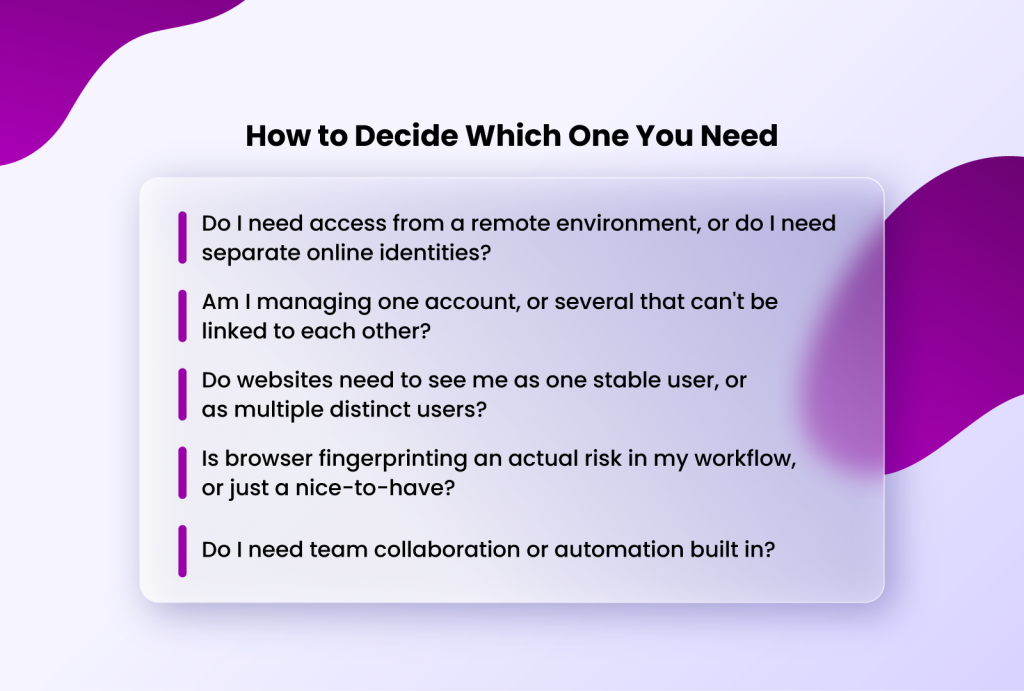
If the lists above still leave you weighing options, run through these:
- Do I need access from a remote environment, or do I need separate online identities?
- Am I managing one account, or several that can't be linked to each other?
- Do websites need to see me as one stable user, or as multiple distinct users?
- Is browser fingerprinting an actual risk in my workflow, or just a nice-to-have?
- Do I need team collaboration or automation built in?
Mostly answering "remote" and "one"? Virtual browser. Mostly answering "separate" and "several"? Antidetect browser.
Conclusion
The difference between a virtual browser and an antidetect browser comes down to purpose. A virtual browser gives you a remote or isolated browsing environment. An antidetect browser gives you true profile separation, with independent storage, proxies, and fingerprints. If you only need remote access, a virtual browser may be enough. But if you manage multiple accounts, rely on privacy-sensitive workflows, or need consistent separation at scale, an antidetect browser like Incogniton is the smarter choice. The right tool is the one that matches your actual workflow, not just the one that sounds more secure.