
There are many anti-detect browsers on the market, but choosing a reliable one is crucial. To help you decide, we’re comparing Incogniton with Morelogin. We’ve previously compared Incogniton against Gologin, Adspower, and VMLogin—now, it’s time to see how it stacks up against Morelogin.
Morelogin, headquartered in Hong Kong, uses machine-learning-driven browser fingerprinting technology and offers flexible pricing. But how does it compare to Incogniton?
In this detailed comparison, we’ll break down their key features, strengths, and weaknesses to help you choose the best anti-detect browser for your needs.
TL:DR: See the table at the end of the article.
Evaluation Criteria
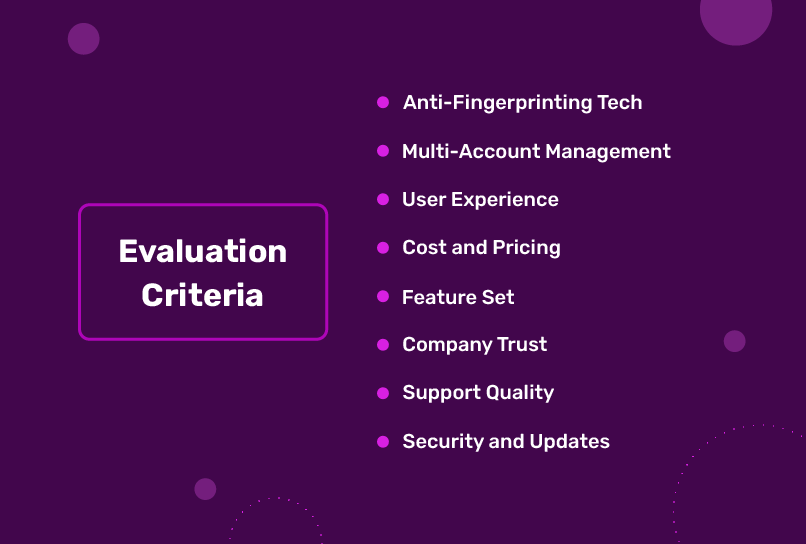
Before we dive into the comparison, let's briefly outline the parameters used to evaluate the browsers. Despite users' differing needs, these factors remain constant and underpin the efficacy of an anti-detect browser.
When assessing both anti-detect browsers, here are the main criteria we evaluated, along with the specific parameters to look for:
- Anti-Fingerprinting Tech: The ability to effectively spoof browser fingerprints to avoid detection and blocking by websites/services. Granular control over fingerprinting settings is important.
- Multi-Account Management: Easy creation and management of multiple browser profiles/online identities for various use cases like marketing campaigns, data collection, etc.
- User Experience: A clean, intuitive interface that is beginner-friendly while providing access to advanced features and configurations.
- Cost and Pricing: Availability of a free starter plan to test features, affordable premium tiers, and the value proposition of each plan based on popular user needs.
- Feature Set: A comprehensive set of features beyond just fingerprint spoofing, such as collaboration tools, proxy management, automation, cookie handling, and cross-platform compatibility.
- Company Trust: The vendor's location, data practices, transparency, and track record - companies in regions with strong data laws may be preferable.
- Support Quality: Timely, knowledgeable technical support across channels like live chat, email, and knowledge bases.
- Security and Updates: Strong security practices like encryption, penetration testing, and frequent updates to protect user data and provide the latest anti-fingerprinting techniques.
In a prior article, we explained in detail how these criteria should influence a user’s choice of anti-detect browsers. Now, with these criteria in mind, let's take a deep dive into how Incogniton and Morelogin stack up.
Incogniton Vs Morelogin
Incogniton and Morelogin are both popular anti-detect browser solutions on the market. Here's how they fare across these key evaluation areas:
Anti-Fingerprinting
Incogniton has powerful anti-fingerprinting capabilities and it is able to prevent a combination of canvas fingerprints and other fingerprinting techniques. This gives users granular control to spoof a wide range of fingerprinting attributes, and create truly unique browser fingerprints for each of their browsing profiles.
Its fingerprint randomization engine uses configurable settings to randomize fingerprints across all managed browser profiles on demand easily. You can specify parameters like user agent strings, screen dimensions, platform details, and dozens of other attributes.
Morelogin takes a different approach with what it calls "Canvas Fingerprint Innovation" technology. It claims to use AI algorithms trained on a database of real user fingerprints from around the world to generate realistic, unique canvas fingerprints in real-time.
However, users have less visibility into and control over the underlying fingerprint settings with Morelogin compared to Incogniton. The AI automates the fingerprint generation, leaving fewer options for user customization.
While the genuineness of innovation and the significance of AI in this context has been questioned a few times within the community, Morelogin has held up well when tested with tools like Browserscan and Pixelscan.
Multi-Account Management & Use Cases
Creating, launching, updating, and organizing any number of profiles is a seamless process in Incogniton. Its versatile feature set (more on that in a jiffy) caters to various professional and personal use cases, including research, data scraping, e-commerce and shopping, affiliate marketing, social media management, crypto airdrop hunting, and many more.
Morelogin also has multi-account management capabilities, allowing you to create and save multiple browser profiles.
It now has a “cloud phone” profile integration. This means you can create profiles that would simulate real mobile behavior. These profiles can also be synchronized. This feature is especially useful for users like social media managers and marketers who need mobile environments for app-specific tasks.
However, Incogniton has the edge when it comes to scaling and advanced use case support. Morelogin's tools are somewhat more limited for power users.
Cost & Pricing
Incogniton offers a free plan with 10 browser profiles to get started risk-free. Its premium paid plans come with monthly and annual subscriptions available to suit different budgets and needs.
Incogniton offers 4 pricing plans:
- Starter - free, up to 10 browser profiles, regular support.
- Entrepreneur - $29.99/month, up to 50 browser profiles, no team member seats available.
- Professional - $79.99/month, up to 150 browser profiles, 3 team member seats available.
- Multinational - $149.99/month, up to 500 browser profiles, 10 team member seats available.
Compared to Incogniton’s fixed plans, Morelogin offers a customizable pro pla. The base plan starts at $9 per month and includes 10 browser profiles and 2 users. For 100 profiles and 2 users, it is $35 per month. For 400 profiles and 10 team members, it is $120 per month.
All in all, both Incogniton and Morelogin provide free plans along with various premium subscription tiers to unlock additional features and capabilities. And while the paid plans are similar, there is a staggering difference in the free plans.
Incogniton’s free plan is 5x better than Morelogin’s, offering 10 free browser profiles to Morelogin’s 2 profiles. In fact, Morelogin’s 9$ a-month plan offers the same number of browser profiles(10) as Incogniton’s free starter pack.
Although Incogniton’s free plan does not include Profile transfer and Team collaboration features, one could argue those aren’t necessarily beginner features, particularly since the trade-off is 5x more browser profiles.
User Experience
A clean, modern user interface is a strength for both Incogniton and Morelogin. However, Incogniton gets higher marks for intuitive user experience and ease of use.
Everything from creating and managing profiles to configuring fingerprint settings and automation tools is logically organized in Incogniton's interface. The learning curve is minimal even for non-technical users new to anti-detect browsers.
Morelogin's user interface is cool and usable but has more room for improvement. Some of its basic features are tucked far away, making it slightly unfriendly for users. For instance, adding proxies to browser profiles is a fairly difficult process for a new user, as some reviewers have pointed out.
Getting started with Incogniton and Morelogin is straightforward. You will download both browsers from their official websites, (Incogniton.com and Morelogin.com). You will find an option to download the installation file for your specific operating system (Windows or macOS).
You install the browsers following the on-screen instructions, and then launch them and start creating and managing browser profiles. You’d have to create an account if you don’t have one.
Feature Set
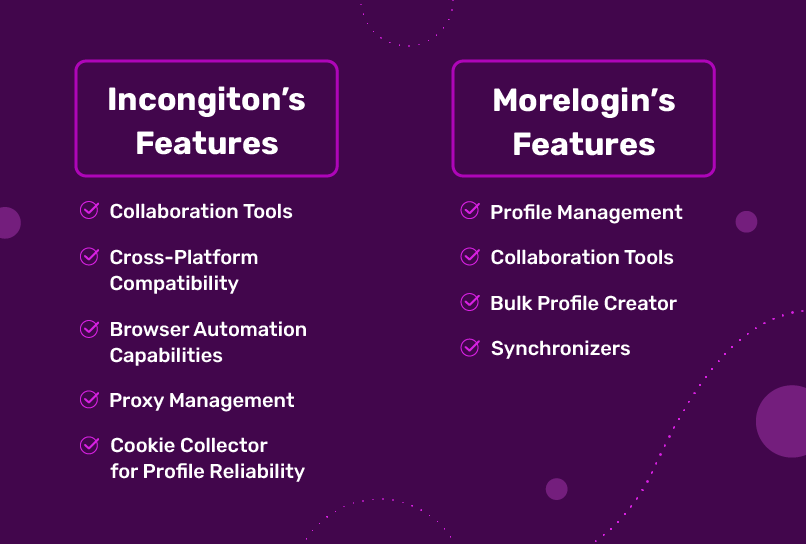
Both browsers are packed with relevant features for an anti-detect browser
Incongiton’s features include:
- collaboration tools,
- cross-platform compatibility,
- proxy management,
- browser automation capabilities (synchronizers, and Selenium integration),
- and its standout Cookie collector for profile reliability.
Morelogin also covers core anti-detect functionality, including:
- profile management,
- Collaboration tools,
- bulk profile creator,
- and synchronizers.
However, it lacks many of Incogniton's standout features like automation, cookie management, a built-in proxy management solution, and more.
Company Trust
Headquartered in Amsterdam, the Netherlands, Incogniton operates under stringent European data regulations like GDPR. This offers peace of mind about data privacy and security.
However, Morelogin operating out of Hong Kong, China, raises data privacy, regulation, and security concerns among users and businesses, depending on their use cases.
Support Quality
Incogniton consistently gets top marks for its responsive and knowledgeable customer support. Their customer support gets top ratings for response times and resolution quality across channels like via email, In-app chat, and an extensive knowledge base.
While Morelogin does offer support channels (email, Telegram, WhatsApp, and Facebook), many users report inconsistent response times and quality of support compared to Incogniton.
Data Security & Updates
Due to the sensitive nature of anti-detect browsers, security and keeping up with the latest updates is paramount.
Security is a clear priority for Incogniton. Its privacy policy explains how the developer team collects and processes user data. When it comes to personal data protection, Incogniton has a developed system of organizational and technical security measures in place. The software also receives frequent updates to patch vulnerabilities and integrate new anti-fingerprinting techniques.
There is less transparency around Morelogin's security practices and update frequency.
Comparison Between Incogniton and Morelogin
| Evaluation Criteria | INCOGNITON | MORELOGIN |
| Operating systems compatibility | Windows, macOS | Windows, macOS, |
| Anti-Fingerprinting Tech | Advanced, offers granular control over parameters | Standard, but no granular control |
| Multi-Accounting and Use Case |
|
|
| User Experience and Ease of Use | Beginner Friendly | Beginner Friendly |
| Feature Set |
1. Cookie collector 2. Proxy management 3. Bulk Profile Creator 5. Selenium and Pupeteer integration |
|
| Company Trust and Location | The Netherlands, Amsterdam (Europe) | Hong Kong, China (Asia) |
| Quality of Support | Multiple channels, quick response times | Multiple Channels, Relatively slow response times |
| Security and Ongoing Updates | Clear data security practices | Unclear data management system. |
| Cost & Pricing | Robust starter and premium plans | Limited but customizable plans |
The Bottom Line: Incogniton Holds the Edge in 2024
When weighing the pros and cons of Incogniton vs Morelogin as an option for your needs, Incogniton emerges as the superior choice for most use cases in 2024. The browser covers all the essential bases you need - cookie automation, bulk profile creation, synchronization, proxy management, top-notch support, and more.
While Morelogin is a legitimate alternative that may have slightly more affordable premium plans, Incogniton’s generous free plan and feature pool make it the clear winner.
There are also data privacy considerations to weigh when using a Chinese-based software platform like Morelogin vs a European company like Incogniton which operates under stricter data regulations like GDPR.
Of course, your specific needs and use case will play a role in determining which browser profile manager is the ideal fit. But for most businesses, online marketers, and technology professionals in 2024, Incogniton's versatile feature set, standout automation capabilities, and unbeatable support make it the obvious choice over Morelogin.
Conclusion
When it’s all said and done, the best way to determine which anti-detect browser is right for you is to test them yourself. That way you get a clear picture of what we’re communicating here? Thankfully, both Incogniton and Morelogin offer free plans to get started risk-free.
We recommend signing up for both free trials to explore the interfaces, create some profiles, and run a few tests.