
A proxy can hide your IP address, but that does not necessarily mean your setup is leak-free. Your browser can expose other information through WebRTC, DNS requests, geolocation, timezone, language settings, and other browser signals.
This matters if you use proxies for account management, ad verification, market research, e-commerce, or accessing location-specific content. A leak can expose your real network information or create inconsistencies that make separate browser profiles easier to link.
The good news is that proxy leaks are relatively easy to test. In this guide, we’ll explain what a proxy leak is, what causes it, how to test for one, and how to fix common problems in Incogniton.
What Is a Proxy Leak?
A proxy acts as an intermediary between your device and the websites you visit. Ideally, the website sees the proxy’s IP address rather than your real one.
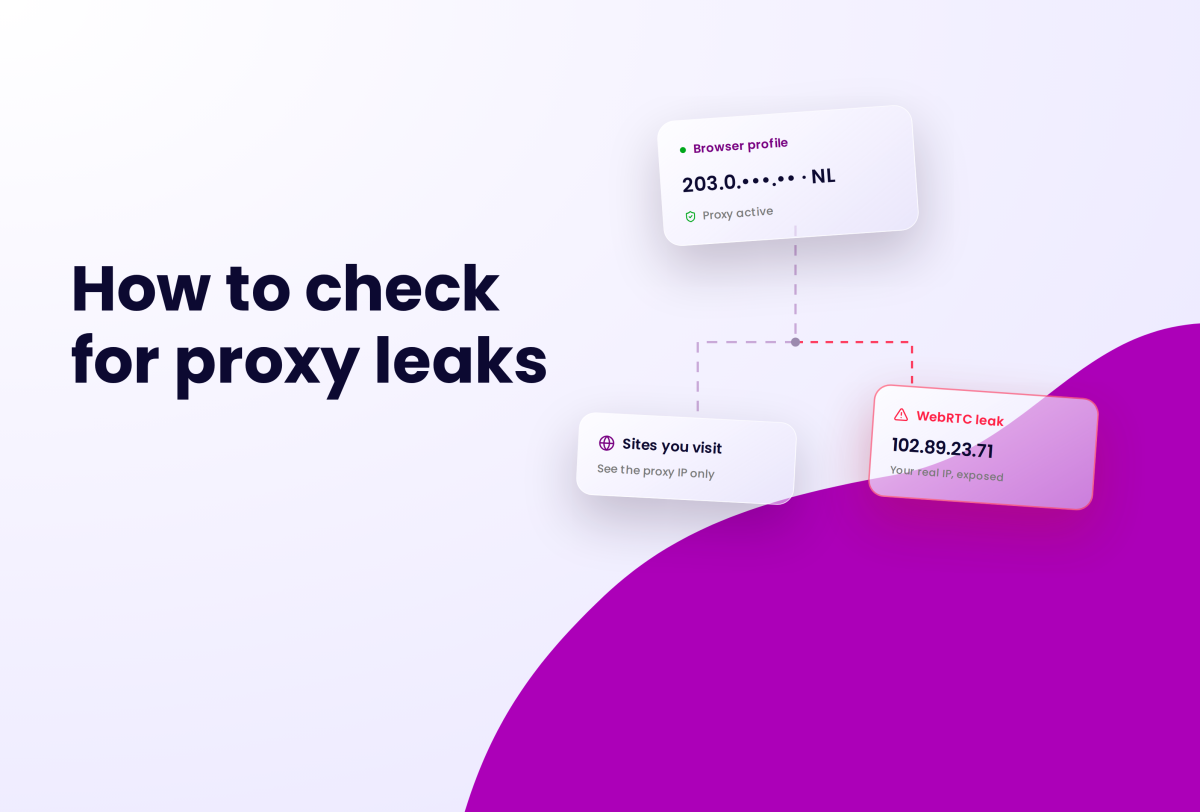
A proxy leak happens when information that should remain behind the proxy is exposed to a website or another network service. This information is usually your real public or local IP address and by extension, most times, your actual location.
A proxy can therefore appear to be working while still exposing information that makes your connection identifiable.
This is particularly important when using an anti-detect browser such as Incogniton to keep browser profiles separate. A leak or obvious fingerprint mismatch can undermine that separation.
Common Signs of a Proxy Leak
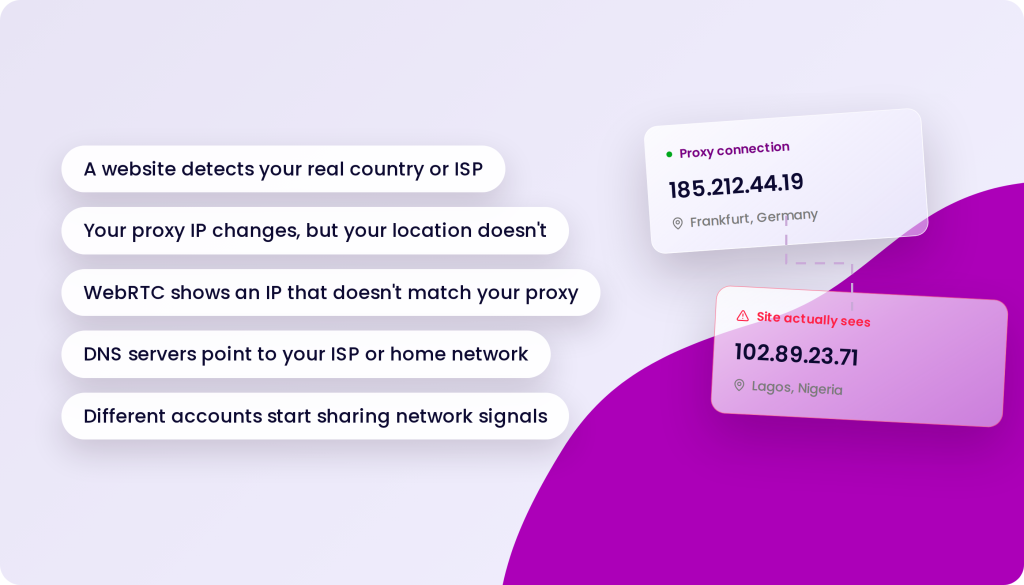
You may have a leak if:
- A website detects your real country or ISP
- Your proxy IP changes but your location remains tied to your actual location
- WebRTC displays an IP that does not match your proxy
- DNS servers point to your ISP or home network
- Different accounts begin showing similar network or browser characteristics
- Websites immediately flag a login as suspicious
One of these signs does not necessarily prove that you have a proxy leak. It may also indicate a configuration or fingerprint mismatch.
Why Do Proxy Leaks Happen?
Proxy leaks usually come from a few common sources.
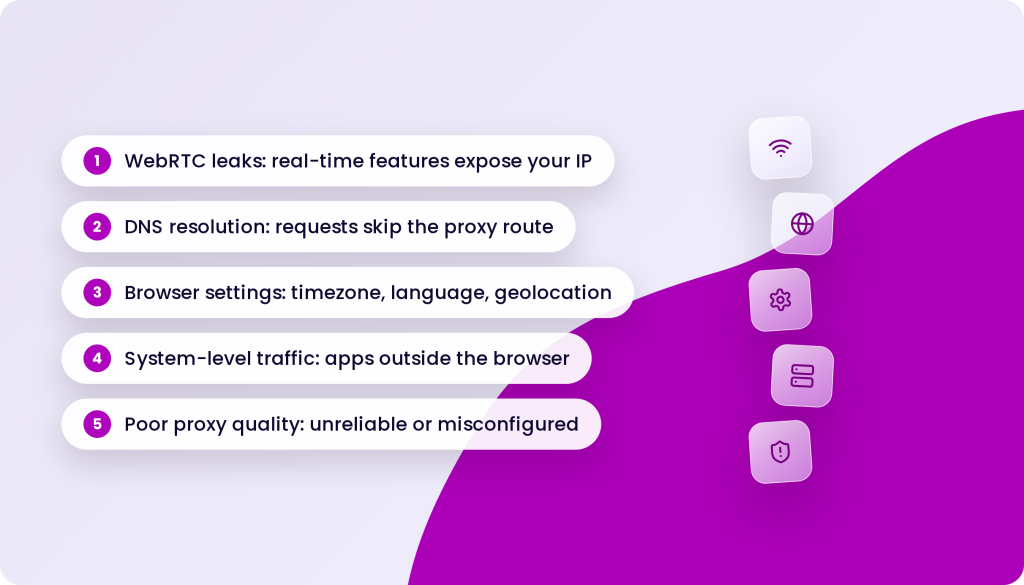
1. WebRTC Leaks
WebRTC (Web Real-Time Communication) enables browsers to support features such as video calls and peer-to-peer connections. It can also expose network information that is not covered by a standard proxy connection.
If WebRTC is not properly configured, a website may be able to discover IP information that does not match your proxy IP.
For a deeper explanation, see What Is WebRTC Leakage and How Do You Prevent It?.
2. DNS Resolution
The DNS system is how domain names are translated into IP addresses. If DNS requests are sent through your normal network instead of the expected connection, they can reveal information about your network or browsing activity.
A proxy that correctly handles web traffic does not automatically guarantee that every DNS request follows the same route.
See What Is a DNS Leak? Browser DNS Leak Test & Fix for a more detailed explanation of DNS leaks and how to test them.
3. Browser Settings
Your IP address is only one part of the information websites can observe.
Timezone, language, geolocation, screen characteristics, and other browser attributes can also contribute to your browser fingerprint. If these signals contradict the location associated with your proxy, the inconsistency can make your setup easier to detect.
For more on the information browsers expose, read What Your Browser Tells Websites About You.
4. System-Level Traffic
This is another common way proxy leaks happen. Depending on whether you implement a device wide proxy connection or just a browser level connection, not every app on device connecting to the internet is covered in a proxy configuration. A program or service operating outside your browser may connect directly to the internet.
If you are troubleshooting a leak, therefore, test the actual browser profile and the services you use rather than assuming that configuring the proxy in one place covers everything.
5. Poor Proxy Quality
Sometimes the problem is the proxy itself. An unreliable or incorrectly configured proxy can cause connection failures, inconsistent locations, or other unexpected behaviour. If the same proxy exposes problems when tested independently of Incogniton, contact the proxy provider.
How to Test for Proxy Leaks
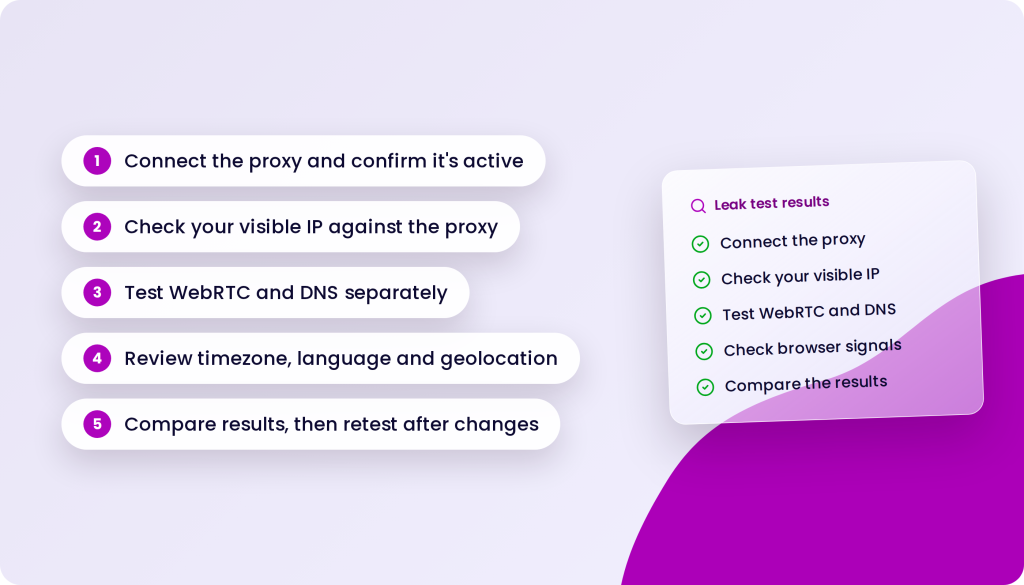
Testing should be part of your setup process, especially when you changing proxies.
Step 1: Connect the Proxy
Add the proxy to your browser and confirm that the connection is active.
In Incogniton, you can use the proxy check when adding proxy details to verify the connection.
Step 2: Check Your Visible IP
Use an IP-checking service such as Whoer to confirm the IP address and approximate location visible to websites. The result should correspond to the proxy details you selected rather than your normal connection.
Step 3: Test WebRTC and DNS
Run separate WebRTC and DNS tests. Do not rely solely on a basic IP checker.
Look for:
- Your real public IP
- Your local IP, where applicable
- DNS servers associated with your normal connection
- Any location that contradicts the proxy
Step 4: Check Browser Signals
Review your timezone, language, geolocation, and other available fingerprint information.
For a more detailed fingerprint check, you can use BrowserLeaks.
Step 5: Compare the Results
Ask four basic questions:
- Does the visible IP match the proxy?
- Does the location make sense for that IP?
- Is any real or local network information exposed?
- Are the browser signals consistent with the proxy location?
Step 6: Retest After Making Changes
If you change your WebRTC, DNS, geolocation, or other settings, run the tests again.
A configuration is not confirmed simply because you changed a setting. Test the result.
How to Fix Proxy Leaks
Once you identify the source of a leak, the fix depends on what is exposing your information.
Use a Reliable Proxy Provider
Proxy quality affects both stability and the reliability of your setup. The right proxy type depends on what you are doing, your required location, and how much stability you need.
If the same proxy continues to expose problems when tested independently of your browser setup, contact the provider or switch to a more reliable provider.
Check WebRTC Settings
If a WebRTC test exposes an IP address that does not match your proxy, review your browser's WebRTC configuration.
The appropriate setting depends on your browser and workflow, but the important thing is to prevent WebRTC from exposing network information that contradicts your proxy. Test again after making changes.
Check System-Level Traffic
A browser proxy does not necessarily route traffic from every application on your device. Other applications, background services, or browser features may connect directly to the internet.
If you need traffic from other applications to use the same proxy, you may need a system-wide proxy configuration or another network-level solution. If you only need the proxy for browser activity, make sure you are testing the browser profile itself and understand which traffic is actually covered by its proxy settings.
This distinction is important: a proxy working correctly inside your browser does not mean that every connection from your device is using that proxy.
Configuring Incogniton to Prevent Proxy Leaks
Testing tells you whether a leak exists; configuration helps prevent one from occurring in the first place.
Incogniton provides granular browser, privacy, and network settings that allow users to control how individual profiles handle information such as IP-related data, WebRTC, geolocation, and other browser characteristics.
This is useful when working with multiple browser profiles because settings can be managed at the profile level rather than relying entirely on the configuration of the underlying device.
With Incogniton, you set your WebRTC details, DNS resolution parameters, geolocation, and timezone and other details that you need to ensure your proxy behaves exactly how you want it.
For instance, when setting up your browser profile, you can enable the "Fill WebRTC public IP based on the IP" option. This forces the spoofed WebRTC value to match your proxy’s external IP dynamically.
For users who require an extra layer of assurance, Incogniton allows you to enable a custom DNS server. Instead of relying on the system default (which might leak to your ISP), you can route all DNS queries through a private, non-logging DNS service.
This is an advanced feature; most leaks are solved by the WebRTC and Geolocation settings. However, if you are on a network with aggressive monitoring, pinning a custom DNS in the profile settings ensures that even if the proxy wobbles, your domain lookups don't betray your intent.