
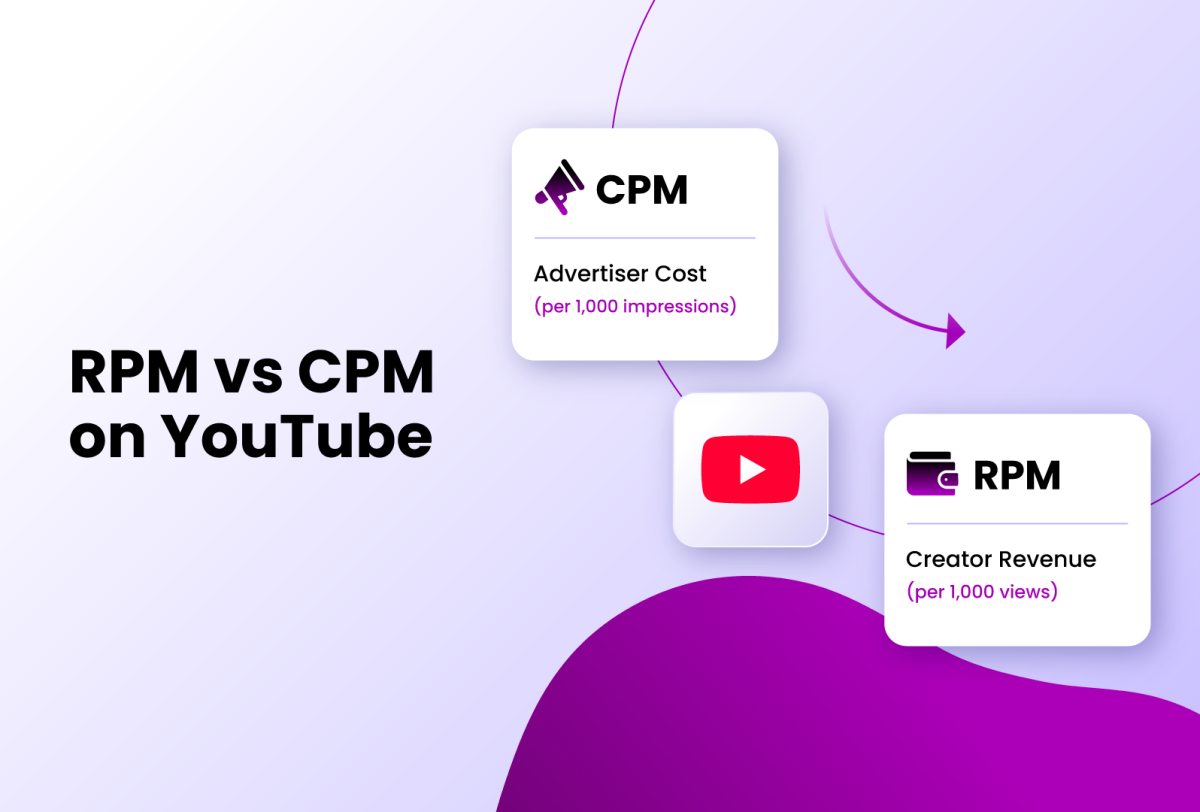

RPM vs CPM is one of the most misunderstood comparisons among creators trying to turn a channel into a reliable income stream. With YouTube now reaching more than 2.5 billion monthly active users and paying out billions to creators each year, knowing which metric to track can be the difference between a side hustle and a sustainable business.
Many emerging YouTubers fixate on CPM (Cost Per Mille), the advertiser-facing number, without realizing their actual take-home revenue is a completely different figure: RPM. If you've ever wondered why your CPM reads $15 but your earnings feel like $2 per thousand views, you're not alone.
In this post, we’ll unpack exactly what RPM and CPM mean, why they diverge so dramatically, and, most importantly, which metric you should focus on to grow your YouTube income.
Understanding CPM on YouTube
CPM stands for Cost Per Mille (“mille” being Latin for thousand). It represents how much an advertiser pays each time their ad is shown 1,000 times on a video. This is a gross metric, meaning it’s the raw amount before any cuts or adjustments. On YouTube, CPM is reported in two flavours:
- YouTube Advertiser CPM: The total amount advertisers pay for 1,000 ad impressions across your videos. For example, if advertisers are paying a $20 CPM, they’re spending about $20 for every 1,000 monetized ad impressions served on your content.
- Playback-Based CPM: The amount earned per 1,000 video views when at least one ad is shown (regardless of how many ads appear within that view).
Which one appears in your analytics depends on whether you’re looking at a specific ad format or at overall video monetization.
The key takeaway is that CPM reflects the advertiser’s side of the transaction. A high CPM usually indicates that advertisers consider your audience valuable. Finance, business, software, and investing channels often have higher CPMs than gaming, entertainment, or lifestyle content.
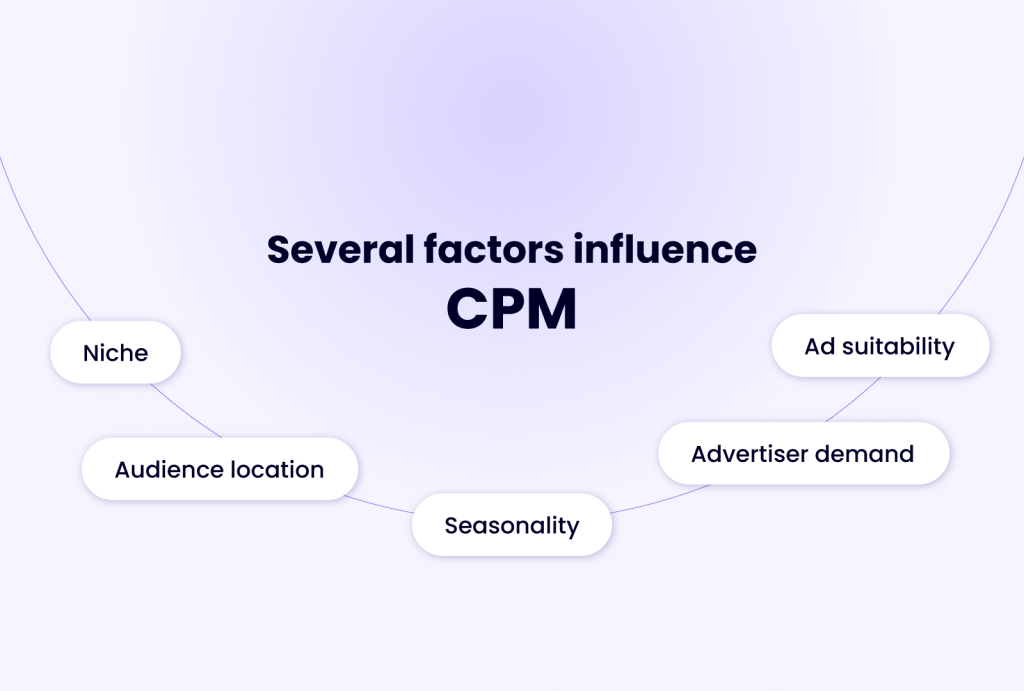
Several factors influence CPM:
- Niche (finance and business typically pay more)
- Audience location (U.S., Canada, and the UK usually have higher CPMs)
- Seasonality (CPMs often rise during Q4)
- Advertiser demand
- Ad suitability
What is RPM on YouTube?
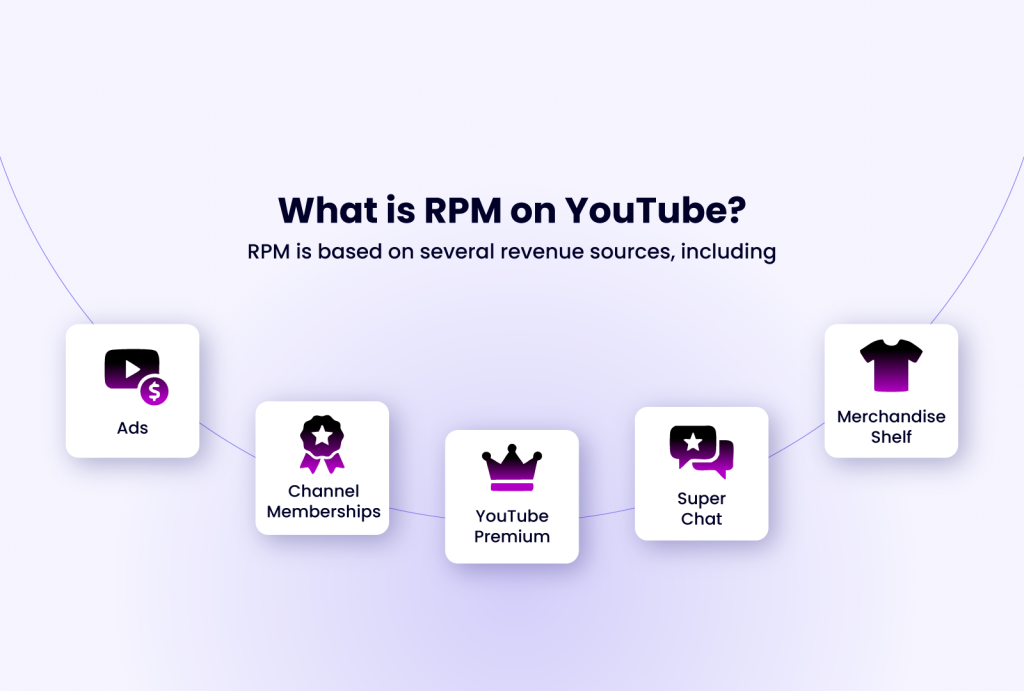
RPM, or Revenue Per Mille, is the metric that actually tells you how much money you’re earning per 1,000 video views. YouTube defines it as:
a metric that represents how much money you've earned per 1,000 video views. RPM is based on several revenue sources, including: ads, channel memberships, YouTube Premium revenue, Super Chat, and Super Stickers.
Unlike CPM, RPM is a net metric that includes all monetisation sources – not just ads but also YouTube Premium revenue, channel memberships, Super Thanks, and Super Chat – minus YouTube’s 45% cut of ad revenue (or the 30% fee on other transactions).
RPM accounts for:
- All views, including those that didn’t show an ad (e.g., views from users with ad blockers, YouTube Premium, or non-monetizable traffic).
- YouTube’s revenue share. Out of the advertiser’s CPM, YouTube takes nearly half; the remainder is split between the creator and any music licensing rights holders for videos that use copyrighted music.
So if your video has a CPM of 10 and YouTube serves 500 monetized ad impressions from 1,000 total views,you might only see an RPM of 10 and YouTube serves 500 monetized ad impressions from 1,000 total views,you might only see an RPM of $3–$4.
For creators, RPM is usually the more useful metric because it answers the question that matters most: “How much money did I actually make from my views?”
How CPM Turns Into RPM
Picture YouTube's monetisation system as a pipe with several leaks along the way. An advertiser spends $20 for 1,000 impressions, and YouTube takes its share before anything reaches you. Then, not every view even triggers an ad: some viewers run ad blockers, some have Premium, some are in regions with thin ad demand, and some simply don't get served one for that view. Even if only 600 of 1,000 views generated an ad impression, RPM still gets divided across all 1,000 views, not just the 600 that paid.
By the time revenue passes through every stage, that $20 CPM might land as a $6 RPM. Nothing mysterious happened to the money. It just passed through several stops before it became your revenue, and each one takes a bite or dilutes the total.
Which Metric Should You Actually Track?
The short answer: RPM is your north star as a creator. Here’s why:
- RPM matches your bank account. At the end of the month, the revenue you receive from YouTube aligns with your RPM, not your CPM.
- RPM reflects all revenue sources. If you actively use Super Thanks or channel memberships, those are invisible in CPM. RPM shows the blended value of all monetisation.
- RPM helps you compare video performance honestly. Two videos could have the same CPM, but if one has a higher audience retention and longer watch time – resulting in more mid-roll ads – its RPM will be significantly higher. You’d never know by looking at CPM alone.
However, CPM still has a role for niche analysis. If you’re deciding between two content verticals, a higher average CPM in one niche suggests more advertiser interest, which can lead to a higher RPM ceiling. But you must then factor in audience demographics, engagement, and ad suitability to predict your actual RPM.
The beauty of YouTube Analytics is that both numbers are available; use CPM for directional insight and RPM for performance measurement.
READ MORE: YouTube Unblocked Browsing with Incogniton
Common Misconceptions About RPM and CPM
"A high CPM means high earnings."
Not necessarily. A travel vlog with a modest CPM but strong ad fill and high retention can out earn a finance channel with a much higher CPM but poor ad delivery.
"RPM includes everything you earn."
It doesn't. RPM only reflects revenue that runs through YouTube's own systems. Sponsorships, affiliate income, and merch sales sit entirely outside it, even though they might be your channel's biggest earners.
"You can control your CPM directly."
You can influence it through niche selection and audience targeting, but advertisers ultimately set the price through demand. RPM is far more within your control, since it responds to watch time, retention, and how you structure ad breaks.
"Only monetized creators can see these numbers."
Both metrics only populate once you're accepted into the YouTube Partner Program. If you're not there yet, understanding how they work still helps you plan content that will convert into real revenue later.
"Shorts and long-form videos earn the same way."
They don't. Shorts pull from a separate revenue pool funded by a share of ad income and music licensing costs, then split among creators based on views. RPM for Shorts is typically calculated and reported separately from long-form RPM, so comparing the two directly can be misleading.
Conclusion
In summary, RPM and CPM are two sides of the same coin, but only one tells you what you’re actually taking home. CPM tells you what advertisers are willing to pay. RPM tells you what actually showed up in your account. Once you stop confusing the two, the rest of your channel strategy gets a lot clearer: build for retention so more ads can run, diversify your revenue beyond ads alone, and check RPM first every time you're deciding whether a video or a niche is actually working. CPM can point you toward a promising direction. RPM is what proves you got there.
If you manage more than one YouTube channel, comparing RPM and CPM across channels can also help you identify which content strategy is generating the strongest returns. (By the way, if you're growing several channels, this guide on managing multiple YouTube channels safely from one device is a useful next read)
Ultimately, don't chase the highest CPM screenshot. Focus on building a channel that consistently produces a strong RPM, because that's the metric that reflects the money you're actually making.