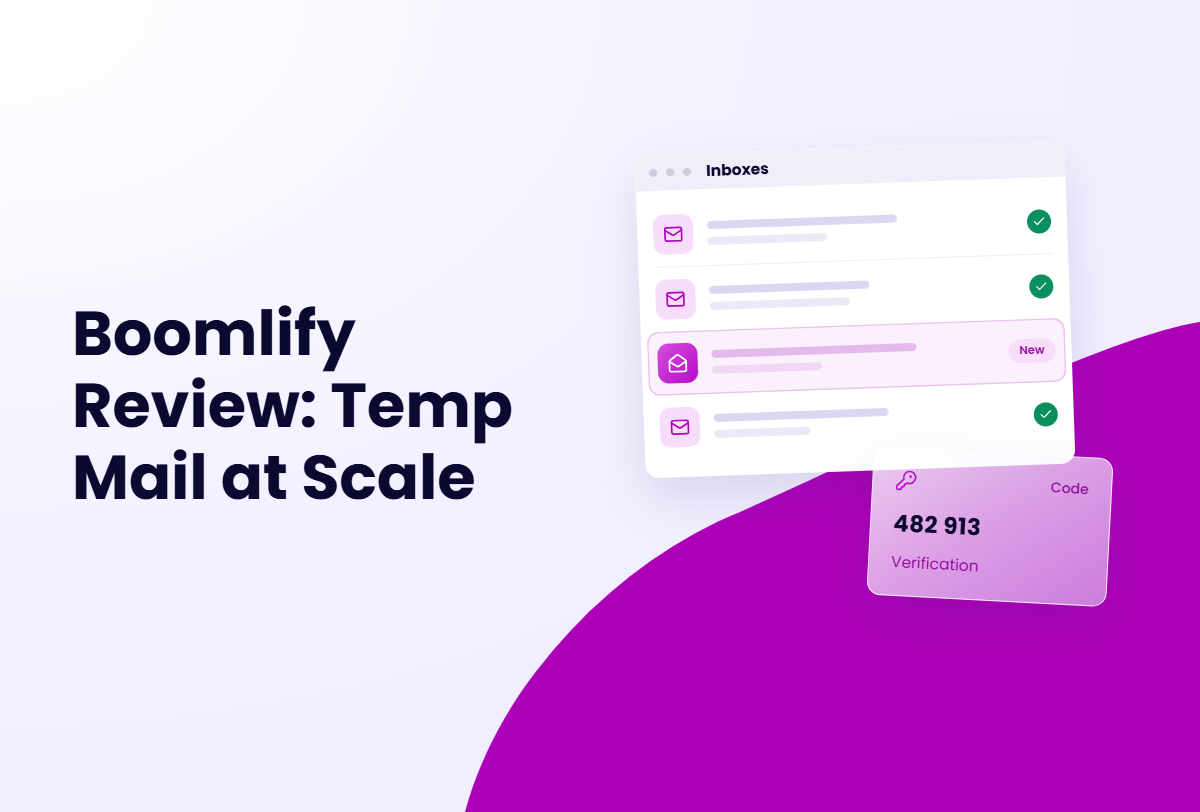

A disposable email address takes seconds to generate. Managing 50 or 100 inboxes without losing track of messages, verification codes, or expiry dates is a different problem entirely. The more inboxes you manage, the harder it becomes to keep them organized, retrieve the right messages, and ensure each address remains accessible when you need it.
Boomlify approaches temporary email as an inbox-management problem, not just an address-generation one. It lets you create addresses on demand, manage hundreds of inboxes from one dashboard, use custom domains, and access inboxes programmatically through an API. You can also keep notes, manage 2FA codes, and control how long inboxes remain active.
This Boomlify review examines how well those features work in practice, what the free and paid plans include, and where the service falls short. We'll also look at its API credit system, inbox and message retention limits, and the situations where a dedicated email service makes more sense.
Quick answer: Boomlify is a temporary email service designed for managing multiple inboxes from one dashboard. Its free plan includes 150 mailboxes, up to 50 new mailboxes per day, 60-day inbox validity, and API access at 60 requests per minute. You also get 50 free API credits daily. Paid plans range from $4.99 to $89.99 per month.
At a glance
At a glance
- Best for: Managing multiple temporary inboxes through one dashboard, with API access for automation.
- Free plan: Includes 150 mailboxes, 50 new mailboxes per day, 60-day inbox validity, and 50 free API credits daily.
- Paid plans: Start at $4.99/month and go up to $89.99/month, with higher mailbox limits, longer retention, and increased API limits.
- Main limitation: Temporary inboxes aren't suitable for accounts that require reliable long-term email access, and public temp-mail domains may be blocked by some services.
The email address is the fourth linking signal
Fingerprint, IP, and session state get all the attention because they are the hard part. The email address gets treated as an afterthought, which is exactly why it becomes the leak.
Registration is the moment a platform attaches a durable identifier to a profile, and the address is usually the most stable identifier in the whole stack. Proxies rotate, fingerprints can be rebuilt, but an inbox that has received an account's verification mail and every password reset since is a very strong link.
In an antidetect browser like Incogniton, each profile already gets its own fingerprint, proxy, and cookies. The inbox is the one piece that usually sits outside that setup, shared across profiles or reused from an old account, and that’s where the separation breaks.
There is a blocklist dimension too. Signup forms increasingly reject domains known for disposable mail, and some platforms score the address before the account does anything at all. A public temp mail domain that other people are signing up with at the same time is not a neutral choice when the account is supposed to look ordinary.
One address per profile is the rule, which means the inbox deserves the same planning as the browser. The rest of this review is about whether Boomlify holds up under that rule at scale.
What Boomlify actually is
The first useful detail is what does not happen: there is no registration before you have an address. Guest mode generates an inbox the moment the page loads, and the name can be chosen instead of accepted at random.
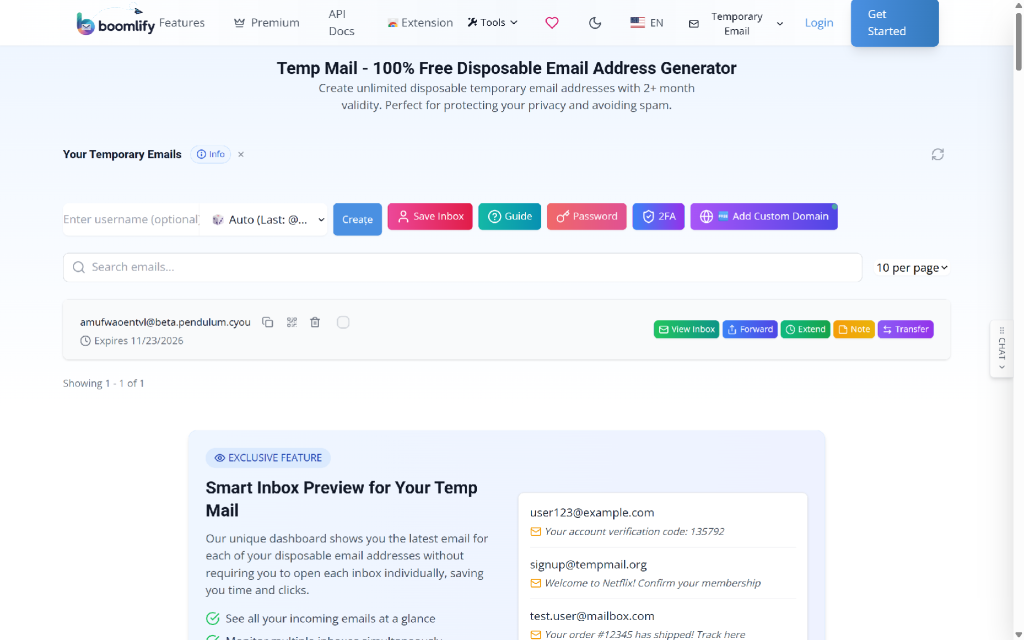
An inbox that exists the moment the generator loads, with no sign-up step in the way
Pick a name, pick a domain, and the address is live. Incoming mail appears within seconds, and every inbox supports the expected moves: read, reply from inside, extend the expiry, share the address as a QR code.
What changes things for account work is what happens next. Link that guest session to an account, and every inbox moves under a single dashboard, where it stays across browsers and devices. That is the line between a generator and a manager: the twentieth inbox is as easy to find as the first, and the list can be searched and cleaned in bulk.
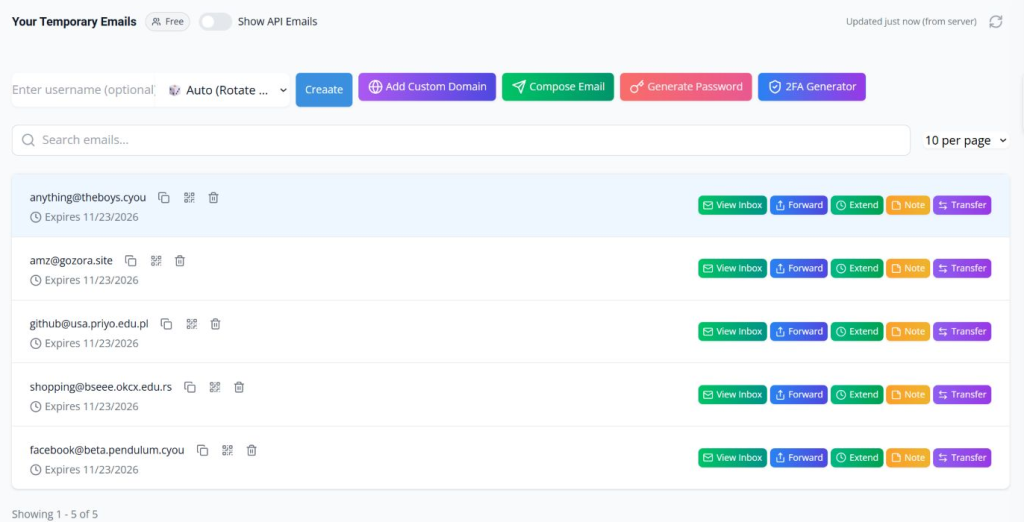
Every inbox in one dashboard, with validity and status visible at a glance
Underneath, it is the familiar temporary mail model: an address that takes signups and resets without touching your real inbox, with the management layer most services never build.
Built for many inboxes, not one
Three features carry the daily workload
Smart inbox preview. The dashboard shows incoming mail from every inbox in one view, so a verification code or a payout notice can be spotted without opening anything. When dozens of inboxes are alive at once, this is the difference between a one-minute check and losing an afternoon to tab-hopping.
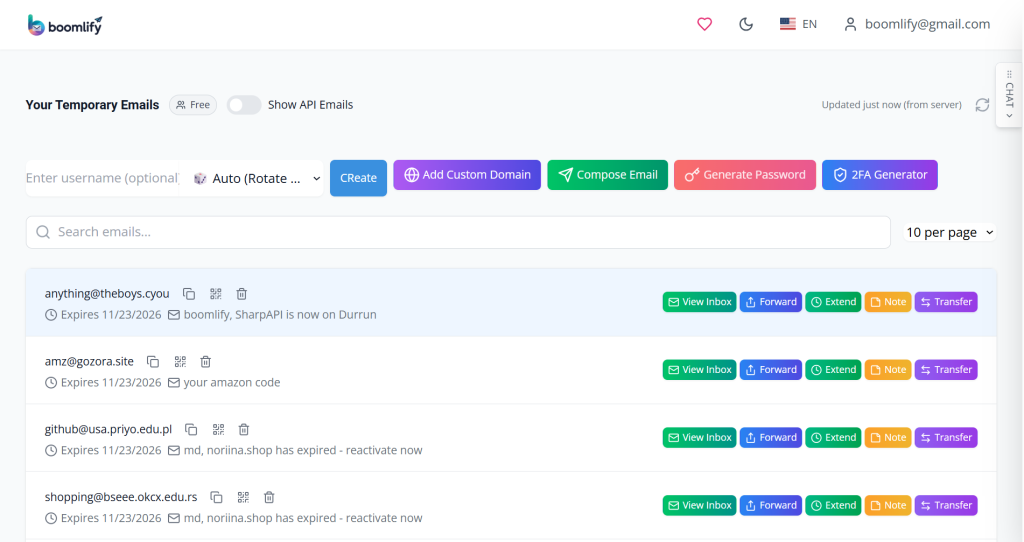
Previews across every inbox, without opening each one
Bulk operations. Select a group of inboxes and apply one action: delete, extend, enable Telegram forwarding, or hand them to another Boomlify account. Transfers work for a single inbox or hundreds at once and leave a history entry, which matters when a VA or a client takes over a set of addresses mid-project.
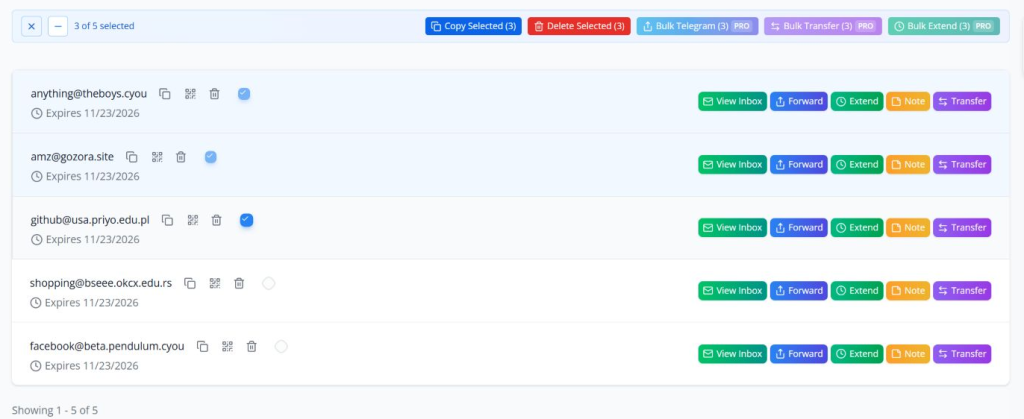
One action applied to a whole selection of inboxes
Pre-receive capture. On paid plans, mail can be caught before the inbox exists: whitelist trusted sender domains, and messages are held until you claim an address, any time within 24 hours, up to 200 at once. Signup flows that fire off an email the moment a form is submitted stop being a race against your own inbox creation.
Custom domains: when the address has to look ordinary
The honest limitation of every temporary email service is the domain. A shared address can be refused by a signup form in seconds because its domain sits on a public list, and nothing about careful browsing changes that.
Boomlify's answer is to put a domain you own in front of the mailboxes. Attach the domain, point its records at the service, and new inboxes are created on it. This is not a paid extra: the free plan includes two custom domains per account, and each one takes 20 new mailboxes a day and holds 100 over its lifetime. Paid tiers raise the ceiling from three domains on Basic to 60 on Elite and unlimited at the top.
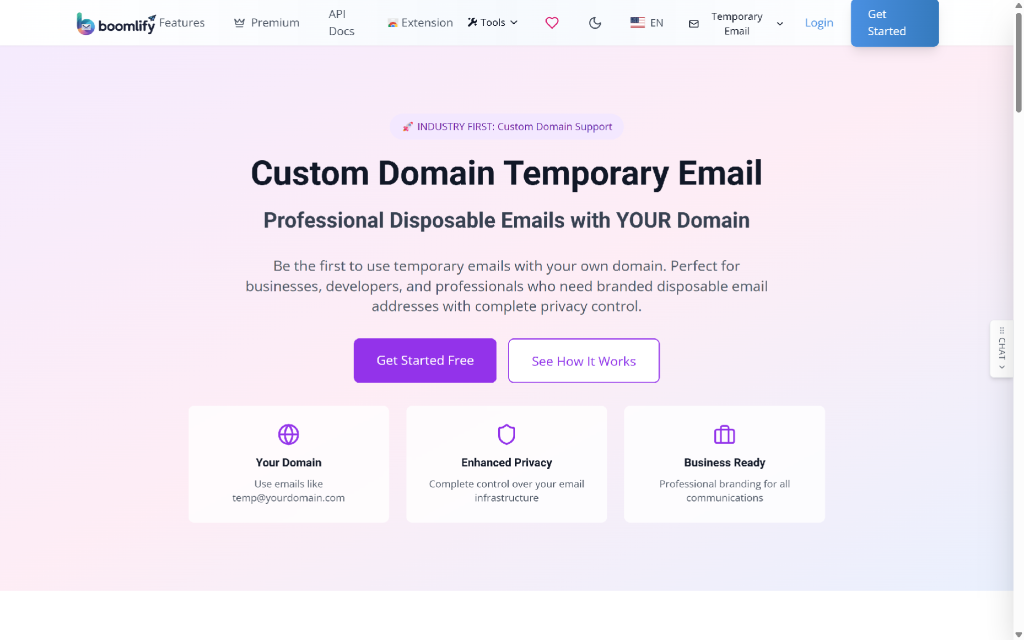
Attaching a domain you own, so inboxes stop sharing a public one
The commercial effect is bigger than it looks. Forms that instantly reject a shared disposable domain treat a custom domain temp mail address like any other business address, because from the outside that is exactly what it is. For agency work, where accounts carry client names and long-term value, this is the feature that decides whether the rest of the review matters. Curated premium domains, for the days a form has already burned through the public pool you were using, come with the paid tiers.
Lifespan: match the inbox to the account
The most common way an inbox costs someone an account has nothing to do with blocklists. It is the calendar. A mailbox that expires before the account needs recovery turns a working login into a dead end: the platform sends the reset link, and the address that should receive it no longer exists.
Validity is where the plans separate. Free inboxes live 60 days; paid tiers stretch from 90 days to 365, and expiry can be extended manually on paid plans when a project runs long. There are two clocks to watch, not one. Inbox validity is how long the address exists; message storage is how long incoming mail stays readable. On the free tier those are 60 and 14 days, which means the inbox outlives the mail inside it. Anything that might matter later should be forwarded or read before that window closes.
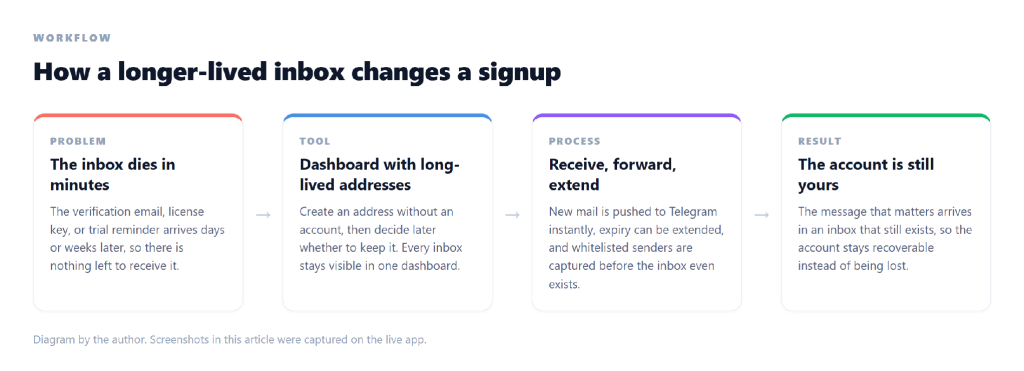
How inbox lifespan changes the outcome of a signup
If an address genuinely needs to exist forever, that exists too, but only through the API: a permanent mailbox costs 15 credits and carries no expiry date at all. For accounts that have to be recoverable years out, it is the cheapest insurance in the product.
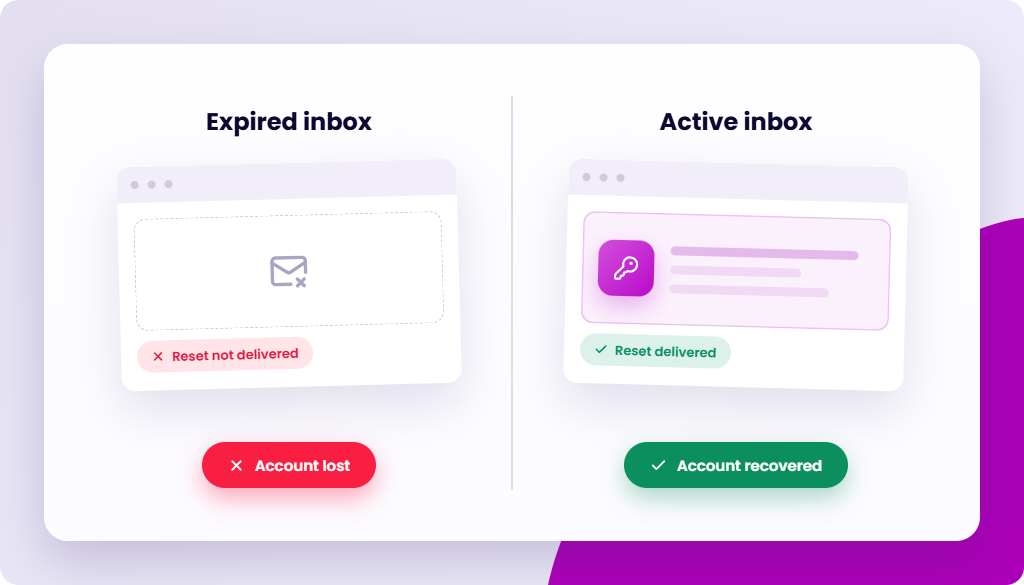
The API, for when clicking stops scaling
Everything so far assumes a human in a browser. Boomlify also exposes the same operations over HTTP: create an inbox with a chosen lifetime, list it, read its mail, delete it when done. Every account gets an API key, the free plan included, with 60 requests per minute and 50 credits refilled daily.
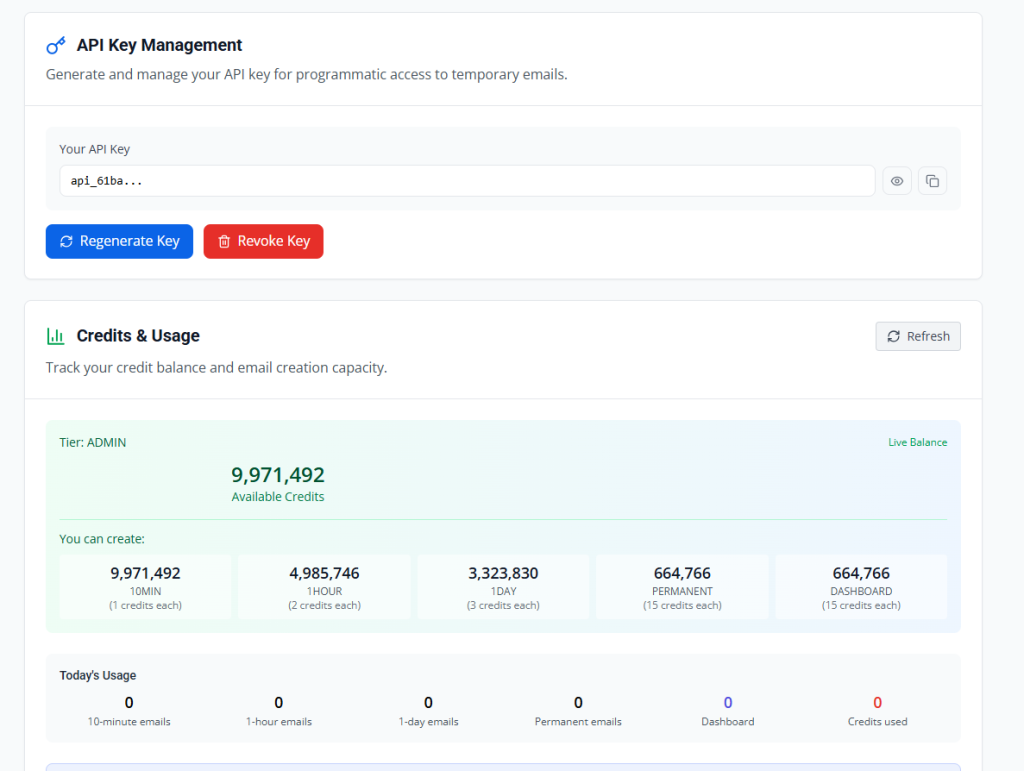
API keys and today's credit usage, both visible in the dashboard
The credit model is the part worth reading twice. Creating a mailbox costs 1 credit for ten minutes, 2 for an hour, 3 for a day, and 15 for permanent. Reading, listing, deleting, renaming, and managing keys are free on every plan, so a polling script costs nothing beyond the boxes it creates, and a thousand short-lived inboxes cost about a dollar. Reaching back into dashboard inboxes through the API is a premium extra with a small per-request credit cost, so automation stays cheapest when it works with mailboxes the API created. That arithmetic is what makes a temp mail API practical for bulk trials, affiliate tooling, or an internal panel that creates accounts on demand. Rate limits rise from 60 requests per minute on free to 3,500 on Elite, and the Unlimited plan removes credits and rate limits entirely.
The extras that keep a stack tidy
2FA in the same dashboard. Every account that survives long enough collects a two-factor secret, and scattering those across a phone and three apps is how handoffs go wrong. Boomlify generates TOTP codes inside the dashboard, scans QR codes, and stores unlimited accounts locally on every plan, with cloud sync that scales with the tier.
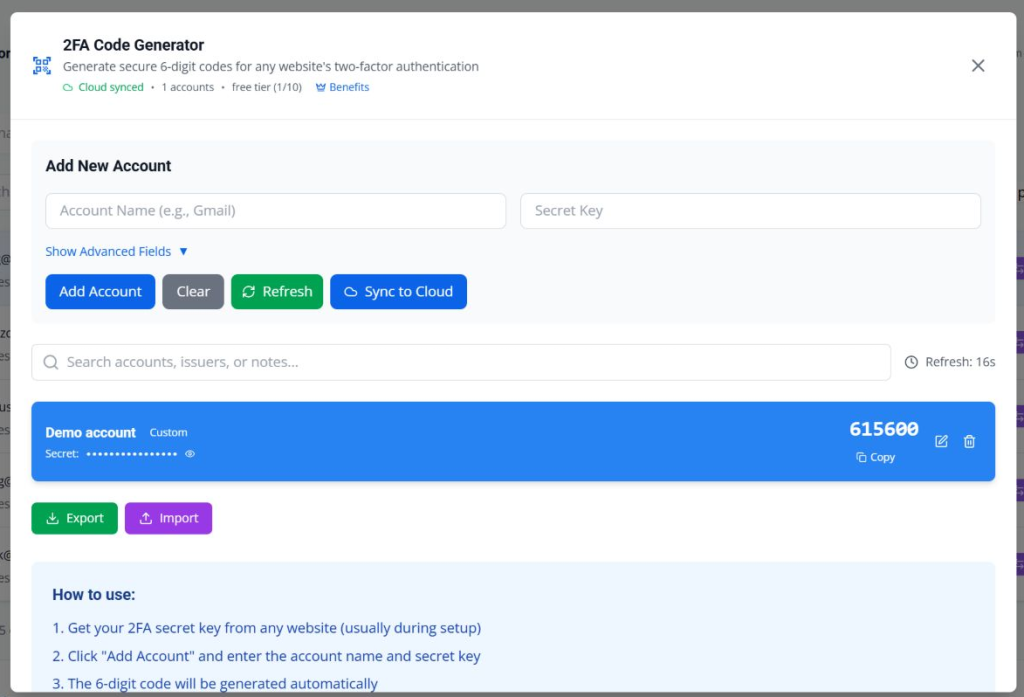
TOTP codes generated next to the inboxes they belong to
Telegram forwarding. Enable it on an inbox and every new message lands in Telegram the moment it arrives. When profiles run on a remote desktop or a server, this removes the check-the-inbox step from the day entirely.
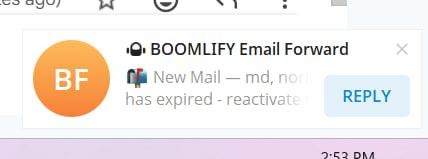
New mail pushed to Telegram as it arrives
Passwords and notes. A generator with a live strength meter sits beside a local vault that stores unlimited passwords, free on every plan, and each inbox carries private notes that sync across devices. Nothing exotic, just fewer reasons to keep account data in a spreadsheet.
Smaller things worth knowing. Addresses on Gmail infrastructure are available for extra deliverability, incoming mail can be translated on the spot in any language at no cost, and student signups get a dedicated pool of education domains under edu temp mail.
What it costs
The free plan is not a demo. It is a working tier: 150 mailboxes, 50 new ones a day, 60-day validity, 14-day storage, two custom domains, an API key, and 50 credits every day. A single operator running a few dozen accounts can stay on it indefinitely. The ceilings start to matter when a team or a farm pushes volume.
The full breakdown lives on the pricing page. The short version:
| Plan | Price | Mailboxes | Custom domains | Inbox validity | Message storage | API rate |
| Free | $0 | 150 | 2 | 60 days | 14 days | 60 RPM |
| Basic | $4.99/mo | 500 | 3 | 90 days | 30 days | 120 RPM |
| Pro | $9.99/mo | 1,000 | 5 | 90 days | 45 days | 300 RPM |
| Pro Plus | $19.99/mo | 2,500 | 10 | 120 days | 60 days | 600 RPM |
| Ultra Pro | $39.99/mo | 5,000 | 20 | 150 days | 90 days | 1,200 RPM |
| Elite | $69.99/mo | 15,000 | 60 | 240 days | 240 days | 3,500 RPM |
| Unlimited | $89.99/mo | unlimited | unlimited | 365 days | 365 days | no limit |
API credits are separate from the subscription, and the model is unusually fair: $1 buys 1,000 credits, credits never expire, and creating mailboxes is what they pay for. Upgrades add a one-time credit bonus on top, and every plan, including free, gets 50 fresh credits each day.
Where it falls apart
Shared domains get blocked. This is the first wall most people hit: a signup form refuses a public temp domain, and a public domain's reputation is never yours to control. The fix is free, though. Two custom domains are included on the free plan, and to a signup form your own domain looks like any other business address. Paid tiers only raise how many domains and mailboxes you can run.
Message storage is shorter than inbox validity. On the free plan, the address lives 60 days, but the mail inside it lives 14. A verification link from week three is gone by week four, even though the inbox still exists. Read anything that matters while it is there, or forward it to Telegram so important mail keeps a copy outside the inbox.
Do not build anything important on it. No banking, government, healthcare, or employment accounts. If an account matters, keep its inbox alive deliberately, extend it, attach a domain, or create a permanent mailbox through the API. Otherwise, use a real address.
The free tier has friction. Captcha on creation, promotional panels in the app, limited expiry extension, and 50 credits a day. Fine for one person, thin for an operation.
It is one layer, not a stack. Boomlify will not fix a profile that leaks through its fingerprint, and it is not a proxy or a browser. It solves the email problem and should be judged on that.
Who should use it, and who should not
Use it if you run more than a handful of accounts, hand accounts to VAs or clients, automate signups or trials, or want inboxes, 2FA codes, and passwords in one place with an API underneath.
Skip it if you need one burner address for a newsletter, an inbox for anything permanent and important, or the browser and proxy layers handled too. Those are different products.
Pros and cons
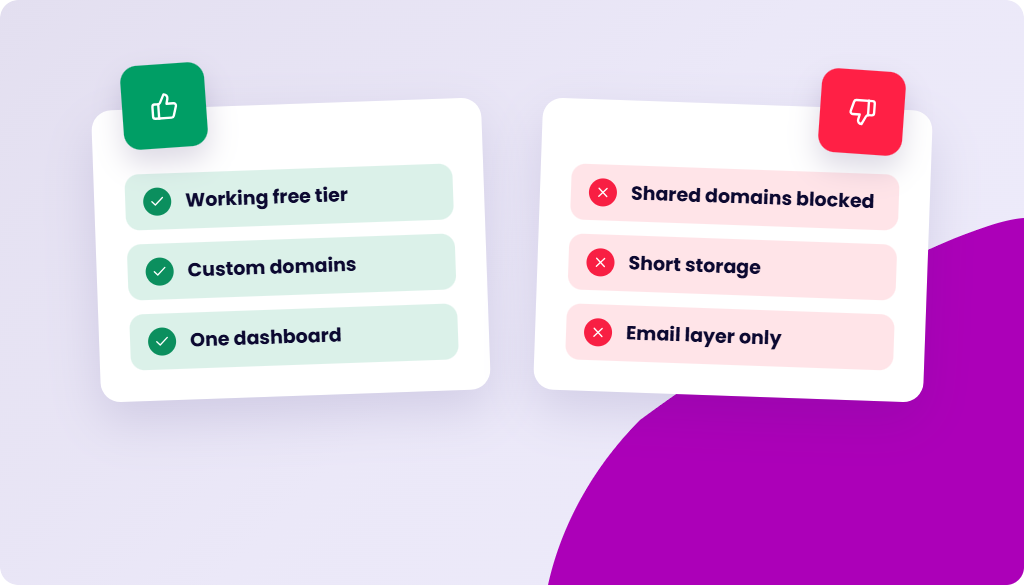
Pros
- A free tier that works: 150 mailboxes, 50 new a day, 60-day validity, and an API key included
- One dashboard for every inbox, with previews and bulk actions instead of tab-hopping
- Custom domains remove the single biggest practical objection to temp mail
- Credit model that reads honestly: pay to create, read for free, credits never expire
- Validity up to 365 days, with permanent mailboxes available through the API
- Telegram push and in-dashboard 2FA cover the two most annoying parts of running accounts remotely
Cons
- Shared domains still get rejected by some signups; two custom domains are free, but the ceiling of 2 domains and 100 mailboxes per domain arrives quickly
- Pre-receive capture and curated premium domains sit on the paid tiers
- Message storage on the free tier is shorter than the inbox's own life
- Captcha, ads, and limited extension on the free tier
- 50 free credits a day is fine for one person and thin for a farm
- It fixes the email layer only; fingerprint and proxy layers still need their own tools
Final Thoughts
Set up right, the inbox stops being the weak link: one address per profile, a domain when the account matters, a lifespan that outlives the job it was created for, and a dashboard that keeps the twentieth inbox as findable as the first.
Boomlify is built around the way accounts actually get run, many of them, for months, by more than one person, and the free plan is enough to test the pattern on your own stack. One address per profile, one dashboard for all of them, one fewer signal connecting your accounts.