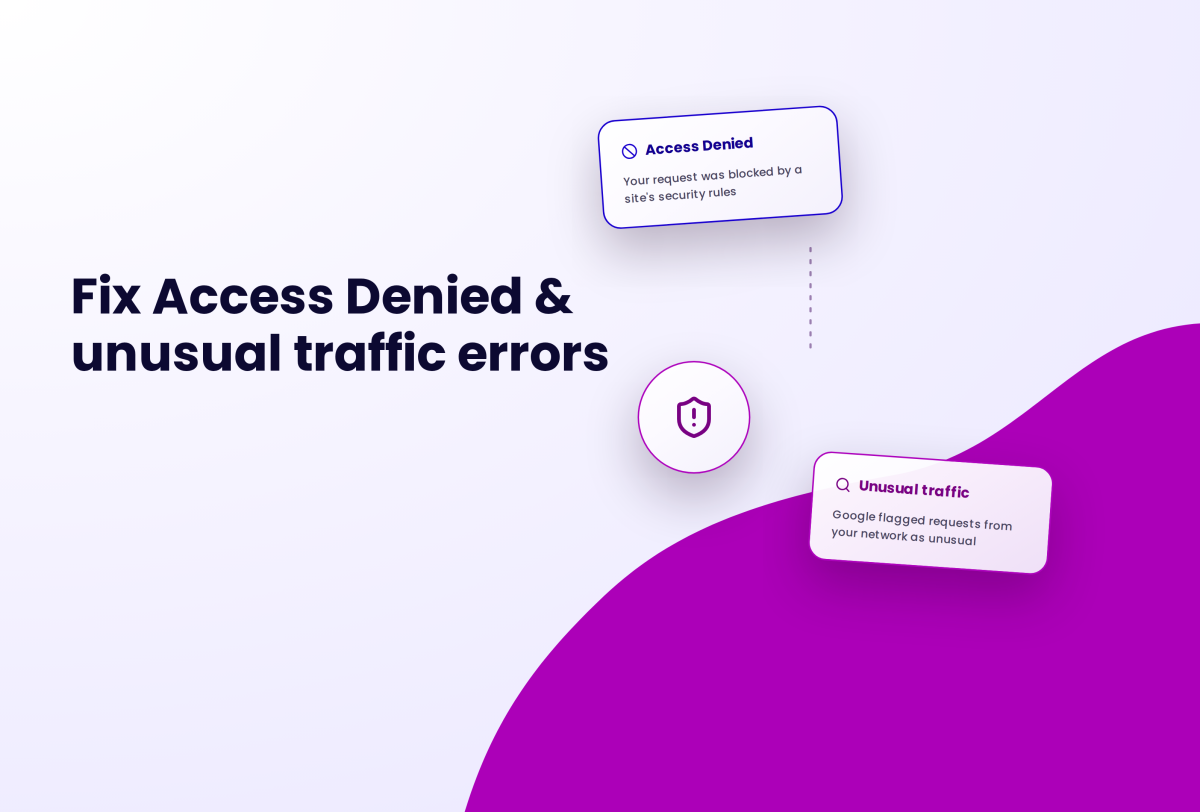

You visit a website you have used before and get an “Access Denied” message. You search Google a few times and suddenly see: “Our systems have detected unusual traffic from your computer.”
Neither message tells you much about what went wrong. You may not have done anything unusual, yet the website has decided that your request needs to be blocked or checked.
Because these error messages are sent by automated security systems, you might not know exactly why you got them. In this guide, we will talk about what these errors mean, what causes them, and what you can do when they keep appearing.
Why Does a Website Keep Showing “Access Denied”?
An “Access Denied” message means the website has refused your request to access a page or resource.
The exact reason depends on the website. Its security system may have decided that your request does not meet one or more of its rules. These rules can be based on your IP address, location, request rate, browser information, cookies, account status, or other signals.
An “Access Denied” message does not necessarily mean your account has been banned. It can be a temporary restriction or a security rule affecting your particular connection.
The following are some of the reasons you might see the “Access Denied” message:
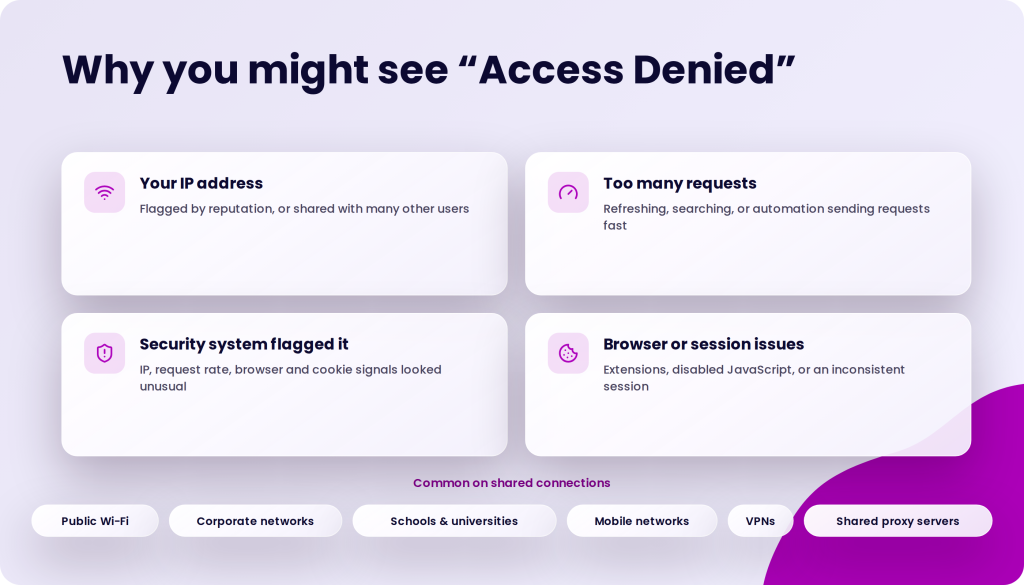
Your IP address may be the problem
Your IP address is one of the first pieces of information a website can see when you connect to it.
Websites and security providers can use IP reputation as one factor in deciding whether to allow a request. An IP address associated with large amounts of unwanted or automated traffic may receive more scrutiny.
This can also happen with shared connections. If several people are using the same public IP address, the website may see their activity as coming from one source.
This is common with:
- Public Wi-Fi
- Corporate networks
- Schools and universities
- Mobile networks
- VPNs
- Shared proxy servers
You may therefore receive an “Access Denied” message because of activity associated with your network rather than something you personally did.
You are sending too many requests
Websites often place limits on how frequently visitors can request pages or other resources.
Repeatedly refreshing a page, making many searches, opening large numbers of pages quickly, or using software that sends requests automatically can trigger these limits.
From the website's perspective, a high volume of requests can look very different from normal browsing.
The website's security system flagged your request
Many websites use security systems that analyse incoming requests before allowing them through.
These systems can look at several signals at once. Depending on the service, that may include the IP address, request frequency, browser information, cookies, geographic information, and other characteristics of the connection.
If enough signals look unusual, the system may challenge or block the request.
Your browser or session may be contributing
A browser is more than the window you use to visit a website. It maintains cookies, local storage, cached data, and other information that websites can use to maintain a session.
Browser configuration can also contribute to how a request is assessed. Extensions, disabled JavaScript, unusual settings, or inconsistent sessions can sometimes interfere with a website's security checks.
This does not mean that having a particular browser configuration will automatically result in a block. Website security systems use different methods, and the same configuration may be treated differently by different websites.
How to Fix an “Access Denied” Error
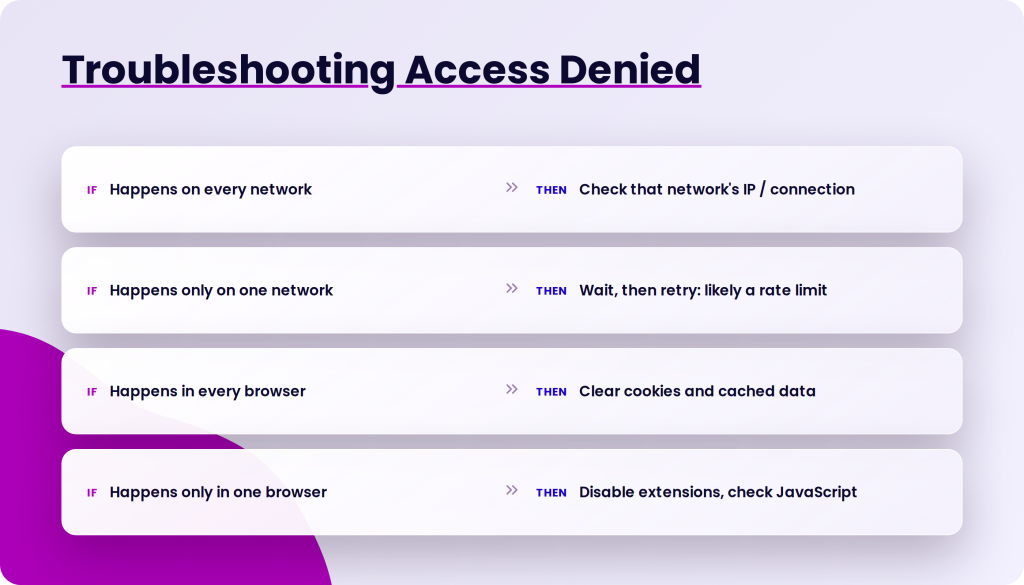
Start with the simplest explanations before changing anything complicated.
- Refresh the page and try again later. If the restriction is temporary or caused by a request-rate limit, continuing to send requests may only prolong the problem.
- Check your connection. If the error only occurs on one network, the network or its public IP address may be relevant.
- Clear the website's cookies and cached data. A damaged or outdated session can sometimes cause problems.
- Check your browser extensions. Privacy, automation, ad-blocking, and other extensions can change how a website loads or communicates with your browser.
- Make sure JavaScript is enabled when the website requires it. Some security checks rely on JavaScript running in the browser.
- Temporarily disconnect from a VPN or proxy. If the website works normally without it, the network or IP address may be contributing to the restriction.
- Try another legitimate network. This can help determine whether the problem follows your device or stays with the network.
If the problem continues across different networks and browsers, contact the website's support team. They may be able to tell you whether your account or IP address has been restricted.
Why Does Google Say “Unusual Traffic”?
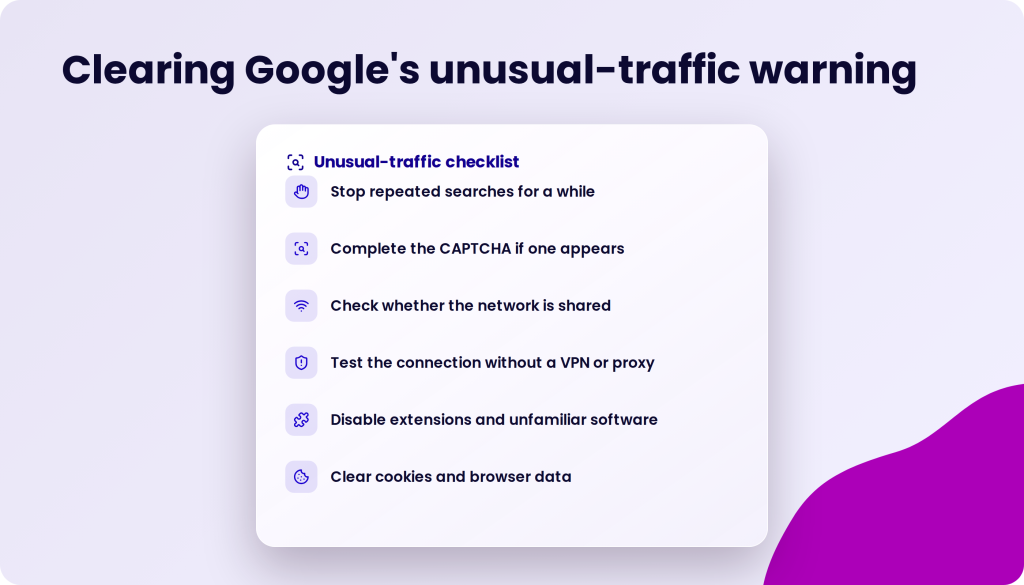
Google's “Our systems have detected unusual traffic” message is another type of automated security warning.
It generally means Google has detected requests from your network that look different from the traffic it expects. The activity may resemble automated requests or a high volume of searches.
Importantly, this message does not necessarily mean that you are deliberately sending automated traffic.
Your network may be shared with other users, your IP address may have an unusual reputation, or software on your device may be generating requests without you realising it.
You are making searches too quickly
If you perform many searches in a short period, Google's systems may interpret the pattern as unusual.
This can happen during legitimate research. For example, someone comparing dozens of queries in quick succession may generate a request pattern that looks very different from ordinary search behaviour.
If the warning appears after a period of unusually intensive searching, stop sending searches for a while and try again later.
Other users may share your IP address
This is one of the easiest explanations to overlook. Google does not necessarily see you as an individual user. It can see the public IP address through which your traffic reaches its services.
If many users share that address, Google may receive requests from the same IP at a volume or frequency that looks unusual. This can occur on corporate networks, university networks, public Wi-Fi, mobile networks, VPNs, and shared proxies. As a result, you can encounter the warning even when your own activity appears completely normal.
A VPN or proxy can contribute
VPN and proxy services can route traffic through IP addresses that are shared among multiple users.
If an IP address is generating a large amount of traffic, Google may apply additional checks to requests coming from it.
This does not mean that VPNs or proxies are inherently problematic. They are used for many legitimate purposes. But the network through which a request is sent is one of the factors that can affect how that request is treated.
Automated software may be generating requests
Browser extensions, scripts, applications, and other software can generate requests in the background.
If you are seeing unusual-traffic warnings when you have not been performing many searches, check whether another application or browser process could be communicating with Google's services.
A malware scan can also be worthwhile if the behaviour seems unexplained.
How to Fix Google's “Our Systems Have Detected Unusual Traffic” Error
There is no single fix because the cause can vary. Start with these steps.
Stop repeated searches temporarily
If you have been searching rapidly, stop for a while rather than continuing to refresh the error page. Repeated requests can make it harder to determine whether the restriction is temporary.
Complete the CAPTCHA if Google provides one
Google may ask you to verify that you are a human user. Complete the verification and follow the instructions provided on the page.
Check your network
If several people are using the same connection, other activity may be contributing to the traffic Google sees.
Try the search again later or, where appropriate, use another network to determine whether the issue is specific to the current connection. If you find success with that, you need to check your network.
Some internet connections use dynamic public IP addresses. Restarting a router may result in a different IP address, although this is not guaranteed and depends on your internet provider.
Check your VPN or proxy
If the warning only appears when you use a VPN or proxy, test the connection without it.
If the problem disappears, the IP or network being used may be contributing to the warning.
Check browser extensions and software
Disable extensions that modify, automate, or heavily interact with websites and see whether the problem persists. Also check for unfamiliar software or processes that may be generating network traffic.
Clear cookies and browser data
If the problem appears only in one browser, clearing its stored website data can help rule out a corrupted or inconsistent session.
READ MORE: Cookies and Their Impact on Browser Profiles
Conclusion
The best approach is to avoid creating traffic patterns that look abnormal in the first place. So use a stable connection where possible and avoid sending large numbers of requests in a short period. If you use a VPN or proxy for a legitimate purpose, understand that the IP address you receive may be shared with other users and may affect how some websites treat your requests.
Finally, pay attention to patterns. If an error only appears on one website, the site's security system is likely relevant. If it follows you across browsers but stays on the same network, investigate the network. If it occurs only with a particular browser, examine that browser's configuration and stored data.