
At a basic level, proxies act as intermediaries between you and the internet - masking your IP address and allowing you to route traffic through different locations. But once you move beyond casual use into automation, data collection, or multi-account workflows, a standard proxy stops being enough.
The problem is simple: scale creates visibility. The more requests you send from a single IP, the faster you get flagged, throttled, or blocked. This is where rotating proxies come in.
Instead of relying on one IP address, they distribute your activity across many, thus making high-volume operations look like normal, distributed user behaviour. To understand why that matters, you first need to see what actually makes a proxy “rotating.”
What Makes a Proxy "Rotating"?
As detailed in our guide on different types of proxies, proxies come in various types, each with distinct characteristics.
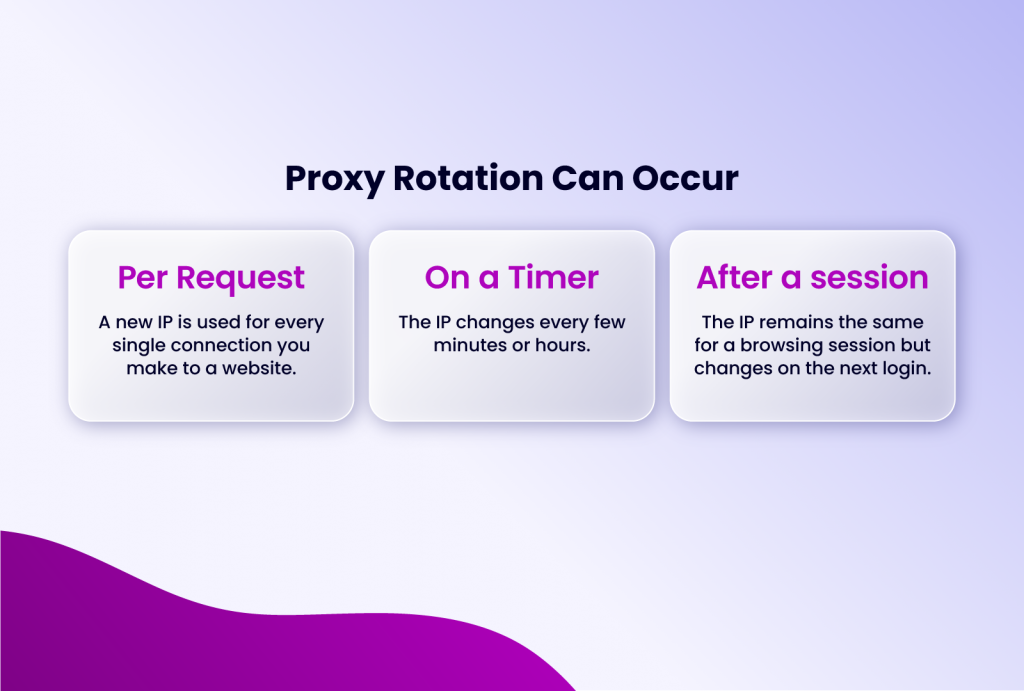
A static proxy assigns you one IP address that remains constant for your session or subscription period. A rotating proxy, by contrast, automatically switches the IP address it uses at predetermined intervals. This rotation can occur:
- Per Request: A new IP is used for every single connection you make to a website.
- On a Timer: The IP changes every few minutes or hours.
- After a session: the IP remains the same for a browsing session but changes on the next login.
The "pool" of IPs can consist of thousands, even millions, of addresses, often sourced from real residential devices (residential proxies) or from cloud servers (datacenter proxies). This constant change makes your traffic look like it's coming from many different, legitimate users around the world.
How Rotating Proxies Actually Work
The idea of constantly switching IPs sounds complex, but in practice, the system is designed to remove that complexity from the user.
The magic of rotation happens through specialized infrastructure, most commonly a backconnect proxy system. This system handles all routing decisions automatically instead of the user manually managing hundreds of IPs. The system usually setup like this:
- The Pool: You connect to a single gateway address provided by your proxy service. Behind this gateway lies a vast, managed pool of individual proxy IPs.
- The Request Flow: When your software or browser sends a request, it goes to the gateway.
- Automatic Assignment: The backconnect system automatically selects an available IP from the pool and routes your request through it to the target website.
- Rotation Execution: Upon the next request (or after the set time interval), the system picks a different IP from the pool. This process is continuous and automatic, requiring no manual intervention from you.
This entire process is continuous and invisible to the user. Compared to manually rotating proxies, which is slow, error-prone, and hard to scale, this setup is significantly more efficient. It’s what makes large-scale operations even possible.
Key Benefits and Advantages of Using Rotating Proxies
The infrastructure only matters if it delivers clear advantages. In the case of rotating proxies, the benefits are tied directly to solving two core problems:
Avoiding IP Bans & Blocks
This is the primary benefit. Websites that detect too many requests from a single IP will block it. Rotating proxies distribute your requests across many IPs, keeping each one under the radar and preventing bans that could halt your entire operation.
Enhanced Anonymity and Privacy
While not a silver bullet for complete anonymity, rotating your IP makes it significantly harder for websites to build a persistent profile of your activity and link it back to your real identity or location. Instead of a consistent identity, your activity appears fragmented across multiple sources, reducing the ability to build a persistent profile.
When Do You Absolutely Need a Rotating Proxy? (Primary Use Cases)
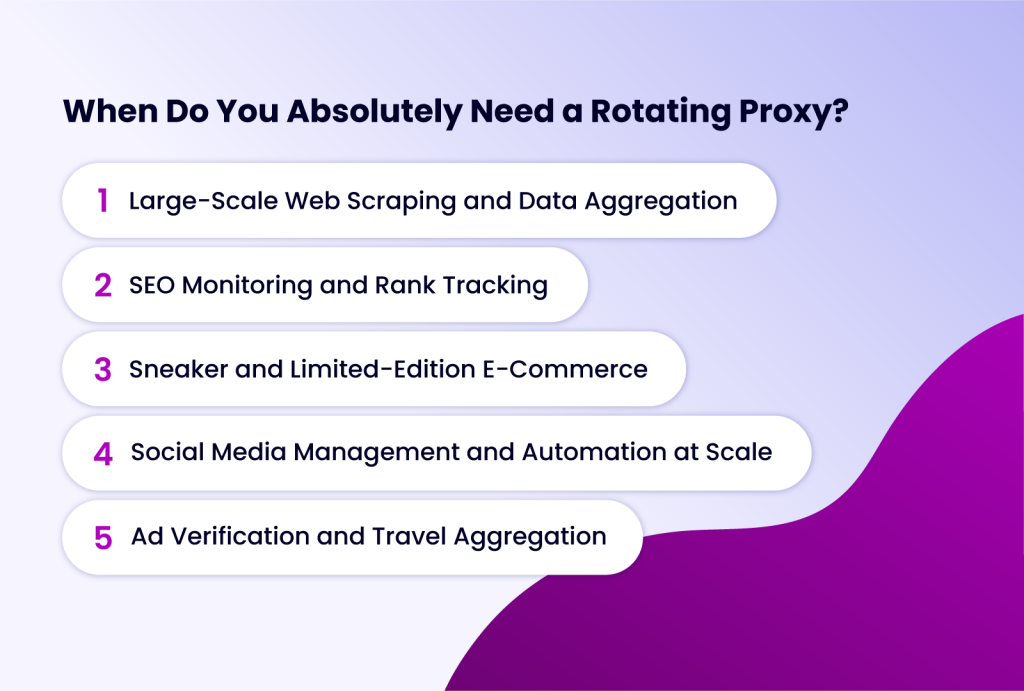
Rotating proxies are specialized tools. You don't need one for casual browsing or managing a single social media account. However, they become essential in the following scenarios:
1. Large-Scale Web Scraping and Data Aggregation
This is the quintessential use case. Whether you're a market researcher tracking prices, an SEO specialist monitoring rankings, or a business gathering leads, scraping at scale triggers defenses. Rotating residential proxies are the gold standard here, as they appear as real users, allowing you to collect vast amounts of data reliably and ethically from e-commerce sites, search engines, directories, and more.
2. SEO Monitoring and Rank Tracking
Accurate SEO requires checking search engine results pages (SERPs) from specific locations. If you check rankings hundreds of times a day from a single IP, Google will quickly flag you. Rotating proxies, especially with geo-targeting, allow you to simulate organic searches from different cities and countries, providing accurate, localized ranking data without distortion.
3. Sneaker and Limited-Edition E-Commerce ("Sneaker Copping")
The competitive world of buying limited-release products online is a technical arms race. Retailers use advanced bot detection to stop scalpers. Successfully "copping" a pair of sneakers or a high-demand graphics card requires automation tools that can bypass these defenses using thousands of different, clean IPs to place orders, making rotating proxies a core component of the tech stack.
4. Social Media Management and Automation at Scale
Managing multiple accounts for social media marketing, growth hacking, or outreach is risky. Platforms like Facebook, Instagram, and Twitter aggressively link accounts by IP address.
Using a single proxy for multiple accounts is a fast track to bans. While static proxies are better for individual account longevity, rotating proxies can be useful for large-scale, one-off actions like data scraping from social platforms or initial account warming processes, though they must be used with extreme caution and paired with other tools.
5. Ad Verification and Travel Aggregation
Businesses need to verify that their ads are displayed correctly across different regions and not placed on fraudulent websites. Rotating proxies allow them to check ad placements from various global IPs. Similarly, travel aggregation sites use rotating proxies to scrape flight and hotel prices from different locations to ensure users get accurate, localized deals.
Choosing the Right Type of Rotating Proxy
Not all rotating proxies are created equal. The source of the IPs dramatically impacts success rate, cost, and suitability.
- Rotating Residential Proxies: IPs are sourced from real devices on home ISP networks. They offer the highest level of trust and are hardest to detect and block. Best for: Critical web scraping, accessing heavily fortified sites, ad verification, and any task where appearing as a genuine user is paramount. They are typically more expensive.
- Rotating Datacenter Proxies: IPs come from cloud servers in data centers. They are faster and significantly cheaper but are easier for websites to identify as proxies. Best for: High-speed tasks where cost is a major factor, and the target sites have less sophisticated blocking (e.g., general web crawling, price comparison on less guarded sites).
- Rotating Mobile Proxies: IPs are assigned by mobile carriers (3G/4G/5G). They are highly trusted but are the most expensive and sometimes have lower bandwidth. Best for: Tasks specifically targeting mobile-only apps or websites, or when the highest possible disguise is needed.
As our comparison of Residential vs. Data Centre Proxies explains, the choice often comes down to a trade-off between legitimacy/stealth (residential) and speed/cost (datacenter).
Implementing Rotating Proxies: A Practical Guide
The effectiveness of rotating proxies depends heavily on how they are deployed. Poor setup cancels out most of the benefits. Getting started involves a few key steps
Select a Reputable Provider
Avoid free proxies, which are slow, insecure, and likely already blacklisted. Choose a paid provider from vetted lists (like our roundup of the 20 Best Proxy Server Services) that offers clear pricing, a large IP pool, good geographic coverage, and reliable customer support. Look for features like precise geo-targeting and customizable rotation intervals.
Integrate with Your Tools
Most providers offer integration via:
- API: For custom-built scraping scripts or applications.
- Proxy Manager Software: Dedicated applications to handle the proxy routing.
- Browser Extensions: For manual, browser-based work.
- Direct Configuration: Adding the proxy gateway address and port to your software settings (e.g., in Python's requests library or a web scraping tool like Scrapy).
Pair with an Anti-Detect Browser (Critical for Account-Based Tasks)
A rotating proxy changes your IP, but it doesn't change your digital fingerprint - your browser's configuration, fonts, screen resolution, etc. For managing multiple accounts (social media, e-commerce seller accounts), you must also rotate this fingerprint.
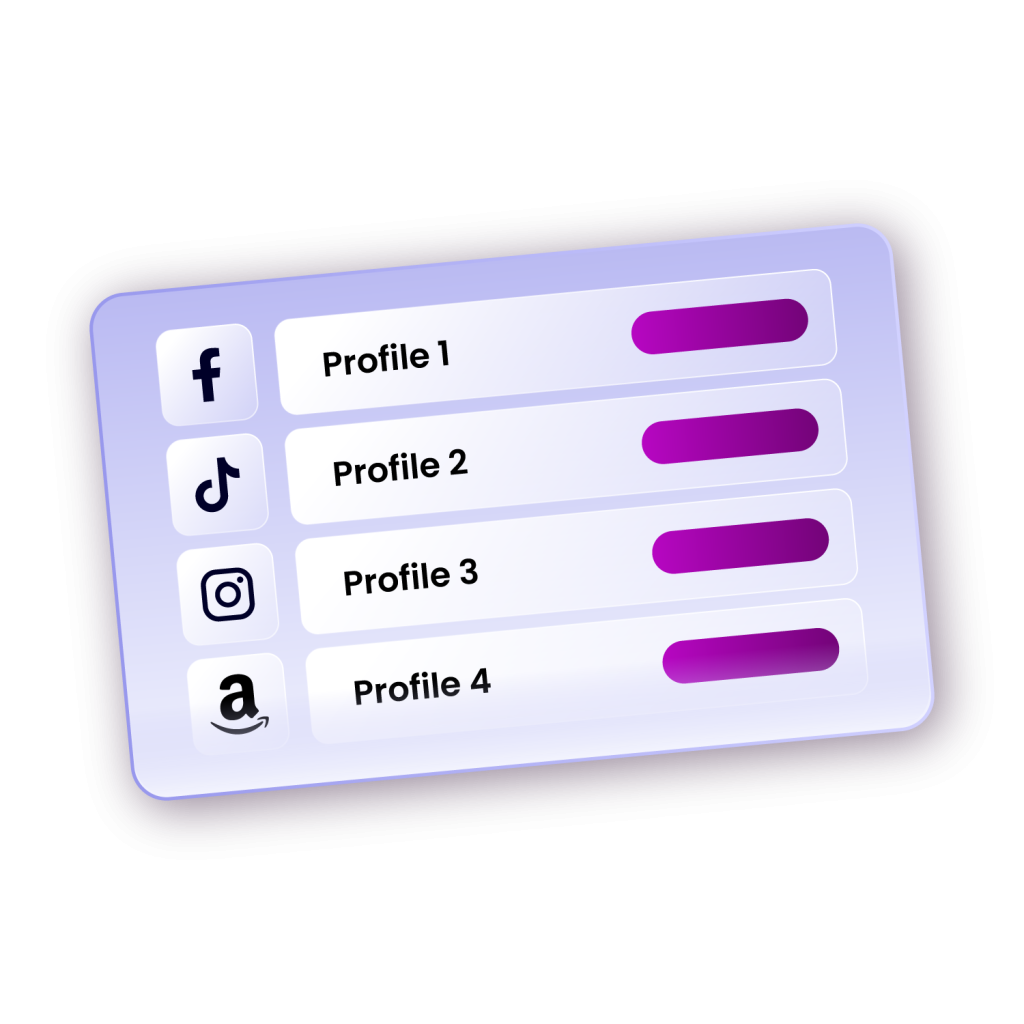
This is where a tool like Incogniton becomes indispensable. Incogniton allows you to create isolated browser profiles, each with a unique, realistic fingerprint. When you pair each profile with a rotating (or more commonly for accounts, a static) proxy, you create a truly distinct digital identity that is incredibly difficult for platforms to link together, securing your accounts from bans.
Conclusion
A rotating proxy addresses a fundamental constraint: the more you do on the internet, the more visible you become. Rotation spreads that visibility across multiple identities, allowing you to continue operating without interruption.
The key decision is not whether rotating proxies are useful - they clearly are. The real question is whether your work demands scale, repetition, or geographic diversity. If it does, then using a rotating proxy stops being optional.
Remember, success lies in choosing the right type of proxy for your specific use case and, for account-based work, combining it with robust fingerprint management through an anti-detect browser. By strategically implementing rotating proxies, you unlock the full, unrestricted potential of the internet as a resource.