
In affiliate marketing, creatives are the starting point of any conversion, as they determine whether the target page receives traffic. The problem is that launching ads without prior research is becoming increasingly inefficient as testing costs continue to rise. In this environment, it makes more sense to rely on affiliate marketing tools to identify what is already working in the market before making decisions about launching campaigns.
This is exactly what ad spy tools are designed for. They provide access to creatives, help track competitors’ ads, identify current trends, and enable you to build your own strategies based on proven approaches. One of the leading solutions in this field is Tyver, an ad spy tool focused on Meta platforms. Its main advantage is not just the ability to browse individual creatives, but also access to the full structure of each campaign.
In this guide, we’ll cover where to find ad creatives and how to effectively spy on competitors’ ads in practice.
What Is Tyver and How It Works
Tyver is an ad spy tool designed for analyzing ads across the entire Meta ecosystem. It combines several core layers: a massive creative database, an advanced filtering system, and built-in analytics for Facebook ads.
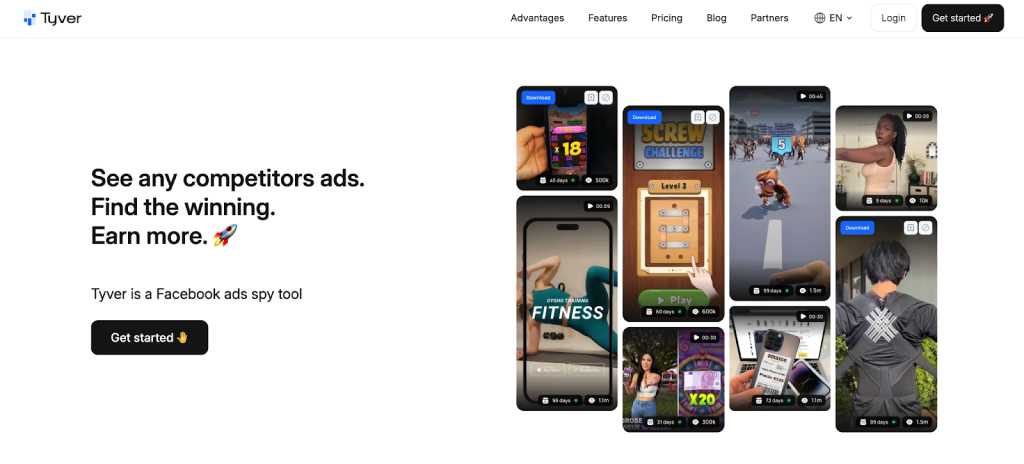
Tyver collects millions of ads on a daily basis from different countries and updates its database in near real time, allowing users to track current trends and active campaigns without delays.
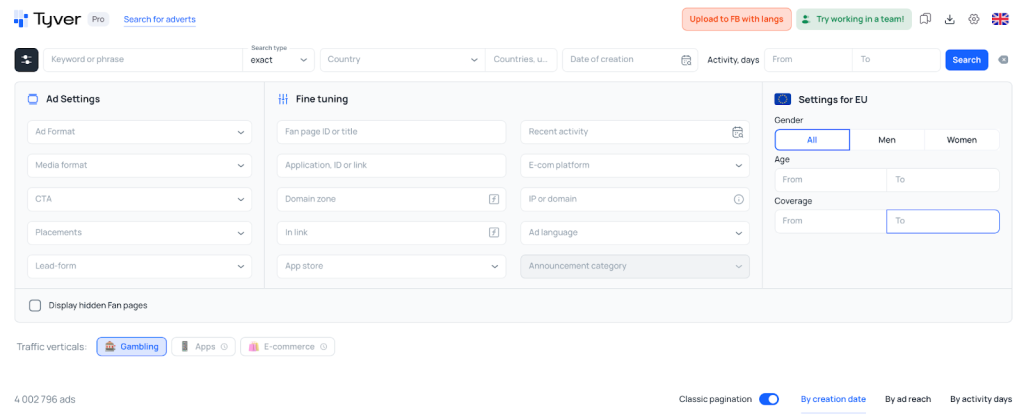
Inside the platform, finding trending ads isn’t limited to keyword search. Tyver offers an advanced filtering system, including options tailored to specific verticals, ad formats, placements, and much more. This makes it possible to quickly discover relevant creatives with greater accuracy.
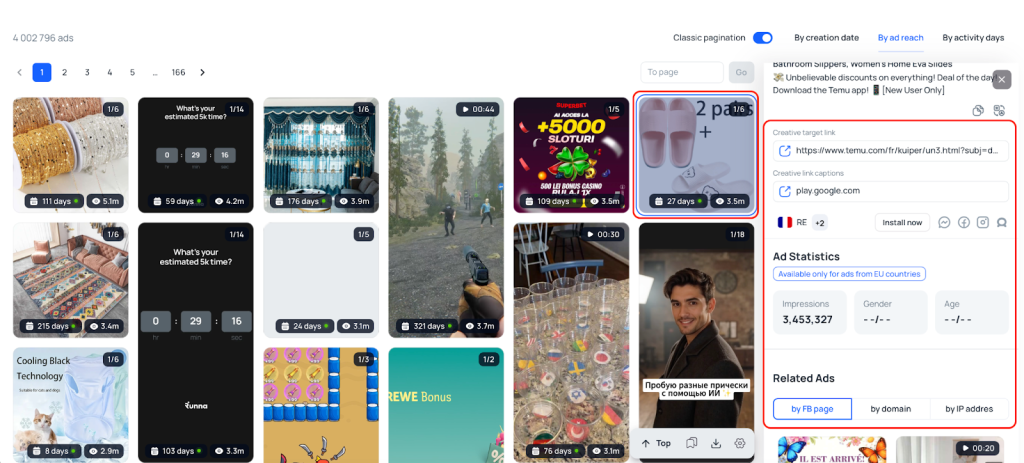
Each creative is also enriched with additional data like audience details, activity days, geo, and related ads, allowing users to move beyond isolated examples and analyze entire campaign structures.
The platform also simplifies working with discovered ideas. You can:
- Instantly translate ad copy with one click.
- Download creatives in a single click.
- Save creatives to favorites.
- Organize creatives into folders and share collections with your team.
As a result, Tyver is not just a database of ad creatives, but a comprehensive tool for analyzing competitors’ campaigns, generating hypotheses, and preparing your own launches.
How to Find Winning Creatives and Campaigns: Gambling, Nutra, and E-commerce
Working with Tyver starts with understanding the search logic. In affiliate marketing, a creative is not just a banner or video. It’s rather a part of a campaign structure. The goal is not to find something visually appealing, but to identify an effective approach: how the offer is presented and which triggers are used to capture audience attention. Let’s take a closer look at how Facebook ad analysis works across the most popular verticals.
Finding Creatives in Gambling
Gambling is one of the most competitive and profitable verticals. Despite the competition, many approaches and formats tend to repeat, making it easier to identify patterns and understand working strategies.
In Tyver you can start with a basic Gambling filter. Simply select the niche and the system will display relevant ads. Even at this stage you get a relatively clean dataset of 4+ millions of creatives.

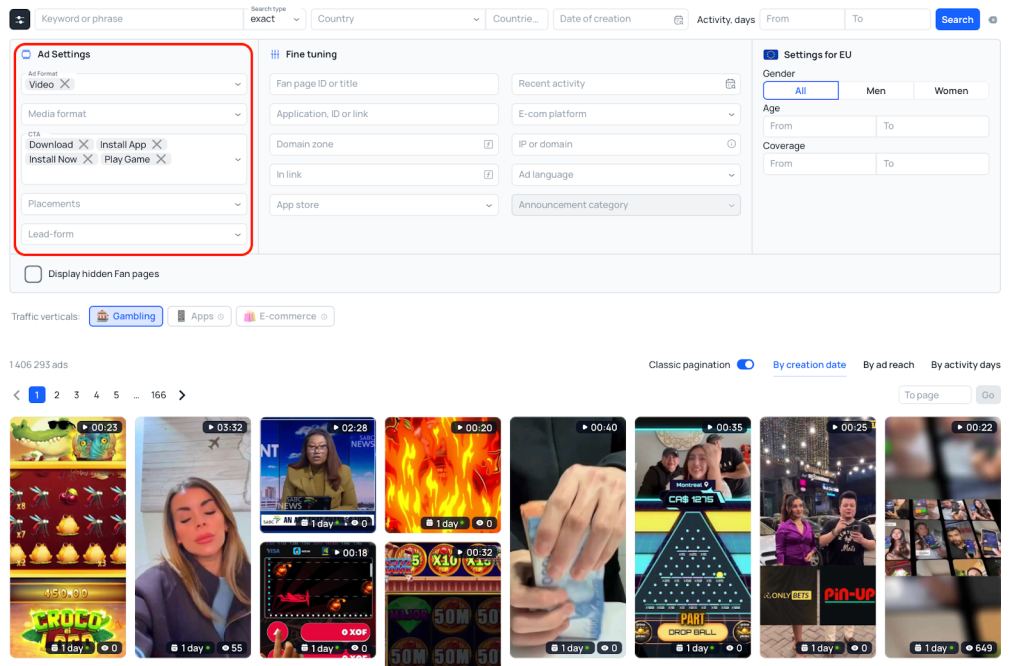
Next it makes sense to narrow the search down by format. In most cases, video creatives perform better in terms of CTR, especially with CTAs like download, install or play. This significantly reduces the dataset and makes analysis more focused. As a result the number of creatives reduced to 1.4 million.
After that, you can move on to keyword-based search, for example, specific game or slot names. Entering something like Chicken Road 2 will show active creatives running for that offer. This is a fast way to access real campaign examples rather than abstract ideas. Sorting by activity duration helps identify long-running ads.
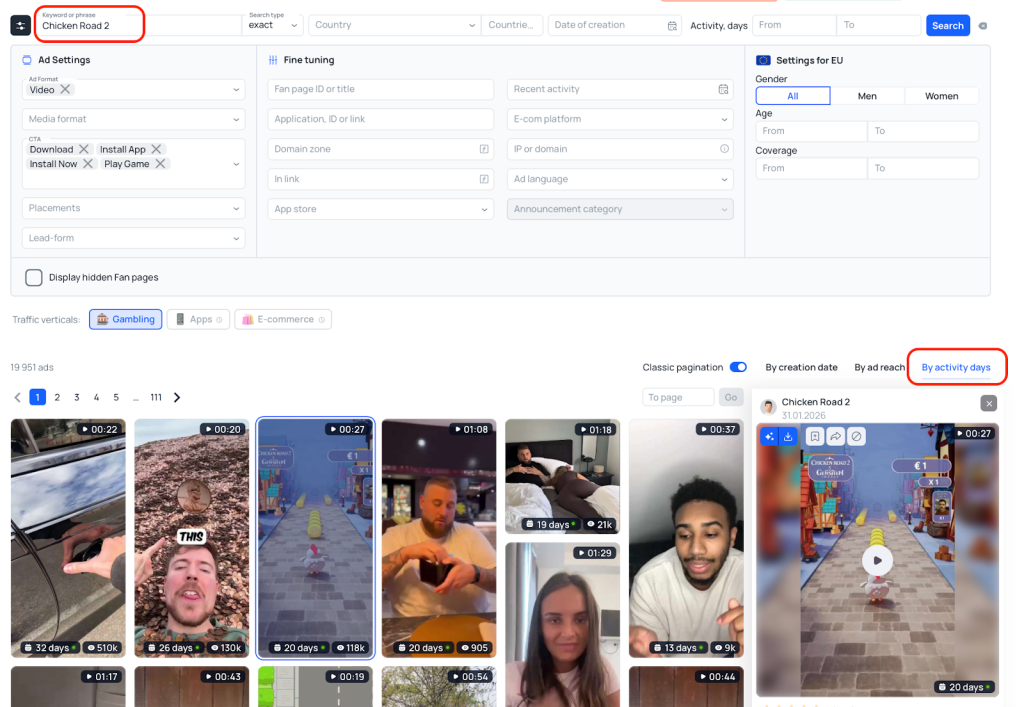
In practice, gambling research in Tyver is a combination of filters and targeted requests. First you use the broadest filters like niche and format and later on add keywords for the most objective results.
Finding Creatives in Nutra
Nutra creatives are typically characterized by visuals related to the user’s pain and the presentation of a solution. That’s why in Tyver it makes sense to start the search with the pain point itself as this allows you to quickly see which approaches are already being used within a specific niche: problem-focused angles, visual storytelling, expert formats or direct result demonstrations. After that the search expands by analyzing competitor traffic and similar ads to understand not just a single product, but the overall logic of the niche.
For example, in the joint health niche, searching keywords like joint pain, arthritis or back pain will return creatives centered around joint-related pain, showing solutions aimed at relieving physical discomfort and improving mobility.
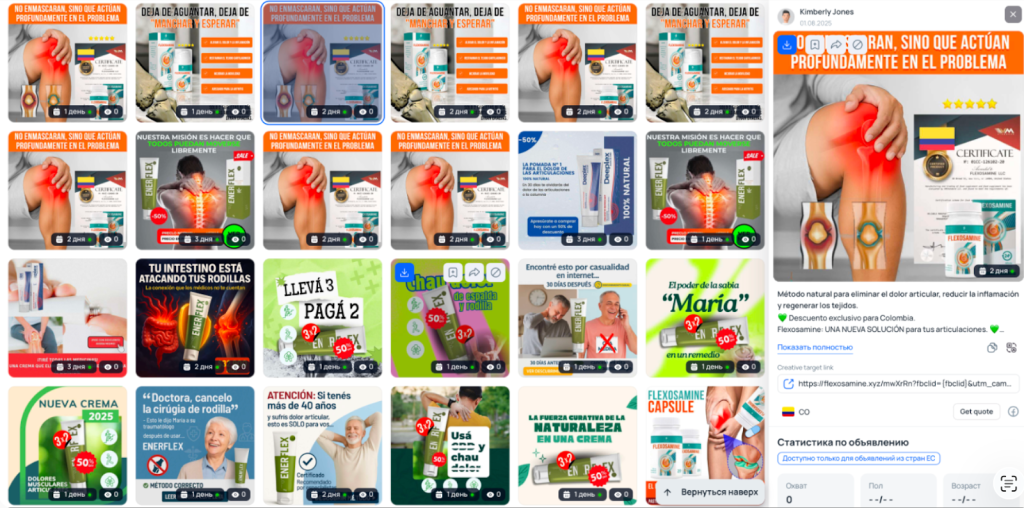
These creatives often use visual representations of pain, everyday difficulties and aging, as well as expert positioning or explanations of the root cause of the problem. Another common format is the “solution through product” approach, where the focus is on fast symptom relief.
In weight loss, searches like weight loss, burn fat or belly fat also reveal consistent patterns. These often include personal stories, before-and-after transformations, emotional triggers and simple explanations of how to achieve fast results. Here, it is important to pay attention to repeated scenarios as they indicate which creatives consistently perform across different geos.
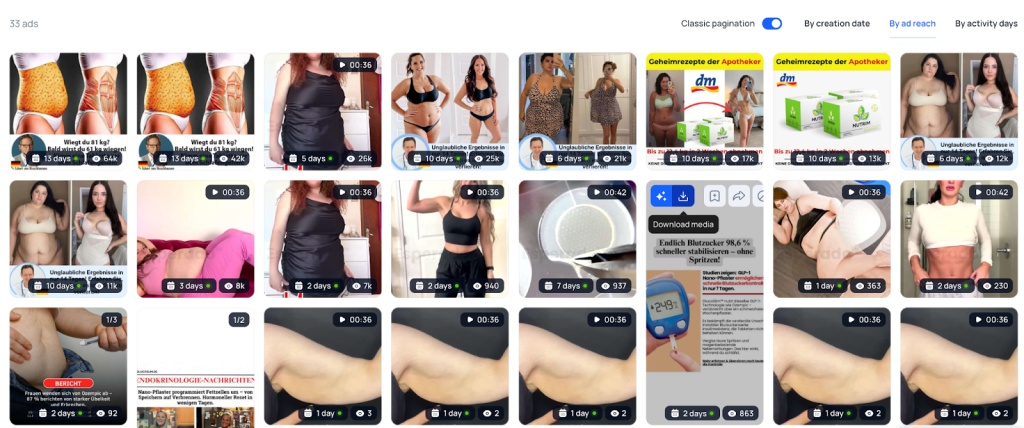
In beauty (cleanse, parasites, detox) creatives are built around the idea of improving one’s condition. They often use visual metaphors, simplified explanations and strong emotional messaging. Despite differences in execution, the overall logic remains the same: first the problem is highlighted, then the solution is presented.

Effective search in Tyver follows an expansion principle: from specific to general. First, a single offer or keyword is analyzed, then related requsts based on symptoms and problems are explored, followed by comparing creatives across different geos and campaign structures. The key objective is not just to collect examples, but to identify repeating elements: visuals, copy and scenarios. It is precisely this repetition that shows which approaches are actually working and can be used in your own tests.
Finding Creatives in E-commerce
Searching for creatives in e-commerce works differently compared to nutra or gambling: the key factor here is not the trigger, but the way the product itself is presented. In Tyver it makes sense to start with a product category rather than a specific offer. Requests like kitchen gadget, home organizer or cleaning tool return a broad range of creatives featuring different products but following a similar logic — demonstrating product usefulness. For example, storage boxes with lighting: both a wow-effect and practical usability.

When analyzing brand advertising strategies or looking for dropshipping products, the approach becomes more targeted. This allows you to see how the same product is promoted by different teams: what angles they use, which scenarios they rely on and how they structure their visuals. Tyver also includes a filter for monitoring ads from major e-commerce platforms, making it possible to analyze ads from online stores. For example, if you want to analyze Shopify store ads, you simply select the corresponding filter.
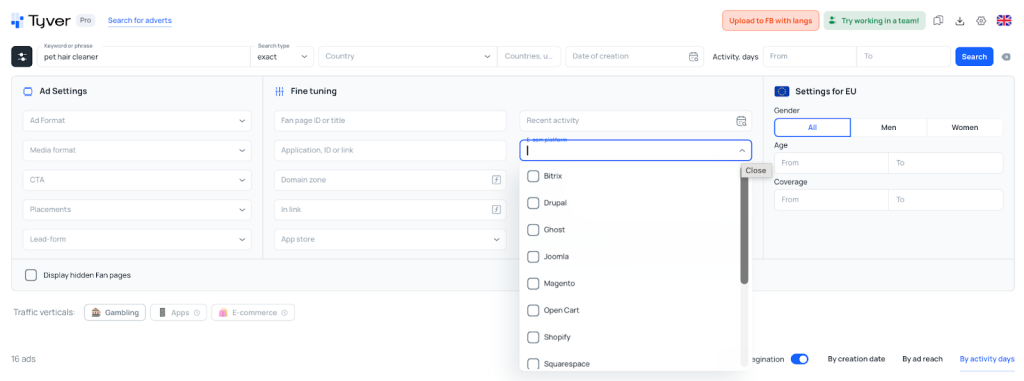
On top of that, the search can be expanded through needs and use cases. Requests like hair removal, pet hair cleaner or back pain relief chair show how different products solve the same problem. This helps reveal a variety of approaches: some focus on visuals, others on emotions and some on quick and straightforward solutions. In most cases, the creatives that scale are those where the product is shown in action. For example, to remove pet hair, it is important to demonstrate the speed and simplicity of the process, as well as the device that enables it.
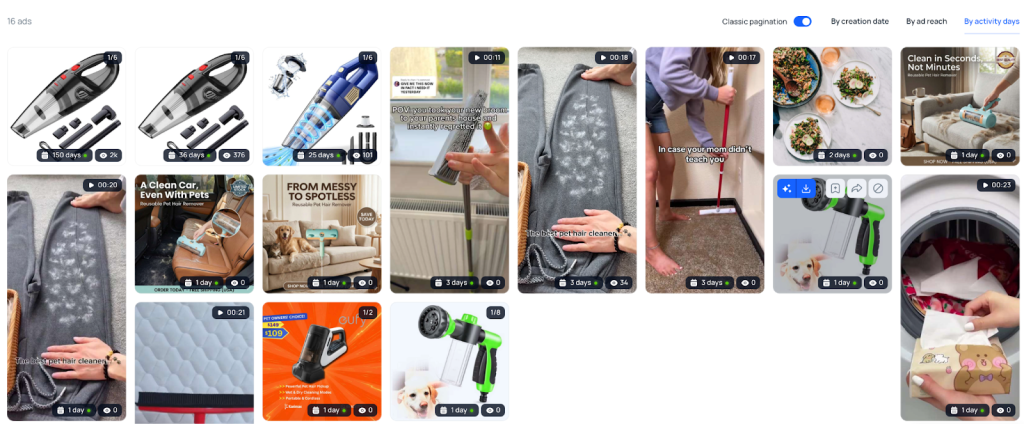
When analyzing trending products, it is important to look not only at the product itself but also at the mechanics of presentation. The first frame plays a crucial role as it determines whether the user will continue watching or not. Common techniques include contrast, problem demonstration or unusual visuals, followed by presenting the product as the solution. The repetition of such scenarios across different advertisers is a strong indicator of their effectiveness.
Advanced Tyver Filters: Campaign and Search Analysis
Advanced filters allow you to move from simply browsing creatives to a deeper analysis of ad campaigns. In addition to standard parameters you can use filtering by link elements such as UTM tags, pixel_id or ad_id.
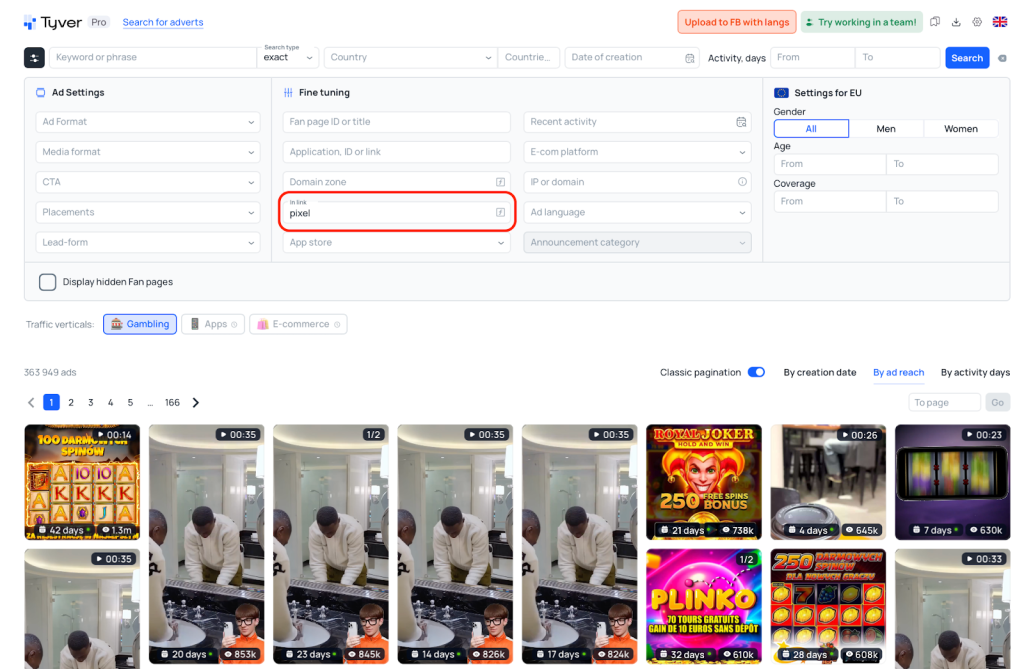
This is important because it allows you to go beyond individual creatives and identify connected advertising structures. The same parameter in a link is typically used within a specific campaign, which means you can find multiple ads, understand testing logic, and evaluate how actively the campaign is being scaled. In Tyver, this helps distinguish random tests from working approaches and analyze real, rather than fragmented, advertising strategies.
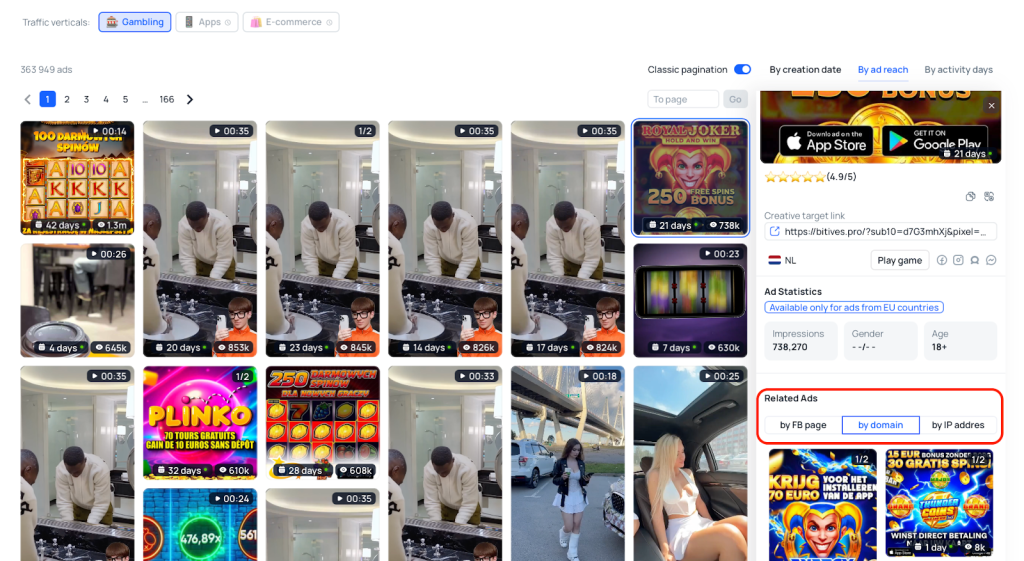
The next level of analysis is working with similar ads. Within a creative’s card, you can see other ads launched from the same page, domain, or IP address. This allows you to move beyond a single example and examine a full set of creatives used within an overall campaign strategy. Such groupings often reveal that multiple approaches are being tested simultaneously, rather than just one variation, providing a more complete understanding of the campaign logic.
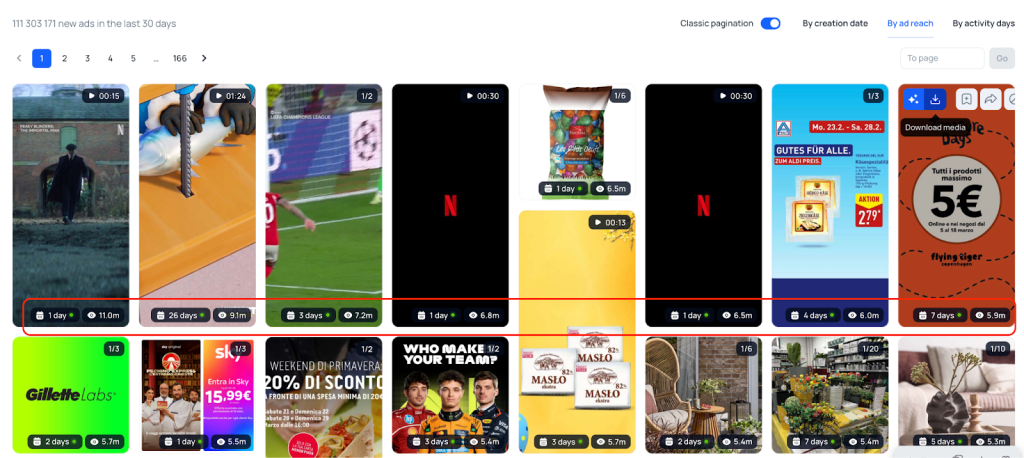
It is also important to consider activity days and reach metrics. If a creative generates a high number of impressions and remains in circulation for a long time, it is usually a sign that it has passed testing and is being scaled. Such ads are especially valuable for analysis, as they reflect real, working campaign structures rather than theory.
Tyver also allows users to save ads and build their own database. This makes it possible to revisit creatives, compare them and track changes in approaches over time. Overall, this turns the platform into not just a search tool, but a complete working environment.
Tyver Pricing
Tyver offers three pricing plans suitable for both basic use and team collaboration.

Free — a free plan for small projects with limited access to the ad database and basic information, but with the full set of filters.
Pro — the optimal option at $79 per month for active work: includes up to 30,000 ad views per month, full access to the database, extended ad information, and the ability to save ads to favorites.
Team — a plan for teams at $119 per month, which increases the limit to 60,000 ad views, adds team collaboration features, and allows setting custom limits for team members.
Conclusion
In Tyver competitor analysis is not just about searching for creatives, but about understanding the market through Meta Ads monitoring. The platform allows you to see which approaches are used in specific verticals, how they evolve, and which ones continue to deliver results.