
In the fiercely competitive world of e-commerce, scaling your business often means thinking beyond a single storefront. The most successful online merchants aren't just optimising one shop; they are strategically deploying multiple accounts across different platforms, regions, and brands to diversify revenue streams, mitigate risk, and capture new markets.
This multi-account strategy is no longer a niche tactic; it's a cornerstone of modern e-commerce growth.
Consider that over 58% of Amazon's sales come from third-party sellers, many of whom operate multiple storefronts to segment their business. Similarly, platforms like Etsy and Shopify empower creators and entrepreneurs to launch distinct shops for different product lines. Yet, managing this expansion is fraught with complexity.
From platform policies forbidding linked accounts to the sheer logistical nightmare of juggling logins, inventory, and branding, scaling through multiple accounts requires more than just ambition—it requires a sophisticated system.
This guide will demystify the multi-account strategy, exploring its undeniable benefits, navigating its significant challenges, and providing a blueprint for efficient, secure, and scalable management.
Understanding the Need for a Multi-Account Strategy
In the early stages of an e-commerce business, a single storefront or seller account often suffices. However, as your business matures and its ambitions grow, limitations become apparent. These limitations can stem from various factors:
- Product Diversification: You might have distinct product categories that would benefit from separate branding, marketing, and customer experiences. For instance, selling handmade jewelry and also curated vintage clothing on the same account can dilute your brand identity and confuse potential customers.
- Market Expansion: Targeting different geographical regions often requires localized strategies, pricing, and even product variations. Operating multiple accounts on international marketplaces allows for this tailored approach.
- Brand Segmentation: You may be building multiple brands under one umbrella business, each with its own unique identity, target audience, and marketing efforts.
- Risk Mitigation: Relying on a single account on any platform carries inherent risks. Account suspension or a policy violation can cripple your entire operation. Diversifying across multiple accounts acts as a crucial safety net.
- Business Model Variations: You might want to experiment with different business models, such as separating B2C from B2B operations, or testing new niche markets without impacting your core business.
As highlighted in our previous discussions on managing multiple Amazon seller accounts and Etsy shops, the core principle remains the same: strategic diversification through multiple accounts can unlock significant growth potential.
Key Benefits of a Multi-Account E-commerce Strategy
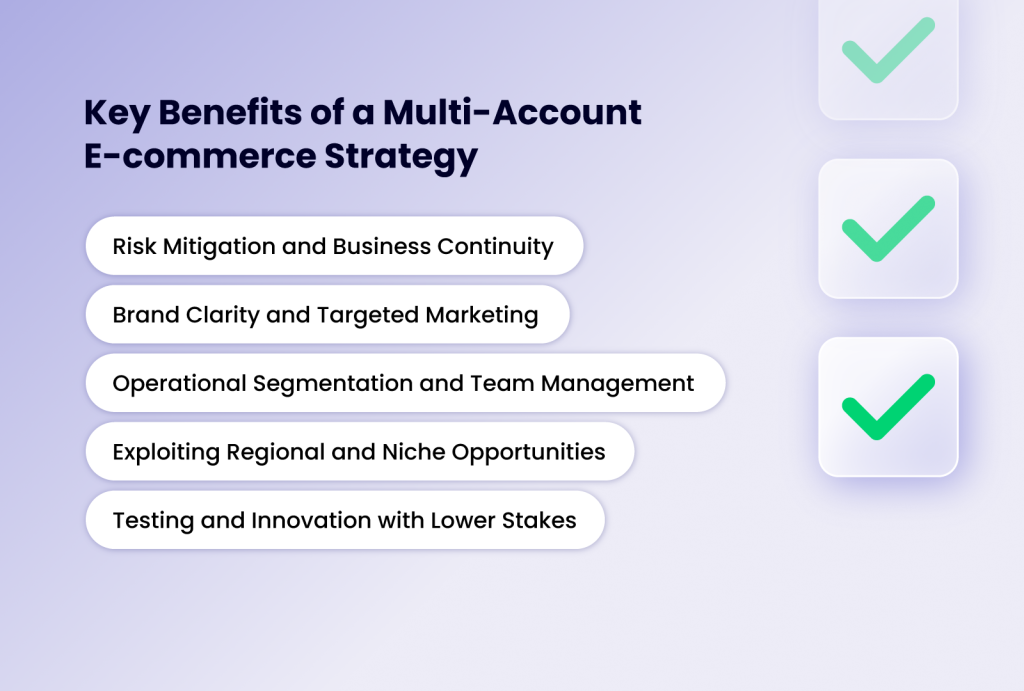
The following are the benefits of a structured E-commerce multi-account management strategy:
Risk Mitigation and Business Continuity
As highlighted in our knowledge base, owning a single seller account is a significant, often underestimated risk. Account suspensions or permanent bans, whether due to policy misunderstandings, customer complaints, or platform errors, can instantly halt your income.
A multi-account strategy acts as an insurance policy. By distributing your business assets across multiple independent accounts, you ensure that a problem with one doesn't sink your entire enterprise.
Brand Clarity and Targeted Marketing
A cohesive brand is powerful. Trying to market luxury watches and budget phone cases under one roof dilutes your messaging. Separate accounts allow for laser-focused branding, tailored product descriptions, and niche-specific marketing campaigns. On Etsy, for instance, a seller might run one shop for intricate woodworking and another for digital printables, each with its own visual identity and customer communication style.
Operational Segmentation and Team Management
As your business grows, so does your team. A multi-account structure allows for clean operational segmentation. You can assign a dedicated account manager, marketing specialist, or customer service agent to a specific brand or region without granting them access to all your business data. This improves accountability and streamlines workflows.
Exploiting Regional and Niche Opportunities
Different markets have different dynamics. A product might be a standard commodity in one country but a premium niche item in another. With separate accounts, you can implement region-specific pricing, promotions, and inventory without affecting your global pricing strategy. This allows you to maximize profitability in each market segment.
Testing and Innovation with Lower Stakes
Launching a new product line or experimenting with a novel business model (like shifting from B2C to B2B) is risky within an established account. A new, separate account provides a sandbox for innovation. You can test new ideas, gauge customer response, and iterate without jeopardizing the reputation and performance of your flagship store.
The Challenges of Managing Multiple Accounts
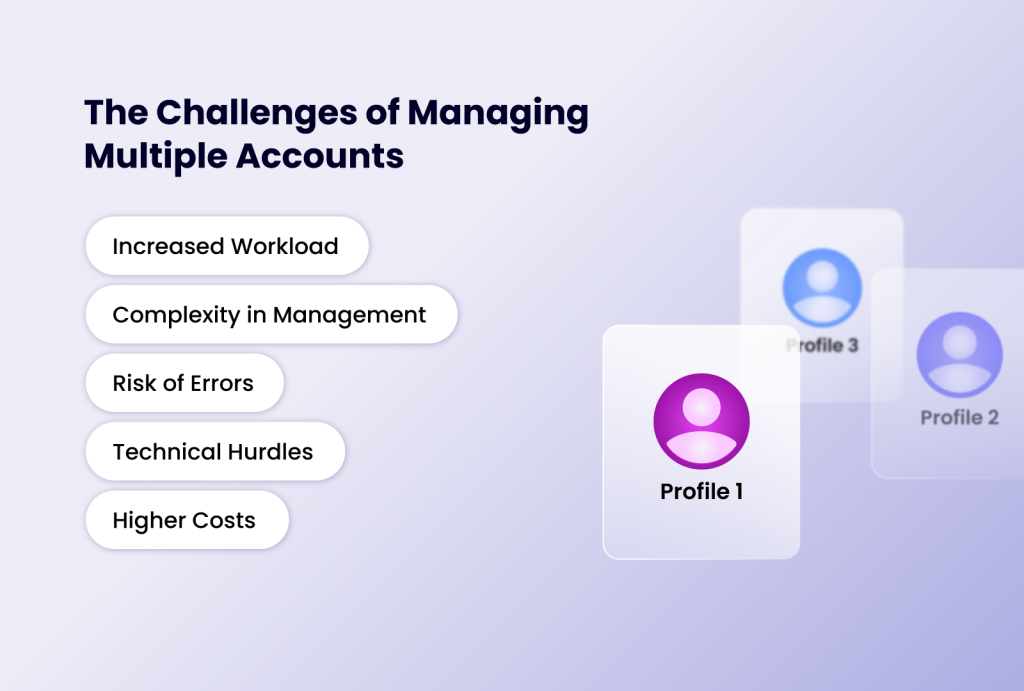
While the benefits are clear, a multi-account strategy is not without its challenges. Understanding these obstacles up front allows you to plan effectively and avoid costly mistakes as you scale.
Increased Workload
Managing multiple accounts demands significantly more time and effort across every operational touchpoint. Inventory updates, order fulfillment, customer service, and marketing must all be handled separately for each storefront. What once took a few hours daily can quickly balloon into a full-time operation, making it essential to hire support staff or invest in automation tools before expanding.
Complexity in Management
Keeping track of logins, passwords, analytics, and inventory across numerous accounts can become overwhelming very quickly. Without a centralised system in place, it's easy to lose visibility into how each account is performing or to overlook critical updates. Sellers often find themselves toggling between dashboards, spreadsheets, and communication tools, creating inefficiencies that eat into productivity and profits.
Risk of Errors
Juggling multiple accounts dramatically increases the likelihood of human error. Shipping to the wrong customer, mismanaging stock levels, or accidentally cross-posting platform-specific promotions are common mistakes that can damage your reputation and erode customer trust. A single fulfillment error on one account can trigger negative reviews that affect your overall seller rating, making quality control across all storefronts absolutely critical.
Technical Hurdles
Platforms actively monitor for suspicious activity, and managing multiple accounts from the same IP address or device can raise red flags. Similar digital fingerprints — such as shared browser profiles, payment methods, or business addresses — may trigger automated reviews or result in account restrictions. Navigating these technical barriers requires careful setup, including the use of dedicated devices, separate business profiles, or virtual private networks where permitted.
Higher Costs
Each additional account or storefront comes with its own financial overhead. Listing fees, monthly subscription costs, advertising budgets, and software tools add up quickly, and these expenses must be carefully weighed against the projected revenue each account generates. Without proper financial planning, the cost of maintaining multiple accounts can quietly outpace your earnings.
Recognising these challenges is the first step toward building a strategy that is both sustainable and scalable.
Leveraging Technology for Seamless Multi-Account Management
The challenges outlined above are real, but they are not insurmountable. With the right technology, managing multiple storefronts can shift from a logistical burden into a streamlined, scalable operation. This is where specialized tools like Incogniton become essential.
What Is Incogniton?
Incogniton is an anti-detect browser built specifically for professionals who need to manage multiple online accounts safely and simultaneously. It works by creating completely isolated browser profiles, each with its own unique digital fingerprint, cookies, cache, and IP address when paired with proxies.
In practical terms, this means every account you manage looks to the platform as if it belongs to a separate, independent user — eliminating the risk of accounts being flagged or linked.
Keeping Your Accounts Safe and Independent
The most pressing technical concern for any multi-account seller is platform detection. Marketplaces like Amazon, Etsy, and Shopify actively scan for shared digital signals, common IP addresses, identical browser configurations, or linked payment methods that suggest one person is operating multiple accounts in violation of their policies. Incogniton addresses this directly by ensuring each browser profile is completely sandboxed.
There is no shared data between profiles, meaning your accounts remain independent, compliant, and protected from automated reviews or restrictions.
Streamlining Daily Operations
Beyond security, Incogniton is built for operational efficiency. Instead of logging in and out of accounts or juggling multiple devices, you can access all your storefronts simultaneously from a single dashboard. Profiles can be organized by platform, brand, or region, allowing you to switch contexts instantly without confusion. This alone can recover hours of lost productivity each week, particularly as your account portfolio grows.
Enabling Team Collaboration Without Compromising Security
As your business scales, so does your team. Incogniton allows you to share specific browser profiles with account managers, virtual assistants, or marketing specialists without ever exposing your passwords or granting access to unrelated accounts. Each team member works within a controlled, defined environment, improving accountability while protecting your most sensitive business data.
Automating Repetitive Tasks
For sellers looking to push efficiency even further, Incogniton integrates with leading automation frameworks, including Puppeteer and Selenium. This compatibility allows you to automate repetitive, time-consuming tasks — such as bulk listing updates, price monitoring, or order tracking — across multiple accounts simultaneously, freeing your team to focus on higher-value strategic work.
Whether you are running multiple Amazon seller accounts, separate Etsy shops, distinct Shopify stores, or a network of dropshipping storefronts, Incogniton provides the infrastructure to scale confidently. It turns what is often the most technically daunting aspect of a multi-account strategy into a manageable, repeatable process.
Conclusion
Scaling an e-commerce business in today's competitive market often necessitates a move beyond a single storefront. A well-executed multi-account strategy is a powerful lever for expanding market reach, refining brand presence, mitigating risks, and ultimately driving revenue growth.
While the complexities of managing multiple accounts can be daunting, the strategic use of specialised tools like Incogniton transforms these challenges into opportunities. By providing secure, isolated browser environments, Incogniton empowers e-commerce businesses to operate multiple storefronts and seller accounts efficiently and compliantly across various platforms.
Embracing a multi-account strategy, supported by the right technology, is not just about managing more; it's about scaling smarter, reaching further, and building a more resilient and profitable e-commerce empire.